Hubbry Logo
Virial coefficientVirial coefficientMain
Open search
Virial coefficient
Community hub
Virial coefficient
logo
7 pages, 0 posts
0 subscribers
Be the first to start a discussion here.
Virial coefficient
Virial coefficient
from Wikipedia

Virial coefficients appear as coefficients in the virial expansion of the pressure of a many-particle system in powers of the density, providing systematic corrections to the ideal gas law. They are characteristic of the interaction potential between the particles and in general depend on the temperature. The second virial coefficient depends only on the pair interaction between the particles, the third () depends on 2- and non-additive 3-body interactions, and so on.

Derivation

[edit]

The first step in obtaining a closed expression for virial coefficients is a cluster expansion[1] of the grand canonical partition function

Here is the pressure, is the volume of the vessel containing the particles, is the Boltzmann constant, is the absolute temperature, is the fugacity, with the chemical potential. The quantity is the canonical partition function of a subsystem of particles:

Here is the Hamiltonian (energy operator) of a subsystem of particles. The Hamiltonian is a sum of the kinetic energies of the particles and the total -particle potential energy (interaction energy). The latter includes pair interactions and possibly 3-body and higher-body interactions. The grand partition function can be expanded in a sum of contributions from one-body, two-body, etc. clusters. The virial expansion is obtained from this expansion by observing that equals . In this manner one derives
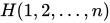
.

These are quantum-statistical expressions containing kinetic energies. Note that the one-particle partition function contains only a kinetic energy term. In the classical limit the kinetic energy operators commute with the potential operators and the kinetic energies in numerator and denominator cancel mutually. The trace (tr) becomes an integral over the configuration space. It follows that classical virial coefficients depend on the interactions between the particles only and are given as integrals over the particle coordinates.

The derivation of higher than virial coefficients becomes quickly a complex combinatorial problem. Making the classical approximation and neglecting non-additive interactions (if present), the combinatorics can be handled graphically as first shown by Joseph E. Mayer and Maria Goeppert-Mayer.[2]

They introduced what is now known as the Mayer function:

and wrote the cluster expansion in terms of these functions. Here is the interaction potential between particle 1 and 2 (which are assumed to be identical particles).

Definition in terms of graphs

[edit]

The virial coefficients are related to the irreducible Mayer cluster integrals through

The latter are concisely defined in terms of graphs.

The rule for turning these graphs into integrals is as follows:

  1. Take a graph and label its white vertex by and the remaining black vertices with .
  2. Associate a labelled coordinate k to each of the vertices, representing the continuous degrees of freedom associated with that particle. The coordinate 0 is reserved for the white vertex
  3. With each bond linking two vertices associate the Mayer f-function corresponding to the interparticle potential
  4. Integrate over all coordinates assigned to the black vertices
  5. Multiply the end result with the symmetry number of the graph, defined as the inverse of the number of permutations of the black labelled vertices that leave the graph topologically invariant.

The first two cluster integrals are

The expression of the second virial coefficient is thus:

where particle 2 was assumed to define the origin (). This classical expression for the second virial coefficient was first derived by Leonard Ornstein in his 1908 Leiden University Ph.D. thesis.

See also

[edit]

References

[edit]

Further reading

[edit]
Revisions and contributorsEdit on WikipediaRead on Wikipedia
from Grokipedia
Virial coefficients are temperature-dependent parameters that characterize the non-ideal behavior of gases through the of the equation of state, where the is expressed as a in : PkBT=ρ+B2(T)ρ2+B3(T)ρ3+\frac{P}{k_B T} = \rho + B_2(T) \rho^2 + B_3(T) \rho^3 + \cdots, with Bi(T)B_i(T) representing the contributions from multi-particle interactions. These coefficients arise from , specifically through cluster expansions in the grand canonical ensemble, linking microscopic interparticle potentials to macroscopic thermodynamic properties. The second virial coefficient, B2(T)B_2(T), is the leading term beyond ideality and captures pairwise molecular interactions, given by B2(T)=12d3r[eβu(r)1]B_2(T) = -\frac{1}{2} \int d^3 \mathbf{r} \, [e^{-\beta u(r)} - 1], where u(r)u(r) is the pair potential and β=1/(kBT)\beta = 1/(k_B T). It is typically negative at low temperatures due to attractive forces, reducing the pressure relative to an , and becomes positive at high temperatures from repulsive effects. Higher-order coefficients, such as the third virial coefficient B3(T)B_3(T), account for interactions and are computed via integrals over Mayer f-functions, becoming significant at higher densities. In practice, the virial equation is often truncated to the second or third coefficient for moderate pressures and densities, enabling accurate predictions of gas properties like phase equilibria and . These coefficients are derived from intermolecular potentials such as the Lennard-Jones model and are essential for applications in , including the study of colloidal systems and protein solutions. Experimental determination involves measuring pressure-volume-temperature and fitting to the expansion, providing insights into molecular forces.

Overview

Definition

Virial coefficients are temperature-dependent parameters BiB_i that quantify the deviations from behavior in dilute gases arising from intermolecular interactions. These coefficients appear in the of thermodynamic properties, providing a systematic way to account for non-ideal effects at low densities where higher-order terms become negligible. The general form of the virial equation of state for is P=ρkT(1+B2ρ+B3ρ2+),P = \rho k T \left( 1 + B_2 \rho + B_3 \rho^2 + \cdots \right), where ρ\rho is the , kk is Boltzmann's constant, and TT is the . By convention, the first virial is set to B1=1B_1 = 1, representing the contribution, while the higher-order coefficients BiB_i (for i2i \geq 2) incorporate the cumulative effects of interactions involving increasing numbers of particles. The term "virial" originates from the in , formulated by in 1870.

Virial Expansion

The represents the equation of state of a non-ideal gas as a in density, enabling the quantification of intermolecular interactions beyond the limit. The ZZ, which measures deviations from ideal behavior and is given by Z=PVNkTZ = \frac{P V}{N k T} (where PP is , VV is , NN is the number of particles, kk is Boltzmann's constant, and TT is temperature), takes the form Z=1+Bρ+Cρ2+Dρ3+Z = 1 + B \rho + C \rho^2 + D \rho^3 + \cdots Here, ρ=N/V\rho = N/V denotes the number density, and BB, CC, DD, and higher coefficients are the virial coefficients, which depend solely on temperature. This density-based expansion is particularly advantageous for analyzing real gases at low to moderate densities, where it captures the effects of finite particle size and attractive forces that cause ZZ to deviate from unity. Alternative formulations of the exist to suit different applications. In terms of VmV_m, the expansion becomes PVmRT=1+BVm+CVm2+DVm3+\frac{P V_m}{R T} = 1 + \frac{B'}{V_m} + \frac{C'}{V_m^2} + \frac{D'}{V_m^3} + \cdots, where RR is the and the primed coefficients relate to the unprimed ones by scaling factors involving Avogadro's number. Another variant expands the pressure in powers of , useful for phase equilibria and mixture properties at low pressures. These forms, originally proposed by Kamerlingh Onnes in 1901, provide flexibility in fitting experimental for various gas systems. Each term in the virial series carries a physical interpretation tied to the order of particle interactions: the leading term of 1 reflects non-interacting particles, BρB \rho accounts for pairwise correlations (e.g., exclusions and attractions between two molecules), Cρ2C \rho^2 incorporates effects, and higher terms represent increasingly complex multi-particle correlations. The expansion is valid primarily at low densities, where ρ\rho is small enough that higher-order terms diminish rapidly, ensuring convergence and approximating the behavior of dilute non-ideal gases effectively. This makes it a tool for understanding and modeling in regimes inaccessible to the . The coefficients BB, CC, and so on correspond to the second, third, and higher virial coefficients introduced in the section.

Historical Development

Virial Theorem

The virial theorem was introduced by Rudolf Clausius in 1870 as a generalization of the center-of-mass theorem, originally formulated to apply to mechanical systems and their relation to heat processes. Clausius derived it from the equations of motion for a system of particles, emphasizing its utility in understanding equilibrium states where forces and positions balance dynamically. The theorem states that for a stable system of discrete particles bound by internal forces, twice the time-averaged total equals the time average of the sum over all particles of the scalar product of their position vectors and the forces acting on them: 2T=iriFi2 \langle T \rangle = \left\langle \sum_i \mathbf{r}_i \cdot \mathbf{F}_i \right\rangle where TT denotes the total , ri\mathbf{r}_i is the position vector of the ii-th particle, and Fi\mathbf{F}_i is the total force on that particle. This relation arises from considering the time derivative of the moment of inertia-like quantity iripi\sum_i \mathbf{r}_i \cdot \mathbf{p}_i, where pi\mathbf{p}_i is the , and averaging over a sufficiently long period where boundary terms vanish. For bound systems, such as those in periodic orbits or confined within finite volumes, the time-averaged form holds because the system's motion is ergodic or recurrent, allowing the average to capture the equilibrium distribution of configurations. In these cases, the provides insight into the balance between kinetic and potential energies without requiring explicit solutions to the . This mechanical principle extends to gases in , where the virial relates the average of molecules to the they exert on walls, forming a basis for kinetic theory derivations.

Introduction of Coefficients

The , established in the of the , laid the groundwork for analyzing the pressure-volume relations in gases, which later influenced the development of expansions for real gases beyond the . In the early 20th century, introduced the empirically in 1901 to describe the equation of state for real gases at low densities, expressing the as a in with coefficients that capture deviations from ideality. This approach generalized the by incorporating higher-order terms, allowing for better fitting of experimental data on gases like oxygen and nitrogen under varying pressures and temperatures. A significant theoretical advancement occurred in 1932 when George E. Uhlenbeck and Leonard Gropper formalized the within , deriving expressions for the coefficients in non-ideal Einstein-Bose and Fermi-Dirac gases and highlighting quantum corrections to classical behavior. Building on this, Joseph E. Mayer and collaborators provided a rigorous justification in the 1930s and 1940s by linking the virial coefficients to intermolecular potentials through statistical mechanical derivations, demonstrating how the coefficients arise from integrals over particle interactions. Following World War II, computations of virial coefficients increasingly incorporated quantum effects, particularly for low-temperature gases like helium, enabling more accurate predictions of thermodynamic properties through semiclassical approximations and direct quantum mechanical evaluations.

Theoretical Foundations

Derivation from Partition Function

In classical statistical mechanics, the virial coefficients are derived from the canonical ensemble partition function for a system of NN indistinguishable particles interacting via a potential energy U(r1,,rN)U(\mathbf{r}_1, \dots, \mathbf{r}_N). The partition function is expressed as Z(N,V,T)=1N!h3Nd3Npd3Nrexp[β(i=1Npi22m+U(r1,,rN))],Z(N, V, T) = \frac{1}{N! \, h^{3N}} \int d^{3N} p \, d^{3N} r \, \exp\left[ -\beta \left( \sum_{i=1}^N \frac{p_i^2}{2m} + U(\mathbf{r}_1, \dots, \mathbf{r}_N) \right) \right], where β=1/(kBT)\beta = 1/(k_B T), hh is Planck's constant, mm is the particle mass, and the integrals are over momenta p\mathbf{p} and positions r\mathbf{r} in volume VV. The momentum integrals factorize and yield (2πmkBT)3N/2(2\pi m k_B T)^{3N/2}, resulting in Z(N,V,T)=1N!((2πmkBT)3/2h3)N1VNd3Nrexp[βU(r1,,rN)]=1N!(Vλ3)NQN(V,T),Z(N, V, T) = \frac{1}{N!} \left( \frac{(2\pi m k_B T)^{3/2}}{h^3} \right)^N \frac{1}{V^N} \int d^{3N} r \, \exp\left[ -\beta U(\mathbf{r}_1, \dots, \mathbf{r}_N) \right] = \frac{1}{N!} \left( \frac{V}{\lambda^3} \right)^N Q_N(V, T), with λ=h/2πmkBT\lambda = h / \sqrt{2\pi m k_B T}
Add your contribution
Related Hubs
User Avatar
No comments yet.