
Recent from talks
Vocabularium Cornicum
Knowledge base stats:
Talk channels stats:
Members stats:
Vocabularium Cornicum
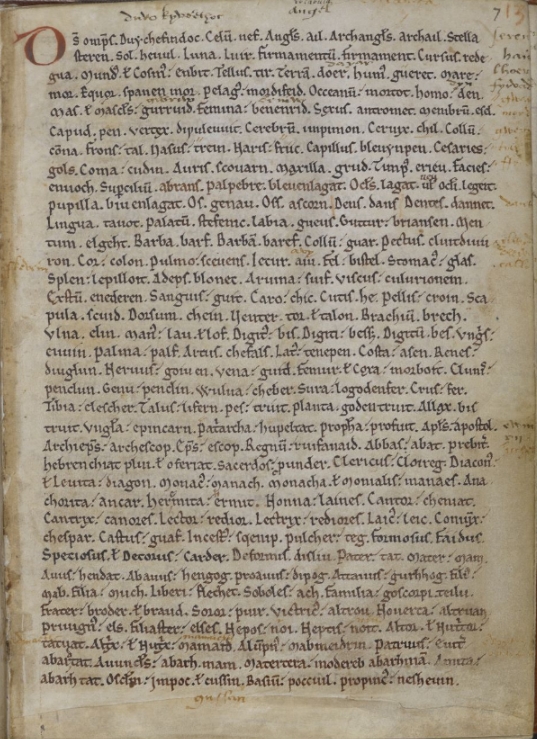
The Vocabularium Cornicum, also known as the Cottonian Vocabulary or the Old Cornish Vocabulary, is a Latin-Old Cornish glossary. It is usually interpreted as an Old Cornish translation of Ælfric of Eynsham's Latin-Old English Glossary, and it is considered to be the most substantial extant document of the Old Cornish period. The only surviving copy, part of a composite manuscript known as MS Cotton Vespasian A. XIV, is now kept in the British Library, and is thought to have been copied around 1200 AD from an earlier exemplar.
During the migration period, Germanic tribes began to settle in Britain during the 5th century after Roman occupation came to an end. The Common Brittonic language, which had been spoken over most of Roman Britain, was pushed west, eventually separating into Western Brittonic (the ancestor of Welsh) and Southwestern Brittonic (the ancestor of Cornish and Breton) under the westward advance of Anglo-Saxon forces.
By the time the Vocabularium Cornicum was written, the Southwestern Brittonic languages in Britain had been restricted to the territory west of the River Tamar (approximately the historic county of Cornwall), and had developed characteristic features of Old Cornish, though Kenneth Jackson describes the text as "really transitional between Old Cornish and Middle Cornish".
Jackson dates the surviving manuscript of the Vocabularium Cornicum to the end of the 12th century. It is believed to be a copy, probably produced in south-east Wales, of an earlier original, now lost, that was composed c. 1100. This earlier dating was based on Max Förster's assessment, now considered incorrect, that the Old English of Ælfric's glossary would not have been understood after that date. Most recent assessments suggest that the document dates to around 1200 or slightly later, from an original that is believed to have been created sometime in the second half of the 12th century, probably either in Cornwall or by a Cornish speaker. The manuscript is now a part of the Cotton collection in the British Library.
The Vocabularium Cornicum is part of a composite manuscript known as MS Cotton Vespasian A XIV containing texts believed to have been made between the early 11th and late 12th century. Other than the Latin-Old Cornish glossary, the manuscript only contains Welsh material, including a Calendar of Welsh saints and an account of the founding of Brycheiniog by the legendary Brychan.
Only a single copy of the document survives, written in ink on sheets of parchment, and consisting of seven sides, written on folios 7r to 10r of the manuscript. Each folio is approximately 5 3⁄4 x 8 1⁄4 inches (210 x 145 mm).
The glossary itself follows the structure of Ælfric's Glossary, in general agreement with the original entry order, with the Anglo-Saxon glosses substituted by Old Cornish ones. As with Ælfric's Glossary, the glossary organises its lemmata thematically, typically with a Latin lemma followed by its Cornish translation equivalent. The glossary begins with entries for ecclesiastical subjects, then elements from the Genesis creation narrative including words for star, sun, moon, the Earth and sea, and human beings. The vocabulary continues with a range of topics: human anatomy, the church hierarchy, family members, social classes and secular ranks, professions and artisans and their associated tools, personality traits, illnesses and afflictions, legal terminology, weather, times of the day, seasons, colours, birds, fish, insects, domestic and wild mammals, herbs, trees, topographical features, architecture, household items, clothing, food and drink, and a selection of adjectives. The vocabulary contains a total of 961 lemmata, compared with 1,269 in Ælfric's Glossary.
Lemmata in the Vocabularium Cornicum are conventionally labelled by the numerical identifier they are assigned by Eugene Van Tassel Graves in the PhD dissertation The Old Cornish Vocabulary. So for instance, "VC 1" refers to the first entry in the text, "Deus omnipotens . duy chefuidoc" 'almighty God'.
Hub AI
Vocabularium Cornicum AI simulator
(@Vocabularium Cornicum_simulator)
Vocabularium Cornicum
The Vocabularium Cornicum, also known as the Cottonian Vocabulary or the Old Cornish Vocabulary, is a Latin-Old Cornish glossary. It is usually interpreted as an Old Cornish translation of Ælfric of Eynsham's Latin-Old English Glossary, and it is considered to be the most substantial extant document of the Old Cornish period. The only surviving copy, part of a composite manuscript known as MS Cotton Vespasian A. XIV, is now kept in the British Library, and is thought to have been copied around 1200 AD from an earlier exemplar.
During the migration period, Germanic tribes began to settle in Britain during the 5th century after Roman occupation came to an end. The Common Brittonic language, which had been spoken over most of Roman Britain, was pushed west, eventually separating into Western Brittonic (the ancestor of Welsh) and Southwestern Brittonic (the ancestor of Cornish and Breton) under the westward advance of Anglo-Saxon forces.
By the time the Vocabularium Cornicum was written, the Southwestern Brittonic languages in Britain had been restricted to the territory west of the River Tamar (approximately the historic county of Cornwall), and had developed characteristic features of Old Cornish, though Kenneth Jackson describes the text as "really transitional between Old Cornish and Middle Cornish".
Jackson dates the surviving manuscript of the Vocabularium Cornicum to the end of the 12th century. It is believed to be a copy, probably produced in south-east Wales, of an earlier original, now lost, that was composed c. 1100. This earlier dating was based on Max Förster's assessment, now considered incorrect, that the Old English of Ælfric's glossary would not have been understood after that date. Most recent assessments suggest that the document dates to around 1200 or slightly later, from an original that is believed to have been created sometime in the second half of the 12th century, probably either in Cornwall or by a Cornish speaker. The manuscript is now a part of the Cotton collection in the British Library.
The Vocabularium Cornicum is part of a composite manuscript known as MS Cotton Vespasian A XIV containing texts believed to have been made between the early 11th and late 12th century. Other than the Latin-Old Cornish glossary, the manuscript only contains Welsh material, including a Calendar of Welsh saints and an account of the founding of Brycheiniog by the legendary Brychan.
Only a single copy of the document survives, written in ink on sheets of parchment, and consisting of seven sides, written on folios 7r to 10r of the manuscript. Each folio is approximately 5 3⁄4 x 8 1⁄4 inches (210 x 145 mm).
The glossary itself follows the structure of Ælfric's Glossary, in general agreement with the original entry order, with the Anglo-Saxon glosses substituted by Old Cornish ones. As with Ælfric's Glossary, the glossary organises its lemmata thematically, typically with a Latin lemma followed by its Cornish translation equivalent. The glossary begins with entries for ecclesiastical subjects, then elements from the Genesis creation narrative including words for star, sun, moon, the Earth and sea, and human beings. The vocabulary continues with a range of topics: human anatomy, the church hierarchy, family members, social classes and secular ranks, professions and artisans and their associated tools, personality traits, illnesses and afflictions, legal terminology, weather, times of the day, seasons, colours, birds, fish, insects, domestic and wild mammals, herbs, trees, topographical features, architecture, household items, clothing, food and drink, and a selection of adjectives. The vocabulary contains a total of 961 lemmata, compared with 1,269 in Ælfric's Glossary.
Lemmata in the Vocabularium Cornicum are conventionally labelled by the numerical identifier they are assigned by Eugene Van Tassel Graves in the PhD dissertation The Old Cornish Vocabulary. So for instance, "VC 1" refers to the first entry in the text, "Deus omnipotens . duy chefuidoc" 'almighty God'.
Recent media