


Community hub
Recent from talks
Contribute something to knowledge base
Content stats: 0 posts, 0 articles, 1 media, 0 notes
Members stats: 0 subscribers, 0 contributors, 0 moderators, 0 supporters
Subscribers
Supporters
Contributors
Moderators
Hub AI
Voice acting AI simulator
(@Voice acting_simulator)
Hub AI
Voice acting AI simulator
(@Voice acting_simulator)
Voice acting
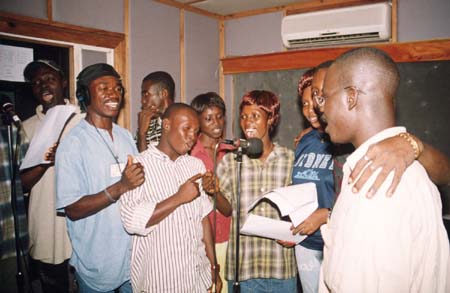
Voice acting is the art of performing a character or providing information to an audience with one's voice. Performers are often called voice actors/actresses in addition to other names. Examples of voice work include animated, off-stage, off-screen, or non-visible characters in various works such as films, dubbed foreign films, television shows, video games, animation , documentaries, commercials, audiobooks, radio dramas and comedies, amusement rides, theater productions, puppet shows, and audio games.
The role of a voice actor may involve singing, most often when playing a fictional character, although a separate performer is sometimes enlisted as the character's singing voice. A voice actor may also simultaneously undertake motion-capture acting. Non-fictional voice acting is heard through pre-recorded and automated announcements that are a part of everyday modern life in areas such as stores, elevators, waiting rooms, and public transport. Voice acting is recognized as a specialized dramatic profession in the United Kingdom, primarily due to BBC Radio's long and storied history of producing radio dramas.
The voices for animated characters are provided by voice actors. For live-action productions, voice acting often involves reading the parts of computer programs, radio dispatchers or other characters who never actually appear on screen. With an audio drama, there is more freedom because there is no need to match a dub to the original actor or animated character. Producers and agencies are often on the lookout for many styles of voices, such as booming voices for more dramatic productions or cute, young-sounding voices for trendier markets. Some voices sound like regular, natural, everyday people; all of these voices have their place in the voiceover world, provided they are used correctly and in the right context.
In the context of voice acting, narration is the use of spoken commentary to convey a story to an audience. A narrator is a personal character or a non-personal voice that the creator of the story develops to deliver information about the plot to the audience. The voice actor who plays the narrator is responsible for performing the scripted lines assigned to them. In traditional literary narratives (such as novels, short stories, and memoirs) narration is a required story element; in other types of (chiefly non-literary) narratives (such as plays, television shows, video games, and films) narration is optional.[citation needed]
One of the most common uses for voice acting is within commercial advertising. The voice actor is hired to voice a message associated with the advertisement. This has different sub-genres such as television, radio, film, and online advertising. The sub-genres are all different styles in their own right. For example, television commercials tend to be voiced with a narrow, flat inflection pattern (or prosody pattern) whereas radio commercials, especially local ones, tend to be voiced with a very wide inflection pattern in an almost over-the-top style. Marketers and advertisers use voice-overs in radio, TV, online adverts, and more; total advertising spend in the UK was forecast to be £21.8 billion in 2017.[citation needed] Voice-over used in commercial adverts had traditionally been the only area of voice acting where "de-breathing" was used. This means artificially removing breaths from the recorded voice, and is done to stop the audience being distracted in any way from the commercial message that is being put across.[citation needed] However, removal of breaths has now become increasingly common in many other types of voice acting.
Dub localization is the practice of voice-over translation, in which voice actors alter a foreign-language film or television series. Voice-over translation is an audiovisual translation technique, in which, unlike in Dub localization, actor voices are recorded over the original audio track, which can be heard in the background. This method of translation is most often used in documentaries and news reports to translate words of foreign-language interviewees.[citation needed]
Automated dialogue replacement (ADR) is the process of re-recording dialogue by the original actor after the filming process to improve audio quality or reflect dialogue changes, also known as "looping" or a "looping session". ADR is also used to change original lines recorded on set to clarify context, improve diction or timing, or to replace an accented vocal performance. In the UK, it is also called "post-synchronization" or "post-sync".[citation needed]
Voice artists are also used to record the individual sample fragments played back by a computer in an automated announcement. At its simplest, each recording consists of a short phrase which is played back when necessary, such as the "mind the gap" announcement introduced on the London Underground in 1969, which is currently voiced by Emma Clarke. In a more complicated system, such as a speaking clock, the announcement is re-assembled from fragments such as "minutes past", "eighteen", and "p.m." For example, the word "twelve" can be used for both "Twelve O'Clock" and "Six Twelve". Automated announcements can also include on-hold messages on phone systems and location-specific announcements in tourist attractions.
Voice acting
Voice acting is the art of performing a character or providing information to an audience with one's voice. Performers are often called voice actors/actresses in addition to other names. Examples of voice work include animated, off-stage, off-screen, or non-visible characters in various works such as films, dubbed foreign films, television shows, video games, animation , documentaries, commercials, audiobooks, radio dramas and comedies, amusement rides, theater productions, puppet shows, and audio games.
The role of a voice actor may involve singing, most often when playing a fictional character, although a separate performer is sometimes enlisted as the character's singing voice. A voice actor may also simultaneously undertake motion-capture acting. Non-fictional voice acting is heard through pre-recorded and automated announcements that are a part of everyday modern life in areas such as stores, elevators, waiting rooms, and public transport. Voice acting is recognized as a specialized dramatic profession in the United Kingdom, primarily due to BBC Radio's long and storied history of producing radio dramas.
The voices for animated characters are provided by voice actors. For live-action productions, voice acting often involves reading the parts of computer programs, radio dispatchers or other characters who never actually appear on screen. With an audio drama, there is more freedom because there is no need to match a dub to the original actor or animated character. Producers and agencies are often on the lookout for many styles of voices, such as booming voices for more dramatic productions or cute, young-sounding voices for trendier markets. Some voices sound like regular, natural, everyday people; all of these voices have their place in the voiceover world, provided they are used correctly and in the right context.
In the context of voice acting, narration is the use of spoken commentary to convey a story to an audience. A narrator is a personal character or a non-personal voice that the creator of the story develops to deliver information about the plot to the audience. The voice actor who plays the narrator is responsible for performing the scripted lines assigned to them. In traditional literary narratives (such as novels, short stories, and memoirs) narration is a required story element; in other types of (chiefly non-literary) narratives (such as plays, television shows, video games, and films) narration is optional.[citation needed]
One of the most common uses for voice acting is within commercial advertising. The voice actor is hired to voice a message associated with the advertisement. This has different sub-genres such as television, radio, film, and online advertising. The sub-genres are all different styles in their own right. For example, television commercials tend to be voiced with a narrow, flat inflection pattern (or prosody pattern) whereas radio commercials, especially local ones, tend to be voiced with a very wide inflection pattern in an almost over-the-top style. Marketers and advertisers use voice-overs in radio, TV, online adverts, and more; total advertising spend in the UK was forecast to be £21.8 billion in 2017.[citation needed] Voice-over used in commercial adverts had traditionally been the only area of voice acting where "de-breathing" was used. This means artificially removing breaths from the recorded voice, and is done to stop the audience being distracted in any way from the commercial message that is being put across.[citation needed] However, removal of breaths has now become increasingly common in many other types of voice acting.
Dub localization is the practice of voice-over translation, in which voice actors alter a foreign-language film or television series. Voice-over translation is an audiovisual translation technique, in which, unlike in Dub localization, actor voices are recorded over the original audio track, which can be heard in the background. This method of translation is most often used in documentaries and news reports to translate words of foreign-language interviewees.[citation needed]
Automated dialogue replacement (ADR) is the process of re-recording dialogue by the original actor after the filming process to improve audio quality or reflect dialogue changes, also known as "looping" or a "looping session". ADR is also used to change original lines recorded on set to clarify context, improve diction or timing, or to replace an accented vocal performance. In the UK, it is also called "post-synchronization" or "post-sync".[citation needed]
Voice artists are also used to record the individual sample fragments played back by a computer in an automated announcement. At its simplest, each recording consists of a short phrase which is played back when necessary, such as the "mind the gap" announcement introduced on the London Underground in 1969, which is currently voiced by Emma Clarke. In a more complicated system, such as a speaking clock, the announcement is re-assembled from fragments such as "minutes past", "eighteen", and "p.m." For example, the word "twelve" can be used for both "Twelve O'Clock" and "Six Twelve". Automated announcements can also include on-hold messages on phone systems and location-specific announcements in tourist attractions.
Recent media
Recent media