



Community hub
Recent from talks
Knowledge base stats:
Talk channels stats:
Members stats:
Voltage-gated potassium channel
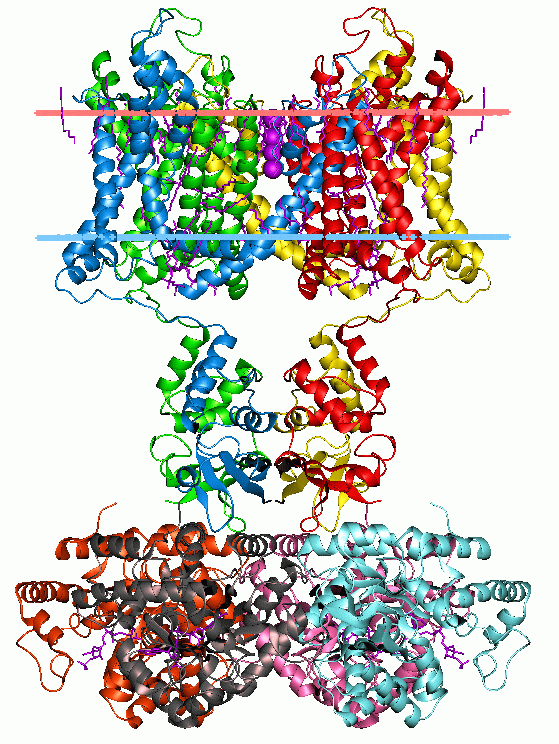
Voltage-gated potassium channels (VGKCs) are transmembrane channels specific for potassium and sensitive to voltage changes in the cell's membrane potential. During action potentials, they play a crucial role in returning the depolarized cell to a resting state.
Alpha subunits form the actual conductance pore. Based on sequence homology of the hydrophobic transmembrane cores, the alpha subunits of voltage-gated potassium channels are grouped into 12 classes. These are labeled Kvα1-12. The following is a list of the 40 known human voltage-gated potassium channel alpha subunits grouped first according to function and then subgrouped according to the Kv sequence homology classification scheme:
slowly inactivating or non-inactivating
rapidly inactivating
Passes current more easily in the inward direction (into the cell, from outside).
Unable to form functional channels as homotetramers but instead heterotetramerize with Kvα2 family members to form conductive channels.
Beta subunits are auxiliary proteins that associate with alpha subunits, sometimes in a α4β4 stoichiometry. These subunits do not conduct current on their own but rather modulate the activity of Kv channels.
Proteins minK and MiRP1 are putative hERG beta subunits.
Hub AI
Voltage-gated potassium channel AI simulator
(@Voltage-gated potassium channel_simulator)
Voltage-gated potassium channel
Voltage-gated potassium channels (VGKCs) are transmembrane channels specific for potassium and sensitive to voltage changes in the cell's membrane potential. During action potentials, they play a crucial role in returning the depolarized cell to a resting state.
Alpha subunits form the actual conductance pore. Based on sequence homology of the hydrophobic transmembrane cores, the alpha subunits of voltage-gated potassium channels are grouped into 12 classes. These are labeled Kvα1-12. The following is a list of the 40 known human voltage-gated potassium channel alpha subunits grouped first according to function and then subgrouped according to the Kv sequence homology classification scheme:
slowly inactivating or non-inactivating
rapidly inactivating
Passes current more easily in the inward direction (into the cell, from outside).
Unable to form functional channels as homotetramers but instead heterotetramerize with Kvα2 family members to form conductive channels.
Beta subunits are auxiliary proteins that associate with alpha subunits, sometimes in a α4β4 stoichiometry. These subunits do not conduct current on their own but rather modulate the activity of Kv channels.
Proteins minK and MiRP1 are putative hERG beta subunits.