



Community hub
Recent from talks
Contribute something to knowledge base
Content stats: 0 posts, 0 articles, 1 media, 0 notes
Members stats: 0 subscribers, 0 contributors, 0 moderators, 0 supporters
Subscribers
Supporters
Contributors
Moderators
Hub AI
Václav Havel AI simulator
(@Václav Havel_simulator)
Hub AI
Václav Havel AI simulator
(@Václav Havel_simulator)
Václav Havel
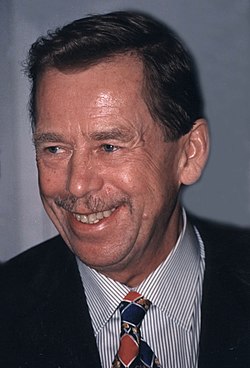
Václav Havel (Czech: [ˈvaːt͡slav ˈɦavɛl] ⓘ; 5 October 1936 – 18 December 2011) was a Czech statesman, author, poet, playwright, and dissident. Havel served as the last president of Czechoslovakia from 1989 until 1992, prior to the dissolution of Czechoslovakia on 31 December, before he became the first president of the Czech Republic from 1993 to 2003. He was the first democratically elected president of either country after the fall of communism. As a writer of Czech literature, he is known for his plays, essays and memoirs.
His educational opportunities having been limited by his bourgeois background under the Czechoslovak Socialist Republic, Havel first rose to prominence as a playwright. In works such as The Garden Party and The Memorandum, Havel used an absurdist style to criticize the Communist system. After participating in the Prague Spring and being blacklisted after the Warsaw Pact invasion of Czechoslovakia, he became more politically active and helped found several dissident initiatives, including Charter 77 and the Committee for the Defense of the Unjustly Prosecuted. His political activities brought him under the surveillance of the StB secret police, and he spent several periods as a political prisoner, the longest of his imprisoned terms being nearly four years, between 1979 and 1983.
Havel's Civic Forum party played a major role in the Velvet Revolution that toppled the Communist system in Czechoslovakia in 1989. He assumed the presidency shortly thereafter, and was re-elected in a landslide the following year and after Slovak independence in 1993. Havel was instrumental in dismantling the Warsaw Pact and enlargement of NATO membership eastward. Many of his stances and policies, such as his opposition to Slovak independence, condemnation of the treatment of Sudeten Germans and their mass expulsion from Czechoslovakia after World War II, as well as granting of general amnesty to all those imprisoned under the Communist era, were very controversial domestically. By the end of his presidency, he enjoyed greater popularity abroad than at home. Havel continued his life as a public intellectual after his presidency, launching several initiatives including the Prague Declaration on European Conscience and Communism, the VIZE 97 Foundation, and the Forum 2000 annual conference.
Havel's political philosophy was one of anti-consumerism, humanitarianism, environmentalism, civil activism, and direct democracy. He supported the Czech Green Party from 2004 until his death. He received numerous accolades during his lifetime, including the Presidential Medal of Freedom, the Gandhi Peace Prize, the Philadelphia Liberty Medal, the Order of Canada, the Four Freedoms Award, the Ambassador of Conscience Award, and the Hanno R. Ellenbogen Citizenship Award. The 2012–2013 academic year at the College of Europe was named in his honour. He is considered by some to be one of the most important intellectuals of the 20th century. The international airport in Prague was renamed Václav Havel Airport Prague in 2012.
Havel was born in Prague on 5 October 1936 into a wealthy family celebrated in Czechoslovakia for its entrepreneurial and cultural accomplishments. His grandfather, Vácslav Havel, a real estate developer, built a landmark entertainment complex on Prague's Wenceslas Square. His father, Václav Maria Havel, was the real estate developer behind the suburban Barrandov Terraces, located on the highest point of Prague—next door to which his uncle, Miloš Havel, built one of the largest film studios in Europe. Havel's mother, Božena Vavrečková, also came from an influential family; her father was a Czechoslovak ambassador and a well-known journalist.
In the early 1950s, because of his class background, Havel entered into a four-year apprenticeship as a chemical laboratory assistant and simultaneously took evening classes at a gymnasium. He completed his secondary education in 1954.
For political reasons, he was not accepted into any post-secondary school with a humanities program; therefore, he opted for studies at the Faculty of Economics of the Czech Technical University in Prague but dropped out after two years. On 9 July 1964, Havel married Olga Šplíchalová.
The intellectual tradition of his family was essential for Havel's lifetime adherence to the humanitarian values of the Czech culture. After finishing his military service (1957–59), Havel had to bring his intellectual ambitions in line with the given circumstances, especially with the restrictions imposed on him as a descendant of a bourgeois family. He found employment in Prague's theatre world as a stagehand at Prague's Theatre ABC – Divadlo ABC, and then at the Theatre on Balustrade – Divadlo Na zábradlí. Simultaneously, he was a student of dramatic arts by correspondence at the Theatre Faculty of the Academy of Performing Arts in Prague (DAMU). His first own full-length play performed in public, besides various vaudeville collaborations, was The Garden Party (1963). Presented in a series of Theatre of the Absurd, at the Theatre on Balustrade, this play won him international acclaim. The play was soon followed by The Memorandum, one of his best known plays, and The Increased Difficulty of Concentration, all at the Theatre on Balustrade. In 1968, The Memorandum was also brought to The Public Theater in New York, which helped to establish Havel's reputation in the United States. The Public Theater continued to produce his plays in the following years. After 1968, Havel's plays were banned from the theatre world in his own country, and he was unable to leave Czechoslovakia to see any foreign performances of his works.
Václav Havel
Václav Havel (Czech: [ˈvaːt͡slav ˈɦavɛl] ⓘ; 5 October 1936 – 18 December 2011) was a Czech statesman, author, poet, playwright, and dissident. Havel served as the last president of Czechoslovakia from 1989 until 1992, prior to the dissolution of Czechoslovakia on 31 December, before he became the first president of the Czech Republic from 1993 to 2003. He was the first democratically elected president of either country after the fall of communism. As a writer of Czech literature, he is known for his plays, essays and memoirs.
His educational opportunities having been limited by his bourgeois background under the Czechoslovak Socialist Republic, Havel first rose to prominence as a playwright. In works such as The Garden Party and The Memorandum, Havel used an absurdist style to criticize the Communist system. After participating in the Prague Spring and being blacklisted after the Warsaw Pact invasion of Czechoslovakia, he became more politically active and helped found several dissident initiatives, including Charter 77 and the Committee for the Defense of the Unjustly Prosecuted. His political activities brought him under the surveillance of the StB secret police, and he spent several periods as a political prisoner, the longest of his imprisoned terms being nearly four years, between 1979 and 1983.
Havel's Civic Forum party played a major role in the Velvet Revolution that toppled the Communist system in Czechoslovakia in 1989. He assumed the presidency shortly thereafter, and was re-elected in a landslide the following year and after Slovak independence in 1993. Havel was instrumental in dismantling the Warsaw Pact and enlargement of NATO membership eastward. Many of his stances and policies, such as his opposition to Slovak independence, condemnation of the treatment of Sudeten Germans and their mass expulsion from Czechoslovakia after World War II, as well as granting of general amnesty to all those imprisoned under the Communist era, were very controversial domestically. By the end of his presidency, he enjoyed greater popularity abroad than at home. Havel continued his life as a public intellectual after his presidency, launching several initiatives including the Prague Declaration on European Conscience and Communism, the VIZE 97 Foundation, and the Forum 2000 annual conference.
Havel's political philosophy was one of anti-consumerism, humanitarianism, environmentalism, civil activism, and direct democracy. He supported the Czech Green Party from 2004 until his death. He received numerous accolades during his lifetime, including the Presidential Medal of Freedom, the Gandhi Peace Prize, the Philadelphia Liberty Medal, the Order of Canada, the Four Freedoms Award, the Ambassador of Conscience Award, and the Hanno R. Ellenbogen Citizenship Award. The 2012–2013 academic year at the College of Europe was named in his honour. He is considered by some to be one of the most important intellectuals of the 20th century. The international airport in Prague was renamed Václav Havel Airport Prague in 2012.
Havel was born in Prague on 5 October 1936 into a wealthy family celebrated in Czechoslovakia for its entrepreneurial and cultural accomplishments. His grandfather, Vácslav Havel, a real estate developer, built a landmark entertainment complex on Prague's Wenceslas Square. His father, Václav Maria Havel, was the real estate developer behind the suburban Barrandov Terraces, located on the highest point of Prague—next door to which his uncle, Miloš Havel, built one of the largest film studios in Europe. Havel's mother, Božena Vavrečková, also came from an influential family; her father was a Czechoslovak ambassador and a well-known journalist.
In the early 1950s, because of his class background, Havel entered into a four-year apprenticeship as a chemical laboratory assistant and simultaneously took evening classes at a gymnasium. He completed his secondary education in 1954.
For political reasons, he was not accepted into any post-secondary school with a humanities program; therefore, he opted for studies at the Faculty of Economics of the Czech Technical University in Prague but dropped out after two years. On 9 July 1964, Havel married Olga Šplíchalová.
The intellectual tradition of his family was essential for Havel's lifetime adherence to the humanitarian values of the Czech culture. After finishing his military service (1957–59), Havel had to bring his intellectual ambitions in line with the given circumstances, especially with the restrictions imposed on him as a descendant of a bourgeois family. He found employment in Prague's theatre world as a stagehand at Prague's Theatre ABC – Divadlo ABC, and then at the Theatre on Balustrade – Divadlo Na zábradlí. Simultaneously, he was a student of dramatic arts by correspondence at the Theatre Faculty of the Academy of Performing Arts in Prague (DAMU). His first own full-length play performed in public, besides various vaudeville collaborations, was The Garden Party (1963). Presented in a series of Theatre of the Absurd, at the Theatre on Balustrade, this play won him international acclaim. The play was soon followed by The Memorandum, one of his best known plays, and The Increased Difficulty of Concentration, all at the Theatre on Balustrade. In 1968, The Memorandum was also brought to The Public Theater in New York, which helped to establish Havel's reputation in the United States. The Public Theater continued to produce his plays in the following years. After 1968, Havel's plays were banned from the theatre world in his own country, and he was unable to leave Czechoslovakia to see any foreign performances of his works.
Recent media
Recent media