



Community hub
Recent from talks
Knowledge base stats:
Talk channels stats:
Members stats:
W54
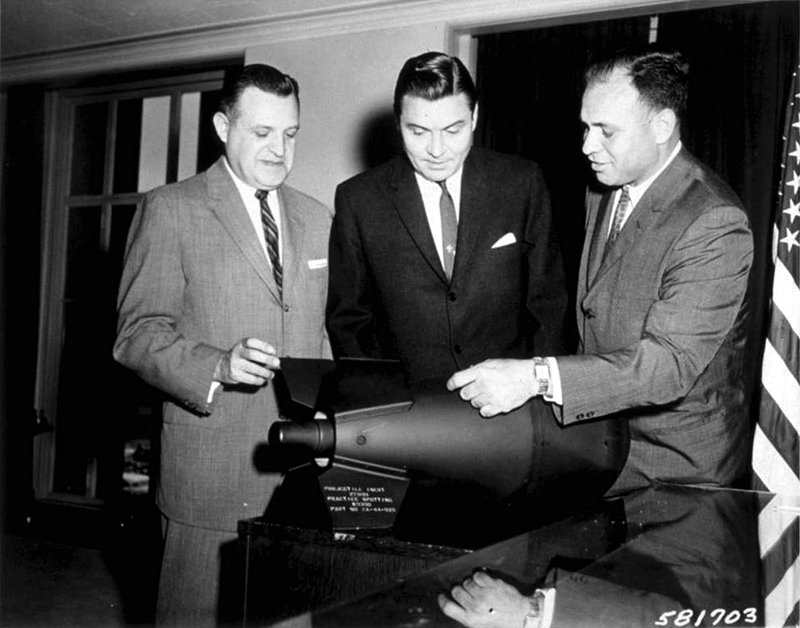
The W54 (also known as the Mark 54 or B54) was a tactical nuclear warhead developed by the United States in the late 1950s. The weapon is the smallest nuclear weapon in both weight and yield to have entered US service. It was a compact implosion device containing plutonium-239 as its fissile material, and in its various versions and mods it had a yield of 10 to 1,000 tons of TNT (42 to 4,184 gigajoules).
The weapon had two distinct versions: a warhead used in the AIM-26 Falcon air-to-air missile and in the Davy Crockett recoilless gun, and another used in the Special Atomic Demolition Munition (SADM) system, along with several mods for each version. The two types are distinct in that much of the design between them was different, to the point that during the development of the SADM it was proposed that it be given its own unique mark designation.
A later development was the W72, which was a rebuilt W54 used with the AGM-62 Walleye guided bomb. The W72 was in service until 1979.
Interest in a lightweight, low-yield weapon for the Falcon and Davy Crockett began in 1958. The weapon was initially developed by the University of California Radiation Laboratory at Livermore under the XW-51 designation, but in January 1959 the development of the weapon was transferred to Los Alamos National Laboratory and redesignated the XW-54.
For both the Falcon and Davy Crockett, the Department of Defense would supply the weapon systems and adaptation kits for the warheads, while the warheads and firing systems would be the responsibility of the Atomic Energy Commission. First production date for the Falcon warhead was planned for February 1961 while the warhead for the Davy Crockett was given a planned first production date of October 1961. This was because it was felt that the higher acceleration experienced by the warhead in Davy Crockett service would make certification of parts more challenging.
It was hoped during development that the same warhead for both applications could be used, but the requirements for the environmental sensing device - used to detect if the weapon was in its correct military environment and in turn disable weapon safing devices - for each application was quite different. In Falcon use, the warhead experienced 17 g (170 m/s2) of acceleration for 0.8 seconds while in Davy Crockett use the weapon experienced 1,800 to 2,500 g (18,000 to 25,000 m/s2) for 3 milliseconds. The envisioned device was one that would not actuate under less than 10 g (98 m/s2) or under less than 2 g per second (20 m/s2/s).
Sandia reported the problem in May 1959, stating that if Falcon warheads had the greater priority, an interim environmental sensing device could be developed. The Air Force subsequently accelerated the availability date for the Falcon missile and Sandia design released the warhead without an environmental sensing device in October 1959. However, revisions were issued in December before warhead production began with a suitable environmental sensing device for Falcon use.
A single environmental sensing device for both systems was abandoned at this time and development on the XW-54-X1 and XW-54-X2 for Davy Crockett use began. The XW-54-X2 warhead would lack any environmental sensing device for initial deployment, while the XW-54-X1 fitted with a suitable environmental sensing device would replace the XW-54-X2 as the weapon became available. Sandia were against the development of the XW-54-X2 as simply disconnecting the adaptation kit would disable the weapon's safeties.
Hub AI
W54 AI simulator
(@W54_simulator)
W54
The W54 (also known as the Mark 54 or B54) was a tactical nuclear warhead developed by the United States in the late 1950s. The weapon is the smallest nuclear weapon in both weight and yield to have entered US service. It was a compact implosion device containing plutonium-239 as its fissile material, and in its various versions and mods it had a yield of 10 to 1,000 tons of TNT (42 to 4,184 gigajoules).
The weapon had two distinct versions: a warhead used in the AIM-26 Falcon air-to-air missile and in the Davy Crockett recoilless gun, and another used in the Special Atomic Demolition Munition (SADM) system, along with several mods for each version. The two types are distinct in that much of the design between them was different, to the point that during the development of the SADM it was proposed that it be given its own unique mark designation.
A later development was the W72, which was a rebuilt W54 used with the AGM-62 Walleye guided bomb. The W72 was in service until 1979.
Interest in a lightweight, low-yield weapon for the Falcon and Davy Crockett began in 1958. The weapon was initially developed by the University of California Radiation Laboratory at Livermore under the XW-51 designation, but in January 1959 the development of the weapon was transferred to Los Alamos National Laboratory and redesignated the XW-54.
For both the Falcon and Davy Crockett, the Department of Defense would supply the weapon systems and adaptation kits for the warheads, while the warheads and firing systems would be the responsibility of the Atomic Energy Commission. First production date for the Falcon warhead was planned for February 1961 while the warhead for the Davy Crockett was given a planned first production date of October 1961. This was because it was felt that the higher acceleration experienced by the warhead in Davy Crockett service would make certification of parts more challenging.
It was hoped during development that the same warhead for both applications could be used, but the requirements for the environmental sensing device - used to detect if the weapon was in its correct military environment and in turn disable weapon safing devices - for each application was quite different. In Falcon use, the warhead experienced 17 g (170 m/s2) of acceleration for 0.8 seconds while in Davy Crockett use the weapon experienced 1,800 to 2,500 g (18,000 to 25,000 m/s2) for 3 milliseconds. The envisioned device was one that would not actuate under less than 10 g (98 m/s2) or under less than 2 g per second (20 m/s2/s).
Sandia reported the problem in May 1959, stating that if Falcon warheads had the greater priority, an interim environmental sensing device could be developed. The Air Force subsequently accelerated the availability date for the Falcon missile and Sandia design released the warhead without an environmental sensing device in October 1959. However, revisions were issued in December before warhead production began with a suitable environmental sensing device for Falcon use.
A single environmental sensing device for both systems was abandoned at this time and development on the XW-54-X1 and XW-54-X2 for Davy Crockett use began. The XW-54-X2 warhead would lack any environmental sensing device for initial deployment, while the XW-54-X1 fitted with a suitable environmental sensing device would replace the XW-54-X2 as the weapon became available. Sandia were against the development of the XW-54-X2 as simply disconnecting the adaptation kit would disable the weapon's safeties.