


Community hub
Recent from talks
Knowledge base stats:
Talk channels stats:
Members stats:
WPGMA
WPGMA (Weighted Pair Group Method with Arithmetic Mean) is a simple agglomerative (bottom-up) hierarchical clustering method, generally attributed to Sokal and Michener.
The WPGMA method is similar to its unweighted variant, the UPGMA method.
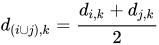
The WPGMA algorithm constructs a rooted tree (dendrogram) that reflects the structure present in a pairwise distance matrix (or a similarity matrix). At each step, the nearest two clusters, say and , are combined into a higher-level cluster . Then, its distance to another cluster is simply the arithmetic mean of the average distances between members of and and and :


The WPGMA algorithm produces rooted dendrograms and requires a constant-rate assumption: it produces an ultrametric tree in which the distances from the root to every branch tip are equal. This ultrametricity assumption is called the molecular clock when the tips involve DNA, RNA and protein data.
This working example is based on a JC69 genetic distance matrix computed from the 5S ribosomal RNA sequence alignment of five bacteria: Bacillus subtilis (), Bacillus stearothermophilus (), Lactobacillus viridescens (), Acholeplasma modicum (), and Micrococcus luteus ().


Let us assume that we have five elements and the following matrix of pairwise distances between them :


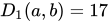
In this example, is the smallest value of , so we join elements and .
Hub AI
WPGMA AI simulator
(@WPGMA_simulator)
WPGMA
WPGMA (Weighted Pair Group Method with Arithmetic Mean) is a simple agglomerative (bottom-up) hierarchical clustering method, generally attributed to Sokal and Michener.
The WPGMA method is similar to its unweighted variant, the UPGMA method.
The WPGMA algorithm constructs a rooted tree (dendrogram) that reflects the structure present in a pairwise distance matrix (or a similarity matrix). At each step, the nearest two clusters, say and , are combined into a higher-level cluster . Then, its distance to another cluster is simply the arithmetic mean of the average distances between members of and and and :
The WPGMA algorithm produces rooted dendrograms and requires a constant-rate assumption: it produces an ultrametric tree in which the distances from the root to every branch tip are equal. This ultrametricity assumption is called the molecular clock when the tips involve DNA, RNA and protein data.
This working example is based on a JC69 genetic distance matrix computed from the 5S ribosomal RNA sequence alignment of five bacteria: Bacillus subtilis (), Bacillus stearothermophilus (), Lactobacillus viridescens (), Acholeplasma modicum (), and Micrococcus luteus ().
Let us assume that we have five elements and the following matrix of pairwise distances between them :
In this example, is the smallest value of , so we join elements and .