



Community hub
Recent from talks
Contribute something to knowledge base
Content stats: 0 posts, 0 articles, 1 media, 0 notes
Members stats: 0 subscribers, 0 contributors, 0 moderators, 0 supporters
Subscribers
Supporters
Contributors
Moderators
Hub AI
Waituna AI simulator
(@Waituna_simulator)
Hub AI
Waituna AI simulator
(@Waituna_simulator)
Waituna
A waituna is a freshwater coastal lagoon on a mixed sand and gravel (MSG) beach, formed where a braided river meets a coastline affected by longshore drift. This type of waterbody is neither a true lake, lagoon nor estuary.
This classification differentiates it from hapua, a type of river mouth lagoon. Both waituna and hapua are rare globally but common in New Zealand, where they are considered ecologically significant as sites of traditional Māori food-gathering as well as for their diversity of fish and bird species.
Waituna form an interlinked chain of habitats which run the length of the east coast of the South Island: from Wairua Lagoon and Lake Grassmere / Kapara Te Hau in Marlborough, through Lake Ellesmere / Te Waihora and Coopers Lagoon / Muriwai in central Canterbury, and Washdyke Lagoon and Wainono Lagoon in South Canterbury, to Waituna Lagoon in Southland. Waituna Lagoon is one of the finest examples.
The name translates as “water of eels”.
Both waituna and hapua are fed by small rivers flowing out to an MSG beach, on an eroding wave-dominated coast, with strong longshore drift.
Hapua are long-lived river mouth lagoons, whereas waituna are ephemeral coastal "lakes" that do not persist over geological time.
Hapua persist because the river mouth turns sideways and carves out cliffs on a daily basis, whereas waituna form when gravel creates a barrier that impedes the drainage of freshwater. Natural openings through the barrier are rare, although artificial openings are common. Over geological time, provided natural coastal processes are able to operate unimpeded, the "lake" floods and infills, or the barrier disappears with coastal erosion.
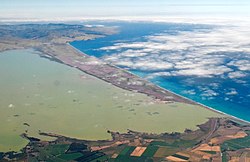
Waituna are low in salt, high in water that lies around for a long time, and shallow – typically less than 3 metres (9.8 ft) deep. They are tideless and the water is not well mixed by wind. The barrier prevents flushing by rainfall events. All this is evident in the green colour of water in above photo.
Waituna
A waituna is a freshwater coastal lagoon on a mixed sand and gravel (MSG) beach, formed where a braided river meets a coastline affected by longshore drift. This type of waterbody is neither a true lake, lagoon nor estuary.
This classification differentiates it from hapua, a type of river mouth lagoon. Both waituna and hapua are rare globally but common in New Zealand, where they are considered ecologically significant as sites of traditional Māori food-gathering as well as for their diversity of fish and bird species.
Waituna form an interlinked chain of habitats which run the length of the east coast of the South Island: from Wairua Lagoon and Lake Grassmere / Kapara Te Hau in Marlborough, through Lake Ellesmere / Te Waihora and Coopers Lagoon / Muriwai in central Canterbury, and Washdyke Lagoon and Wainono Lagoon in South Canterbury, to Waituna Lagoon in Southland. Waituna Lagoon is one of the finest examples.
The name translates as “water of eels”.
Both waituna and hapua are fed by small rivers flowing out to an MSG beach, on an eroding wave-dominated coast, with strong longshore drift.
Hapua are long-lived river mouth lagoons, whereas waituna are ephemeral coastal "lakes" that do not persist over geological time.
Hapua persist because the river mouth turns sideways and carves out cliffs on a daily basis, whereas waituna form when gravel creates a barrier that impedes the drainage of freshwater. Natural openings through the barrier are rare, although artificial openings are common. Over geological time, provided natural coastal processes are able to operate unimpeded, the "lake" floods and infills, or the barrier disappears with coastal erosion.
Waituna are low in salt, high in water that lies around for a long time, and shallow – typically less than 3 metres (9.8 ft) deep. They are tideless and the water is not well mixed by wind. The barrier prevents flushing by rainfall events. All this is evident in the green colour of water in above photo.
Recent media
Recent media