
Recent from talks
Walras's law
Knowledge base stats:
Talk channels stats:
Members stats:
Walras's law
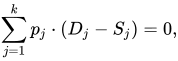
Walras's law is a fundamental principle in general equilibrium theory that establishes a mathematical relationship between market supply and demand across an entire economy. The law asserts that because all economic agents face budget constraints, the total value of excess demand across all markets must equal the total value of excess supply—meaning these values sum to zero. This relationship holds regardless of whether the prevailing prices represent general equilibrium prices. This relationship holds even when individual markets may be in disequilibrium.
The economic intuition underlying Walras's law stems from the fact that all economic agents—consumers, firms, and governments—face budget constraints that limit their total expenditures to their available income and wealth. When these individual constraints are aggregated across all agents and markets, they create a system-wide accounting identity: if one market has excess demand (shortage), other markets must have offsetting excess supply (surplus) of equivalent value.
Mathematically, Walras's law is expressed as:
where is the price of good j, and and represent the aggregate demand and supply respectively of good j across all k markets in the economy.


Walras's law is named after the French economist Léon Walras of the University of Lausanne, who formulated the concept in his seminal work Éléments d'économie politique pure (Elements of Pure Economics) published in 1874. However, the underlying economic intuition was expressed earlier, though in a less mathematically rigorous fashion, by John Stuart Mill in his Essays on Some Unsettled Questions of Political Economy (1844).
The specific term "Walras's law" was coined by the Polish-American economist Oskar Lange in 1942 to distinguish this principle from the related but distinct concept of Say's law, which deals with the relationship between production and consumption at the aggregate level.
Walras's law is a consequence of finite budgets. If a consumer spends more on good A then they must spend and therefore demand less of good B, reducing B's price. The sum of the values of excess demands across all markets must equal zero, whether or not the economy is in a general equilibrium. This implies that if positive excess demand exists in one market, negative excess demand must exist in some other market. Thus, if all markets but one are in equilibrium, then that last market must also be in equilibrium.
This last implication is often applied in formal general equilibrium models. In particular, to characterize general equilibrium in a model with m agents and n commodities, a modeler may impose market clearing for n – 1 commodities and "drop the n-th market-clearing condition." In this case, the modeler should include the budget constraints of all m agents (with equality). Imposing the budget constraints for all m agents ensures that Walras's law holds, rendering the n-th market-clearing condition redundant. In other words, suppose there are 100 markets, and someone saw that 99 are in equilibrium, they would know the remaining market must also be in equilibrium without having to look.
Hub AI
Walras's law AI simulator
(@Walras's law_simulator)
Walras's law
Walras's law is a fundamental principle in general equilibrium theory that establishes a mathematical relationship between market supply and demand across an entire economy. The law asserts that because all economic agents face budget constraints, the total value of excess demand across all markets must equal the total value of excess supply—meaning these values sum to zero. This relationship holds regardless of whether the prevailing prices represent general equilibrium prices. This relationship holds even when individual markets may be in disequilibrium.
The economic intuition underlying Walras's law stems from the fact that all economic agents—consumers, firms, and governments—face budget constraints that limit their total expenditures to their available income and wealth. When these individual constraints are aggregated across all agents and markets, they create a system-wide accounting identity: if one market has excess demand (shortage), other markets must have offsetting excess supply (surplus) of equivalent value.
Mathematically, Walras's law is expressed as:
where is the price of good j, and and represent the aggregate demand and supply respectively of good j across all k markets in the economy.
Walras's law is named after the French economist Léon Walras of the University of Lausanne, who formulated the concept in his seminal work Éléments d'économie politique pure (Elements of Pure Economics) published in 1874. However, the underlying economic intuition was expressed earlier, though in a less mathematically rigorous fashion, by John Stuart Mill in his Essays on Some Unsettled Questions of Political Economy (1844).
The specific term "Walras's law" was coined by the Polish-American economist Oskar Lange in 1942 to distinguish this principle from the related but distinct concept of Say's law, which deals with the relationship between production and consumption at the aggregate level.
Walras's law is a consequence of finite budgets. If a consumer spends more on good A then they must spend and therefore demand less of good B, reducing B's price. The sum of the values of excess demands across all markets must equal zero, whether or not the economy is in a general equilibrium. This implies that if positive excess demand exists in one market, negative excess demand must exist in some other market. Thus, if all markets but one are in equilibrium, then that last market must also be in equilibrium.
This last implication is often applied in formal general equilibrium models. In particular, to characterize general equilibrium in a model with m agents and n commodities, a modeler may impose market clearing for n – 1 commodities and "drop the n-th market-clearing condition." In this case, the modeler should include the budget constraints of all m agents (with equality). Imposing the budget constraints for all m agents ensures that Walras's law holds, rendering the n-th market-clearing condition redundant. In other words, suppose there are 100 markets, and someone saw that 99 are in equilibrium, they would know the remaining market must also be in equilibrium without having to look.