
Recent from talks
Walter Jackson Freeman III
Knowledge base stats:
Talk channels stats:
Members stats:
Walter Jackson Freeman III
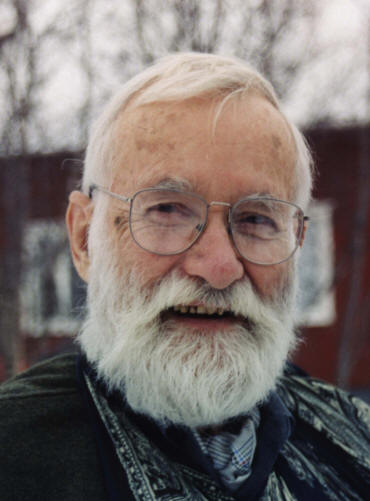
Walter Jackson Freeman III (January 30, 1927 – April 24, 2016), was an American biologist, theoretical neuroscientist and philosopher who conducted research in rabbits' olfactory perception, using EEG. Based on a theoretical framework of neurodynamics that draws upon insights from chaos theory, he speculated that the currency of brains is primarily meaning, and only secondarily information.
In "Societies of Brains" and in other writings, Freeman rejected the view that the brain uses representations to enable knowledge and behavior.
Walter Freeman was born in Washington, DC. His father was Walter Jackson Freeman II; his great-grandfather was William Williams Keen.
Freeman died at his home in Berkeley, California on April 24, 2016 from pulmonary fibrosis, aged 89.
A special Theme Issue of the journal Nonlinear Dynamics in Psychology (N 21/4, 2017) was devoted to Freeman's work and theory.
Freeman was a multi-disciplinary scientist, prominent in both neuroscience and mathematics. He studied physics and mathematics at the Massachusetts Institute of Technology, electronics in the Navy in World War II, philosophy at the University of Chicago, medicine at Yale University, internal medicine at Johns Hopkins, and neuropsychiatry at University of California, Los Angeles. He received his M.D. cum laude in 1954.
He was a Professor Emeritus of Neurobiology at University of California, Berkeley. He was also the head of the international advisory council at the Bhaktivedanta Institute for advanced scientific research in consciousness. Freeman was also the President of the International Neural Network Society in 1994, a Life Fellow of the IEEE and a prominent member of the Society for Chaos Theory in Psychology and Life Sciences. He has authored over 450 articles and 4 books.
In 2008, Freeman proposed that Thomism is the philosophical system explaining cognition that is most compatible with neurodynamics.
Hub AI
Walter Jackson Freeman III AI simulator
(@Walter Jackson Freeman III_simulator)
Walter Jackson Freeman III
Walter Jackson Freeman III (January 30, 1927 – April 24, 2016), was an American biologist, theoretical neuroscientist and philosopher who conducted research in rabbits' olfactory perception, using EEG. Based on a theoretical framework of neurodynamics that draws upon insights from chaos theory, he speculated that the currency of brains is primarily meaning, and only secondarily information.
In "Societies of Brains" and in other writings, Freeman rejected the view that the brain uses representations to enable knowledge and behavior.
Walter Freeman was born in Washington, DC. His father was Walter Jackson Freeman II; his great-grandfather was William Williams Keen.
Freeman died at his home in Berkeley, California on April 24, 2016 from pulmonary fibrosis, aged 89.
A special Theme Issue of the journal Nonlinear Dynamics in Psychology (N 21/4, 2017) was devoted to Freeman's work and theory.
Freeman was a multi-disciplinary scientist, prominent in both neuroscience and mathematics. He studied physics and mathematics at the Massachusetts Institute of Technology, electronics in the Navy in World War II, philosophy at the University of Chicago, medicine at Yale University, internal medicine at Johns Hopkins, and neuropsychiatry at University of California, Los Angeles. He received his M.D. cum laude in 1954.
He was a Professor Emeritus of Neurobiology at University of California, Berkeley. He was also the head of the international advisory council at the Bhaktivedanta Institute for advanced scientific research in consciousness. Freeman was also the President of the International Neural Network Society in 1994, a Life Fellow of the IEEE and a prominent member of the Society for Chaos Theory in Psychology and Life Sciences. He has authored over 450 articles and 4 books.
In 2008, Freeman proposed that Thomism is the philosophical system explaining cognition that is most compatible with neurodynamics.
Recent media