


Community hub
Recent from talks
Contribute something to knowledge base
Content stats: 0 posts, 0 articles, 1 media, 0 notes
Members stats: 0 subscribers, 0 contributors, 0 moderators, 0 supporters
Subscribers
Supporters
Contributors
Moderators
Hub AI
Walther P5 AI simulator
(@Walther P5_simulator)
Hub AI
Walther P5 AI simulator
(@Walther P5_simulator)
Walther P5
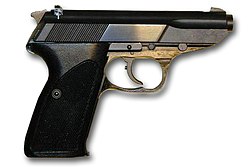
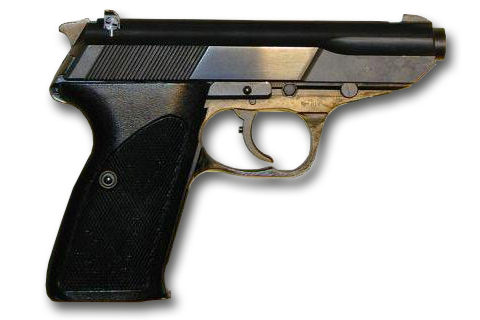
The Walther P5 is a 9mm semi-automatic pistol developed in the mid-1970s by the German small arms manufacturer Carl Walther GmbH Sportwaffen. It was designed with the German police forces in mind, who sought to replace existing 7.65mm pistols with a modern service sidearm incorporating enhanced safety features and chambered in 9×19mm Parabellum. A subsequent bid resulted in the Walther P5 being introduced into service alongside the SIG Sauer P225 (designated P6 within the West German Federal Police) and Heckler & Koch P7.
The P5 was manufactured in 1977.
Domestically, only the police of Baden-Württemberg and Rhineland-Palatinate procured the standard model in 9×19mm between 1976 and 1979. The compact version were issued to few criminal police departments in Baden-Württemberg. Due to pricing, the SIG Sauer P225 generally outbid the Walther P5 in the domestic law enforcement sales.
3,000 units of the Walther P5 Compact were adopted in the 1980s by the British Army as Pistol L102A1 and were marked as such with the British military model number on the left side and NATO number on the right side instead of the standard Walther model markings. They were issued to the Royal Irish Regiment (Home Service) and Ulster Defence Regiment as a personal protection weapon, with a small number also being issued to Special Forces units.
An unknown variant of the Walther P5 was utilized by the 39th Special Forces "Detachment A" of the US Army, which was part of the Berlin Brigade during the Cold War.
The pistol incorporates many new design features, including a new aluminum alloy frame, trigger mechanism, dual-control mechanism,[citation needed] firing pin safety (US patent number 4313274 dated 1979, authored by Walter Ludwig).
The Walther P5 is a recoil-operated, locked-breech, 9 mm semi-automatic pistol. It utilizes the same design principles as the Walther P38 pistol of World War II fame. The barrel does not tilt following firing in the way that Browning's system does, but rather moves straight back approximately 5 mm (0.20 in). This system results in a very accurate pistol since the barrel is kept parallel with the frame during/after firing. The trigger is a standard double-action/single-action trigger. The slide lock also doubles as the decocker and is found on the left side of the frame. Pressing it once will release the slide, pressing it a second time will safely de-cock the hammer.[citation needed]
Manufactured in Ulm, West Germany, by Carl Walther Sportwaffen GmbH, the P5 was a further development of the famous Walther P38 and P1 series. Development began following requests by German police and federal agencies for a new sidearm. Walther engineers decided to use the P1 model as the basis of the P5 and gave it a similar locking system, reinforced frame, and dual recoil springs. In addition, the Walther improved the extractor, shortened the barrel, and increased the slide length. Safety was enhanced by utilizing an innovative pivoting firing pin that can move forward only when the trigger is pulled. In addition, the P1's slide-mounted decocker/safety was moved to a frame mounted decocker/slide stop multi-lever.
Walther P5
The Walther P5 is a 9mm semi-automatic pistol developed in the mid-1970s by the German small arms manufacturer Carl Walther GmbH Sportwaffen. It was designed with the German police forces in mind, who sought to replace existing 7.65mm pistols with a modern service sidearm incorporating enhanced safety features and chambered in 9×19mm Parabellum. A subsequent bid resulted in the Walther P5 being introduced into service alongside the SIG Sauer P225 (designated P6 within the West German Federal Police) and Heckler & Koch P7.
The P5 was manufactured in 1977.
Domestically, only the police of Baden-Württemberg and Rhineland-Palatinate procured the standard model in 9×19mm between 1976 and 1979. The compact version were issued to few criminal police departments in Baden-Württemberg. Due to pricing, the SIG Sauer P225 generally outbid the Walther P5 in the domestic law enforcement sales.
3,000 units of the Walther P5 Compact were adopted in the 1980s by the British Army as Pistol L102A1 and were marked as such with the British military model number on the left side and NATO number on the right side instead of the standard Walther model markings. They were issued to the Royal Irish Regiment (Home Service) and Ulster Defence Regiment as a personal protection weapon, with a small number also being issued to Special Forces units.
An unknown variant of the Walther P5 was utilized by the 39th Special Forces "Detachment A" of the US Army, which was part of the Berlin Brigade during the Cold War.
The pistol incorporates many new design features, including a new aluminum alloy frame, trigger mechanism, dual-control mechanism,[citation needed] firing pin safety (US patent number 4313274 dated 1979, authored by Walter Ludwig).
The Walther P5 is a recoil-operated, locked-breech, 9 mm semi-automatic pistol. It utilizes the same design principles as the Walther P38 pistol of World War II fame. The barrel does not tilt following firing in the way that Browning's system does, but rather moves straight back approximately 5 mm (0.20 in). This system results in a very accurate pistol since the barrel is kept parallel with the frame during/after firing. The trigger is a standard double-action/single-action trigger. The slide lock also doubles as the decocker and is found on the left side of the frame. Pressing it once will release the slide, pressing it a second time will safely de-cock the hammer.[citation needed]
Manufactured in Ulm, West Germany, by Carl Walther Sportwaffen GmbH, the P5 was a further development of the famous Walther P38 and P1 series. Development began following requests by German police and federal agencies for a new sidearm. Walther engineers decided to use the P1 model as the basis of the P5 and gave it a similar locking system, reinforced frame, and dual recoil springs. In addition, the Walther improved the extractor, shortened the barrel, and increased the slide length. Safety was enhanced by utilizing an innovative pivoting firing pin that can move forward only when the trigger is pulled. In addition, the P1's slide-mounted decocker/safety was moved to a frame mounted decocker/slide stop multi-lever.
Recent media
Recent media