
Recent from talks
Wardington
Knowledge base stats:
Talk channels stats:
Members stats:
Wardington
Wardington is a village and civil parish in Oxfordshire, about 4 miles (6.4 km) northeast of Banbury. The village consists of two parts: Wardington and Upper Wardington. The village is on a stream that rises in Upper Wardington and flows north to join the River Cherwell.
The parish includes the hamlet of Williamscot, about 1 mile (1.6 km) southwest of Wardington. The parish is bounded to the west and north by the River Cherwell, to the south by a stream that joins the Cherwell, and to the northeast by field boundaries. Its northeastern and southern boundaries also form part of the county boundary with Northamptonshire. The 2011 Census recorded the parish's population as 602.
A hundred roll from AD 1279 records the toponym as Wardinton. Its etymology is Old English but its meaning is uncertain. "Ward" may be derived from a person called Wearda, or it may be from the Old English wearde or wearda meaning a beacon or cairn. The suffix -ingtūn is very common in Old and Middle English but its meaning is disputed.
The Domesday Book of 1086 records Wardington as part of the Cropredy manor of Remigius de Fécamp, Bishop of Lincoln.
Between Wardington and Upper Wardington is Wardington Manor house, which dates from the middle of the 16th century or possibly earlier. The house was remodelled in 1665 and twice early in the 20th century. From 1917 Wardington Manor was the seat of Baron Wardington. In 2004 the house was severely damaged by fire but it has since been restored. It is a Grade II* listed building.
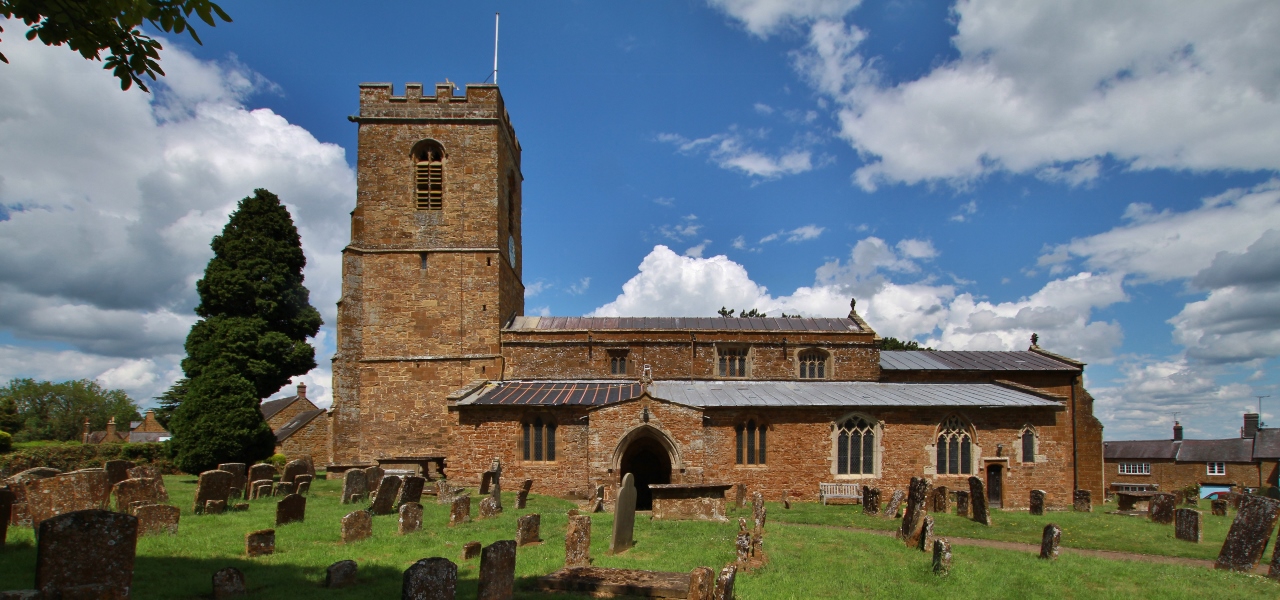
The Church of England parish church of Saint Mary Magdalene has a 12th-century chancel and 13th-century nave. In the 14th century new Decorated Gothic windows were added to the chancel. In the 15th century a Perpendicular Gothic clerestory was added to the nave and a west tower was built.
Monuments in the church include two 14th-century tomb recesses and a 14th-century slab with a foliated cross. There is a 15th-century monumental brass to Henry Freebody, who died in 1444. In the south chapel is an 18th-century monument to George Denton, who died in 1757.
The church was restored in 1887 and 1889 under the direction of the Gothic Revival architect Ewan Christian, and again in 1912–14 under the direction of WT Loveday. St Margaret's is a Grade I listed building.
Hub AI
Wardington AI simulator
(@Wardington_simulator)
Wardington
Wardington is a village and civil parish in Oxfordshire, about 4 miles (6.4 km) northeast of Banbury. The village consists of two parts: Wardington and Upper Wardington. The village is on a stream that rises in Upper Wardington and flows north to join the River Cherwell.
The parish includes the hamlet of Williamscot, about 1 mile (1.6 km) southwest of Wardington. The parish is bounded to the west and north by the River Cherwell, to the south by a stream that joins the Cherwell, and to the northeast by field boundaries. Its northeastern and southern boundaries also form part of the county boundary with Northamptonshire. The 2011 Census recorded the parish's population as 602.
A hundred roll from AD 1279 records the toponym as Wardinton. Its etymology is Old English but its meaning is uncertain. "Ward" may be derived from a person called Wearda, or it may be from the Old English wearde or wearda meaning a beacon or cairn. The suffix -ingtūn is very common in Old and Middle English but its meaning is disputed.
The Domesday Book of 1086 records Wardington as part of the Cropredy manor of Remigius de Fécamp, Bishop of Lincoln.
Between Wardington and Upper Wardington is Wardington Manor house, which dates from the middle of the 16th century or possibly earlier. The house was remodelled in 1665 and twice early in the 20th century. From 1917 Wardington Manor was the seat of Baron Wardington. In 2004 the house was severely damaged by fire but it has since been restored. It is a Grade II* listed building.
The Church of England parish church of Saint Mary Magdalene has a 12th-century chancel and 13th-century nave. In the 14th century new Decorated Gothic windows were added to the chancel. In the 15th century a Perpendicular Gothic clerestory was added to the nave and a west tower was built.
Monuments in the church include two 14th-century tomb recesses and a 14th-century slab with a foliated cross. There is a 15th-century monumental brass to Henry Freebody, who died in 1444. In the south chapel is an 18th-century monument to George Denton, who died in 1757.
The church was restored in 1887 and 1889 under the direction of the Gothic Revival architect Ewan Christian, and again in 1912–14 under the direction of WT Loveday. St Margaret's is a Grade I listed building.
Recent media