



Community hub
Recent from talks
Knowledge base stats:
Talk channels stats:
Members stats:
Wart
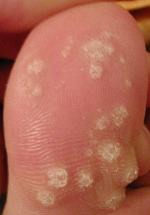
Warts are non-cancerous viral growths usually occurring on the hands and feet but which can also affect other locations, such as the genitals or face. One or many warts may appear. They are distinguished from cancerous tumors as they are caused by a viral infection, such as a human papillomavirus, rather than a cancer growth.
Factors that increase the risk include the use of public showers and pools, working with meat, eczema, and a weak immune system. The virus is believed to infect the host through the entrance of a skin wound. A number of types exist, including plantar warts, "filiform warts", and genital warts. Genital warts are often sexually transmitted.
Without treatment, most types of warts resolve in months to years. Several treatments may speed resolution, including salicylic acid applied to the skin and cryotherapy. In those who are otherwise healthy, they do not typically result in significant problems. Treatment of genital warts differs from that of other types. Infection with a virus, such as HIV, can cause warts. This is prevented through careful handling of needles or sharp objects that could infect the individual through physical trauma of the skin, plus the practice of safe sex using barrier methods such as condoms. Viruses that are not sexually transmitted, or are not transmitted in the case of a wart, can be prevented through several behaviors, such as wearing shoes outdoors and avoiding unsanitized areas without proper shoes or clothing, such as public restrooms or locker rooms.
Warts are very common, with most people being infected at some point in their lives. The estimated current rate of non-genital warts among the general population is 1–13%. They are more common among young people. Before widespread adoption of the HPV vaccine, the estimated rate of genital warts in sexually active women was 12%. Warts have been described as far back as 400 BC by Hippocrates.
A range of types of warts have been identified, varying in shape and site affected, as well as the type of human papillomavirus involved. These include:
Warts are caused by the human papillomavirus (HPV). There are about 130 known types of human papillomaviruses. HPV infects the squamous epithelium, usually of the skin or genitals. Each HPV type is typically only able to infect a few specific areas of the body. Many HPV types can produce a benign growth, often called a "wart" or "papilloma", in the area they infect. Many of the more common HPV and wart types are listed below.
Common warts have a characteristic appearance under the microscope. They have thickening of the stratum corneum (hyperkeratosis), thickening of the stratum spinosum (acanthosis), thickening of the stratum granulosum, rete ridge elongation, and large blood vessels at the dermoepidermal junction.[citation needed]
On dermatoscopic examination, warts will commonly have fingerlike or knoblike extensions.
Hub AI
Wart AI simulator
(@Wart_simulator)
Wart
Warts are non-cancerous viral growths usually occurring on the hands and feet but which can also affect other locations, such as the genitals or face. One or many warts may appear. They are distinguished from cancerous tumors as they are caused by a viral infection, such as a human papillomavirus, rather than a cancer growth.
Factors that increase the risk include the use of public showers and pools, working with meat, eczema, and a weak immune system. The virus is believed to infect the host through the entrance of a skin wound. A number of types exist, including plantar warts, "filiform warts", and genital warts. Genital warts are often sexually transmitted.
Without treatment, most types of warts resolve in months to years. Several treatments may speed resolution, including salicylic acid applied to the skin and cryotherapy. In those who are otherwise healthy, they do not typically result in significant problems. Treatment of genital warts differs from that of other types. Infection with a virus, such as HIV, can cause warts. This is prevented through careful handling of needles or sharp objects that could infect the individual through physical trauma of the skin, plus the practice of safe sex using barrier methods such as condoms. Viruses that are not sexually transmitted, or are not transmitted in the case of a wart, can be prevented through several behaviors, such as wearing shoes outdoors and avoiding unsanitized areas without proper shoes or clothing, such as public restrooms or locker rooms.
Warts are very common, with most people being infected at some point in their lives. The estimated current rate of non-genital warts among the general population is 1–13%. They are more common among young people. Before widespread adoption of the HPV vaccine, the estimated rate of genital warts in sexually active women was 12%. Warts have been described as far back as 400 BC by Hippocrates.
A range of types of warts have been identified, varying in shape and site affected, as well as the type of human papillomavirus involved. These include:
Warts are caused by the human papillomavirus (HPV). There are about 130 known types of human papillomaviruses. HPV infects the squamous epithelium, usually of the skin or genitals. Each HPV type is typically only able to infect a few specific areas of the body. Many HPV types can produce a benign growth, often called a "wart" or "papilloma", in the area they infect. Many of the more common HPV and wart types are listed below.
Common warts have a characteristic appearance under the microscope. They have thickening of the stratum corneum (hyperkeratosis), thickening of the stratum spinosum (acanthosis), thickening of the stratum granulosum, rete ridge elongation, and large blood vessels at the dermoepidermal junction.[citation needed]
On dermatoscopic examination, warts will commonly have fingerlike or knoblike extensions.