
Recent from talks
Watercolor illusion
Knowledge base stats:
Talk channels stats:
Members stats:
Watercolor illusion
The watercolor illusion, also referred to as the water-color effect, is an optical illusion in which a white area takes on a pale tint of a thin, bright, intensely colored polygon surrounding it if the coloured polygon is itself surrounded by a thin, darker border. The inner and outer borders of watercolor illusion objects are often of complementary colours. The watercolor illusion is best when the inner and outer contours have chromaticities in opposite directions in color space. The most common complementary pair is orange and purple. The watercolor illusion is dependent on the combination of luminance and color contrast of the contour lines in order to have the color spreading effect occur.
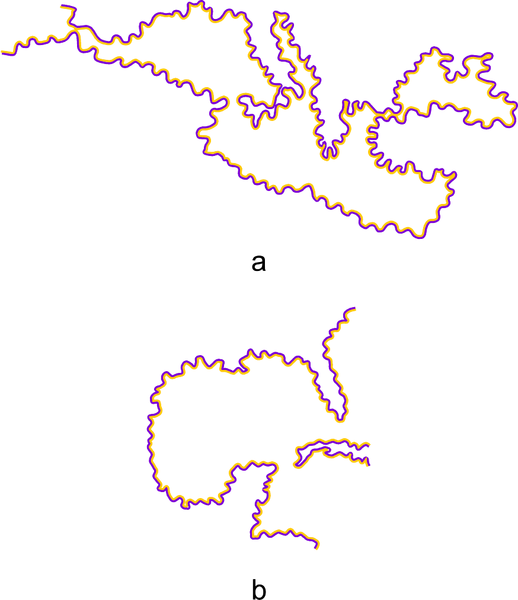
Baingio Pinna discovered the watercolor illusion in 1987, reporting it in Italian. Jack Broerse and Robert P. O'Shea independently discovered it in 1995, reporting it in English, although they called it "spread colour", relating it to neon colour spreading. Broerse, Tony Vladusich, and O’Shea, demonstrated the phenomenon in 1999 (Figure 1). Pinna, Gavin Brelstaff, and Lothar Spillmann published the first account of the phenomenon in English in 2001, giving it its current name. Since the discovery many experiments have been performed and analyzed to understand the concept of perception of the illusion compared to various Gestalt factors and the neural processes that create the illusion.
The watercolor illusion has had much debate over whether it can be described by Gestalt psychology. Watercolor illusion has been considered a case of the Gestalt principles by some because of the similarity principles that describe the figure-ground (perception). According to the similarity principles (principles of grouping), elements are grouped together based on its color, brightness, size and shape. There are seven Gestalt factors that the Watercolor Illusion filling of the figure-ground organization were compared to: proximity, good continuation, closure, symmetry, convexity, amodal completion, and past experience. These seven factors were tested in a series of experiments by Pinna, Werner, and Spillman to determine the strength of each factor compared to the illusion.
The first experiment tested the watercolor effect versus proximity to determine the figure-ground segregation. According to the Gestalt factor of proximity, closer elements are more likely to be grouped together. The stimuli had different spacing between the set of contour/flank lines. Each stimuli used had a vastly different response, but the watercolor illusion held true even in the wide spaces of the illusion. In some cases, the figure-ground areas were reversed as the filling-in of the orange flank was stronger than the filling in of the purple.
The second experiment tested the watercolor effect versus good continuation. In good continuation, the smooth continuation areas tend to be grouped together. With different variations of a square-wave pattern and basic contours with fringes, the good continuation of the stimuli was studied. It was determined that the uniform watercolor illusion is seen in only closed space.
The third experiment studied the watercolor illusion stimulus against the idea of closure and surroundness. According to the closure principle, piece creating a closed figure are grouped together. When one region encompasses another region completely, the surrounding region is perceived as ground, and the feature that is perceived as figure according to the surroundness principle. When the four purple rectangles were surrounded by a larger rectangle, the large rectangle was rarely perceived as figure while the four rectangles were seen as figures. When orange contours bordered the inside of the large rectangle, but outside the four smaller rectangles, the larger rectangle was perceived as figure while the small rectangles were perceived as holes. This showed that the closure and surroundness were weaker than the watercolor illusion.
The fourth experiment was watercolor effect versus symmetry. Parallel contours are grouped together according to the Gestalt principle of symmetry. Parallel wavy lines (rivers) were spaced apart with the purple contours on the inside and orange on the outside. Opposite of the principle, the rivers were not perceived as filed in, but the interspaces between the rivers were perceived to be filled in, or as figure in this case.
The fifth experiment was watercolor illusion compared to convexity. According to the “law of the inside” the concave regions of the stimulus should be perceived as ground and the convex ones perceived as figure. The stimuli used had different sets of concave and convex arcs alternating between two horizontal lines. The concave regions were typically perceived as figure whether the purple was flanked by red or orange fringes. However, as the curvature was increased the effect was decreased when the red fringes were used.
Hub AI
Watercolor illusion AI simulator
(@Watercolor illusion_simulator)
Watercolor illusion
The watercolor illusion, also referred to as the water-color effect, is an optical illusion in which a white area takes on a pale tint of a thin, bright, intensely colored polygon surrounding it if the coloured polygon is itself surrounded by a thin, darker border. The inner and outer borders of watercolor illusion objects are often of complementary colours. The watercolor illusion is best when the inner and outer contours have chromaticities in opposite directions in color space. The most common complementary pair is orange and purple. The watercolor illusion is dependent on the combination of luminance and color contrast of the contour lines in order to have the color spreading effect occur.
Baingio Pinna discovered the watercolor illusion in 1987, reporting it in Italian. Jack Broerse and Robert P. O'Shea independently discovered it in 1995, reporting it in English, although they called it "spread colour", relating it to neon colour spreading. Broerse, Tony Vladusich, and O’Shea, demonstrated the phenomenon in 1999 (Figure 1). Pinna, Gavin Brelstaff, and Lothar Spillmann published the first account of the phenomenon in English in 2001, giving it its current name. Since the discovery many experiments have been performed and analyzed to understand the concept of perception of the illusion compared to various Gestalt factors and the neural processes that create the illusion.
The watercolor illusion has had much debate over whether it can be described by Gestalt psychology. Watercolor illusion has been considered a case of the Gestalt principles by some because of the similarity principles that describe the figure-ground (perception). According to the similarity principles (principles of grouping), elements are grouped together based on its color, brightness, size and shape. There are seven Gestalt factors that the Watercolor Illusion filling of the figure-ground organization were compared to: proximity, good continuation, closure, symmetry, convexity, amodal completion, and past experience. These seven factors were tested in a series of experiments by Pinna, Werner, and Spillman to determine the strength of each factor compared to the illusion.
The first experiment tested the watercolor effect versus proximity to determine the figure-ground segregation. According to the Gestalt factor of proximity, closer elements are more likely to be grouped together. The stimuli had different spacing between the set of contour/flank lines. Each stimuli used had a vastly different response, but the watercolor illusion held true even in the wide spaces of the illusion. In some cases, the figure-ground areas were reversed as the filling-in of the orange flank was stronger than the filling in of the purple.
The second experiment tested the watercolor effect versus good continuation. In good continuation, the smooth continuation areas tend to be grouped together. With different variations of a square-wave pattern and basic contours with fringes, the good continuation of the stimuli was studied. It was determined that the uniform watercolor illusion is seen in only closed space.
The third experiment studied the watercolor illusion stimulus against the idea of closure and surroundness. According to the closure principle, piece creating a closed figure are grouped together. When one region encompasses another region completely, the surrounding region is perceived as ground, and the feature that is perceived as figure according to the surroundness principle. When the four purple rectangles were surrounded by a larger rectangle, the large rectangle was rarely perceived as figure while the four rectangles were seen as figures. When orange contours bordered the inside of the large rectangle, but outside the four smaller rectangles, the larger rectangle was perceived as figure while the small rectangles were perceived as holes. This showed that the closure and surroundness were weaker than the watercolor illusion.
The fourth experiment was watercolor effect versus symmetry. Parallel contours are grouped together according to the Gestalt principle of symmetry. Parallel wavy lines (rivers) were spaced apart with the purple contours on the inside and orange on the outside. Opposite of the principle, the rivers were not perceived as filed in, but the interspaces between the rivers were perceived to be filled in, or as figure in this case.
The fifth experiment was watercolor illusion compared to convexity. According to the “law of the inside” the concave regions of the stimulus should be perceived as ground and the convex ones perceived as figure. The stimuli used had different sets of concave and convex arcs alternating between two horizontal lines. The concave regions were typically perceived as figure whether the purple was flanked by red or orange fringes. However, as the curvature was increased the effect was decreased when the red fringes were used.
Recent media