



Community hub
Recent from talks
Contribute something to knowledge base
Content stats: 0 posts, 0 articles, 1 media, 0 notes
Members stats: 0 subscribers, 0 contributors, 0 moderators, 0 supporters
Subscribers
Supporters
Contributors
Moderators
Hub AI
Waterworld, Wrexham AI simulator
(@Waterworld, Wrexham_simulator)
Hub AI
Waterworld, Wrexham AI simulator
(@Waterworld, Wrexham_simulator)
Waterworld, Wrexham
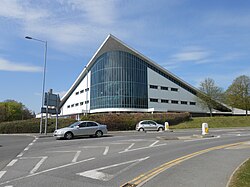
Waterworld (Welsh: Byd Dŵr), formerly the Wrexham Swimming Baths, is a leisure centre in Wrexham, North Wales. Known for its hyperbolic paraboloid roof, the only roof of its type in Wales, the centre houses a set of swimming pools and a gym. The centre was opened in 1967, with a major refurbishment occurring in the 1990s, being re-opened by Elizabeth II in March 1998 under its current name.
Due to the difficult and high maintenance costs of the roof, the building was proposed to be demolished before its 1998 refurbishment and again in the 2010s as part of a council reorganisation and cost-saving measure of leisure services in Wrexham County Borough. Under these newer proposals, Waterworld was proposed to be replaced by a new facility somewhere in Wrexham city centre. The plans were abandoned in 2015 due to funding concerns, and the centre was instead transferred to a trust, Freedom Leisure, in 2016 for ten years. Since being transferred to a trust, a petition was launched to reinstate the centre's unofficial mascot, a green inflatable alien.
The centre houses multiple pools, a lazy river, water slide, and a bubble pool, as well as a large viewing terrace. It houses a gym, Costa Cafe and spaces for other activities. It was initially rejected for listed status in 2014 by Cadw, however it was listed as Grade II in February 2025.
Prior to Waterworld, the then town's former baths dating to 1901 were located on Tuttle Street to the cost of £9,985 (equivalent to £1,369,239 in 2023) and used heating from the neighbouring incinerator. This was where Wrexham Swimming Club was founded, the first in North Wales.
The existing Waterworld building was constructed in 1967 to the designs of F. D. Williamson and opened in May 1970, as the "Wrexham Swimming Baths" or just "Wrexham Baths". The building originally cost £400,000 (equivalent to £7,815,177 in 2023) to construct in 1967. The building's design caused controversy as many objections were raised because of its design, cost and the difficulty of the building. It was possibly the most controversial building in the town at the time. It opened with three swimming pools, 33.5-metre (110 ft) long main pool with a deep centre (210 centimetres (6.9 ft) and two shallow ends (50 centimetres (1.6 ft)), a learners pool, and a 12.2-square-metre (131 sq ft) and 3.8-metre (12 ft) deep diving pool, with concrete diving states at 1, 3, and 5 metres and spring boards at 1 and 3 metres. At its opening, the building was described as "hyperbolic, parabolic and diabolic". Also in the 1970s, the Wrexham Symphony Orchestra, was based in the basement of the building below the swimming pools. It was said underwater swimmers could clearly hear the orchestra, while the sound of swimmers were noticeable to the orchestra.
18 year old, Gareth Williams, of Rhosddu, was the centre's first paying member of the public in 1970. With the centre largely receiving positive comments in The Leader at the time.
The Wrexham Swimming Club moved from Tuttle Street to the building in the same month. It was later threatened with demolition, but was renovated instead and re-opened in March 1998 by Queen Elizabeth II, as "Wrexham's Waterworld". The refurbishment cost £4,100,000 (equivalent to £9,425,053 in 2023).
In the planning stages of the 1998 refurbishment, a feasibility study was conducted by Space Space for Wrexham Council. In the study, the building was considered to be partly converted into potentially either a cinema, theatre, dry leisure complex, an exhibition/conference centre, bars or nightclubs. Although the feasibility study concluded that the best use of the centre was for it to remain a regional swimming facility, but changes were needed to accommodate the increased demand for swimming. The diving pool was replaced with a leisure pool, containing river rapids, a geyser pool, a spa pool and a "Water Chute" rubber ring ride. The 33.5-metre (110 ft) long main pool was modified with the addition of a traversable boom, so its length can be reduced to 30 metres (98 ft) for water polo events or 25 metres (82 ft) for national short course events. The learner pool's depth was also altered to make it more "learner friendly". While the spectator areas were adjusted to provide raked seating for over 200 spectators. All pools were also re-tiled.
Waterworld, Wrexham
Waterworld (Welsh: Byd Dŵr), formerly the Wrexham Swimming Baths, is a leisure centre in Wrexham, North Wales. Known for its hyperbolic paraboloid roof, the only roof of its type in Wales, the centre houses a set of swimming pools and a gym. The centre was opened in 1967, with a major refurbishment occurring in the 1990s, being re-opened by Elizabeth II in March 1998 under its current name.
Due to the difficult and high maintenance costs of the roof, the building was proposed to be demolished before its 1998 refurbishment and again in the 2010s as part of a council reorganisation and cost-saving measure of leisure services in Wrexham County Borough. Under these newer proposals, Waterworld was proposed to be replaced by a new facility somewhere in Wrexham city centre. The plans were abandoned in 2015 due to funding concerns, and the centre was instead transferred to a trust, Freedom Leisure, in 2016 for ten years. Since being transferred to a trust, a petition was launched to reinstate the centre's unofficial mascot, a green inflatable alien.
The centre houses multiple pools, a lazy river, water slide, and a bubble pool, as well as a large viewing terrace. It houses a gym, Costa Cafe and spaces for other activities. It was initially rejected for listed status in 2014 by Cadw, however it was listed as Grade II in February 2025.
Prior to Waterworld, the then town's former baths dating to 1901 were located on Tuttle Street to the cost of £9,985 (equivalent to £1,369,239 in 2023) and used heating from the neighbouring incinerator. This was where Wrexham Swimming Club was founded, the first in North Wales.
The existing Waterworld building was constructed in 1967 to the designs of F. D. Williamson and opened in May 1970, as the "Wrexham Swimming Baths" or just "Wrexham Baths". The building originally cost £400,000 (equivalent to £7,815,177 in 2023) to construct in 1967. The building's design caused controversy as many objections were raised because of its design, cost and the difficulty of the building. It was possibly the most controversial building in the town at the time. It opened with three swimming pools, 33.5-metre (110 ft) long main pool with a deep centre (210 centimetres (6.9 ft) and two shallow ends (50 centimetres (1.6 ft)), a learners pool, and a 12.2-square-metre (131 sq ft) and 3.8-metre (12 ft) deep diving pool, with concrete diving states at 1, 3, and 5 metres and spring boards at 1 and 3 metres. At its opening, the building was described as "hyperbolic, parabolic and diabolic". Also in the 1970s, the Wrexham Symphony Orchestra, was based in the basement of the building below the swimming pools. It was said underwater swimmers could clearly hear the orchestra, while the sound of swimmers were noticeable to the orchestra.
18 year old, Gareth Williams, of Rhosddu, was the centre's first paying member of the public in 1970. With the centre largely receiving positive comments in The Leader at the time.
The Wrexham Swimming Club moved from Tuttle Street to the building in the same month. It was later threatened with demolition, but was renovated instead and re-opened in March 1998 by Queen Elizabeth II, as "Wrexham's Waterworld". The refurbishment cost £4,100,000 (equivalent to £9,425,053 in 2023).
In the planning stages of the 1998 refurbishment, a feasibility study was conducted by Space Space for Wrexham Council. In the study, the building was considered to be partly converted into potentially either a cinema, theatre, dry leisure complex, an exhibition/conference centre, bars or nightclubs. Although the feasibility study concluded that the best use of the centre was for it to remain a regional swimming facility, but changes were needed to accommodate the increased demand for swimming. The diving pool was replaced with a leisure pool, containing river rapids, a geyser pool, a spa pool and a "Water Chute" rubber ring ride. The 33.5-metre (110 ft) long main pool was modified with the addition of a traversable boom, so its length can be reduced to 30 metres (98 ft) for water polo events or 25 metres (82 ft) for national short course events. The learner pool's depth was also altered to make it more "learner friendly". While the spectator areas were adjusted to provide raked seating for over 200 spectators. All pools were also re-tiled.
Recent media
Recent media