
Recent from talks
Watt's linkage
Knowledge base stats:
Talk channels stats:
Members stats:
Watt's linkage
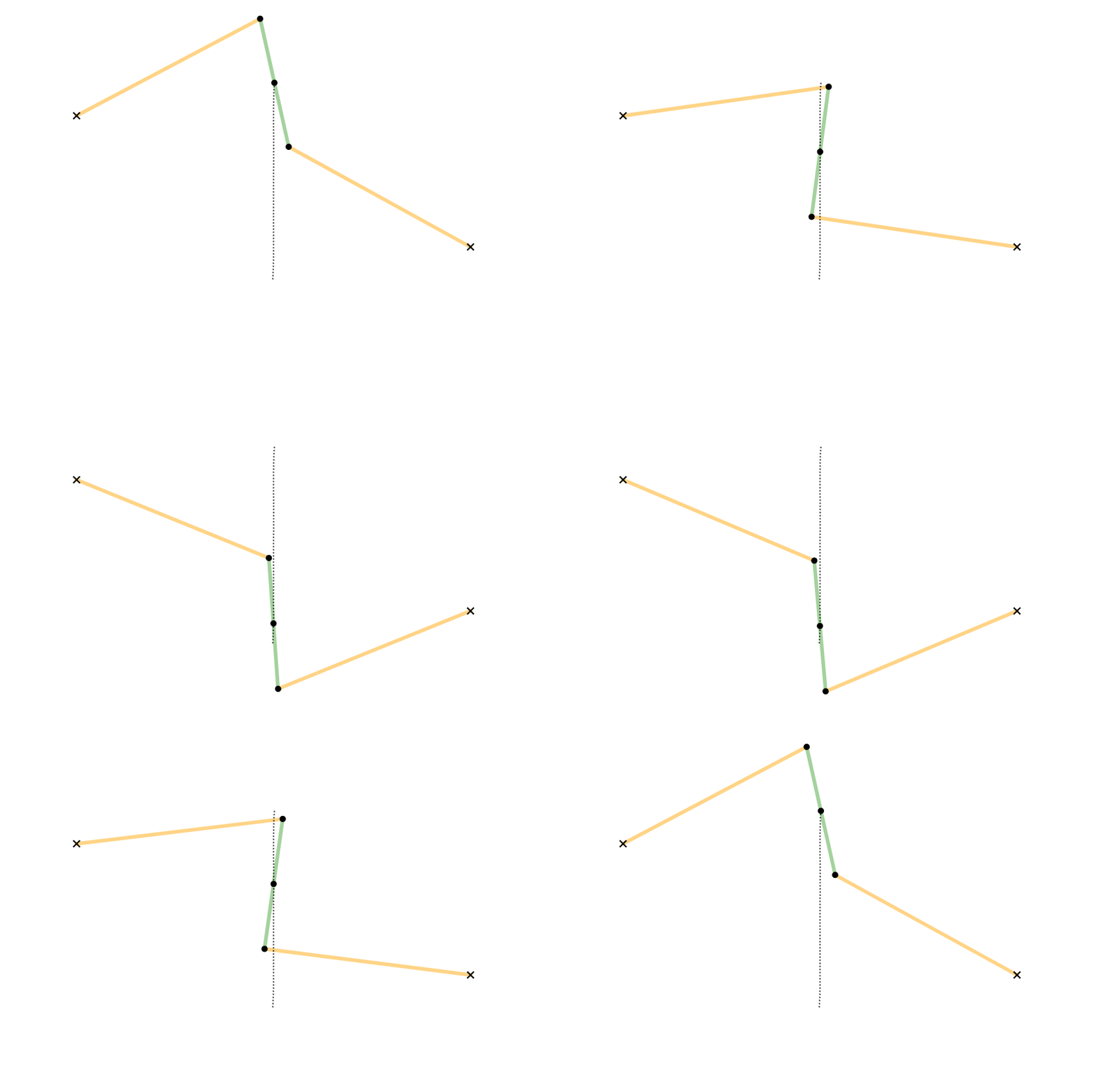
A Watt's linkage is a type of mechanical linkage invented by James Watt in which the central moving point of the linkage is constrained to travel a nearly straight path. Watt described the linkage in his patent specification of 1784 for the Watt steam engine.
Today it is used in automobile suspensions, where it is key to a suspension's kinematics, i.e., its motion properties, constraining the vehicle axle's movement to nearly vertical travel while also limiting horizontal motion.
Watt's linkage consists of three bars bolted together in a chain. The chain of bars consists of two end bars and a middle bar. The middle bar is bolted at each of its ends to one of the ends of each outer bar. The two outer bars are of equal length, and are longer than the middle bar. The three bars can pivot around the two bolts. The outer endpoints of the long bars are fixed in place relative to each other, but otherwise the three bars are free to pivot around the two joints where they meet.
In linkage analysis, there is an imaginary fixed-length bar connecting the outer endpoints. Thus, Watt's linkage is an example of a four-bar linkage.
Its genesis is contained in a letter Watt wrote to Matthew Boulton in June 1784.
I have got a glimpse of a method of causing a piston rod to move up and down perpendicularly by only fixing it to a piece of iron upon the beam, without chains or perpendicular guides [...] and one of the most ingenious simple pieces of mechanics I have invented.
The context of Watt's innovation has been described by C. G. Gibson:
This type of linkage is one of several types described in Watt's 28 April 1784 patent specification. However, in his letter to Boulton he was actually describing a development of the linkage which was not included in the patent. The slightly later design, called a parallel motion linkage, led to a more convenient space-saving design which was actually used in his reciprocating, and his rotary, beam engines.
Hub AI
Watt's linkage AI simulator
(@Watt's linkage_simulator)
Watt's linkage
A Watt's linkage is a type of mechanical linkage invented by James Watt in which the central moving point of the linkage is constrained to travel a nearly straight path. Watt described the linkage in his patent specification of 1784 for the Watt steam engine.
Today it is used in automobile suspensions, where it is key to a suspension's kinematics, i.e., its motion properties, constraining the vehicle axle's movement to nearly vertical travel while also limiting horizontal motion.
Watt's linkage consists of three bars bolted together in a chain. The chain of bars consists of two end bars and a middle bar. The middle bar is bolted at each of its ends to one of the ends of each outer bar. The two outer bars are of equal length, and are longer than the middle bar. The three bars can pivot around the two bolts. The outer endpoints of the long bars are fixed in place relative to each other, but otherwise the three bars are free to pivot around the two joints where they meet.
In linkage analysis, there is an imaginary fixed-length bar connecting the outer endpoints. Thus, Watt's linkage is an example of a four-bar linkage.
Its genesis is contained in a letter Watt wrote to Matthew Boulton in June 1784.
I have got a glimpse of a method of causing a piston rod to move up and down perpendicularly by only fixing it to a piece of iron upon the beam, without chains or perpendicular guides [...] and one of the most ingenious simple pieces of mechanics I have invented.
The context of Watt's innovation has been described by C. G. Gibson:
This type of linkage is one of several types described in Watt's 28 April 1784 patent specification. However, in his letter to Boulton he was actually describing a development of the linkage which was not included in the patent. The slightly later design, called a parallel motion linkage, led to a more convenient space-saving design which was actually used in his reciprocating, and his rotary, beam engines.
Recent media