Hubbry Logo
Parallel motion linkageParallel motion linkageMain
Open search
Parallel motion linkage
Community hub
Parallel motion linkage
logo
8 pages, 0 posts
0 subscribers
Be the first to start a discussion here.
Parallel motion linkage
from Wikipedia
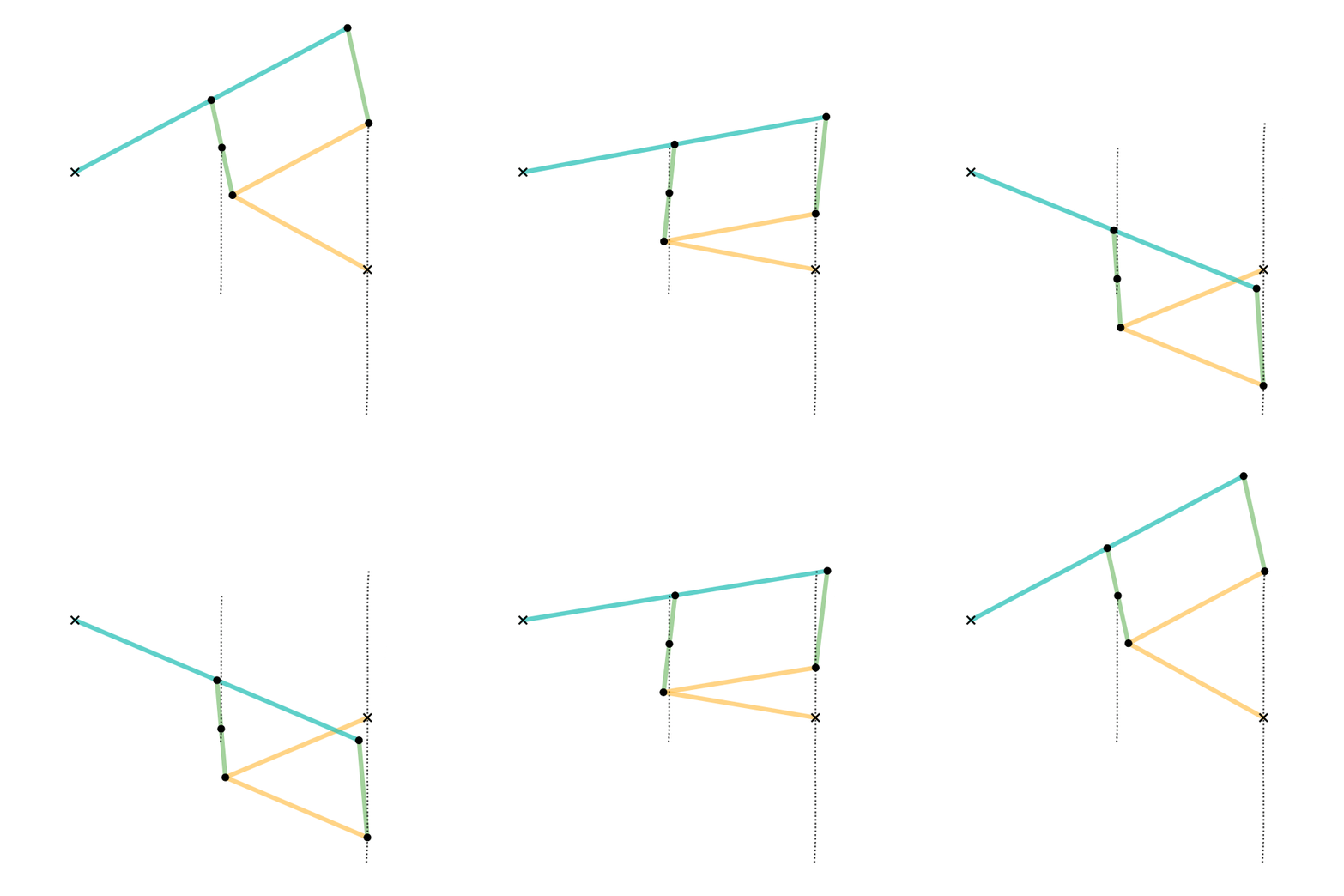
Animation of the parallel motion linkage.
Dimensions (unit lengths a, b):
  Link 2: a + a
  Links 3 & 5: b + b, 2b
  Links 4 & 6: a
Vertical distance between ground joints ≈ 2b
Horizontal distance between ground joints ≈ 2a
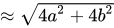
Thus, link 1 (total distance between ground joints)
In kinematics, the parallel motion linkage is a six-bar mechanical linkage invented by the Scottish engineer James Watt in 1784 for the double-acting Watt steam engine. It allows a rod moving practically straight up and down to transmit motion to a beam moving in an arc, without putting significant sideways strain on the rod.

Description

[edit]
Watt's parallel motion on a pumping engine

In previous engines built by Newcomen and Watt, the piston pulled one end of the walking beam downwards during the power stroke using a chain, and the weight of the pump pulled the other end of the beam downwards during the recovery stroke using a second chain, the alternating forces producing the rocking motion of the beam. In Watt's new double-acting engine, the piston produced power on both the upward and downward strokes, so a chain could not be used to transmit the force to the beam. Watt designed the parallel motion to transmit force in both directions whilst keeping the piston rod very close to vertical. He called it "parallel motion" because both the piston and the pump rod were required to move vertically, parallel to one another.

Hand-drawn diagram in James Watt's letter to his son.[1]

In a letter to his son in 1808 describing how he arrived at the design, James Watt wrote "I am more proud of the parallel motion than of any other invention I have ever made."[1] The sketch he included actually shows what is now known as Watt's linkage which was a linkage described in Watt's 1784 patent but it was immediately superseded by the parallel motion.[2]

The parallel motion differed from Watt's linkage by having an additional pantograph linkage incorporated in the design. This did not affect the fundamental principle but it allowed the engine room to be smaller because the linkage was more compact.[2]

The Newcomen engine's piston was propelled downward by the atmospheric pressure. Watt's device allowed live steam to be used for direct work on both sides of the piston, thus almost doubling the power, and also delivering the power more evenly through the cycle, an advantage when converting the reciprocating motion to rotary motion (whether through a crank or through a Sun and planet gear system).

Principle of operation

[edit]
Schematic of Watt's parallel motion: A and G are fixed hinge joints while F is not a joint but merely signifies the point on the linkage which follows a lemniscate. Its motion is magnified in D by the parallelogram ▱BCDE.

See the diagram on the right. A is the journal (bearing) of the walking beam KAC, which rocks up and down about A. H is the piston, which is required to move vertically but not horizontally. The heart of the design is the four-bar linkage consisting of AB, BE and EG and the base link is AG, both joints on the framework of the engine. As the beam rocks, point F (which is drawn to aid this explanation, but is not a marked point on the machine itself) describes an elongated figure-eight (more precisely, a lemniscate of Bernoulli) in mid-air. Since the motion of the walking beam is constrained to a small angle, F describes only a short section of the figure-eight, which is quite close to a vertical straight line. The figure-eight is symmetrical as long as arms AB and EG are equal in length, and straightest when the ratio of BF to FE matches that of AB to EG. If the stroke length (that is, the maximum travel of F) is S, then the straight section is longest when BE is around S and AB is 1.5 S.[3]

It would have been possible to connect F directly to the piston rod (the "Watt's linkage" design), but this would have made the machine an awkward shape, with G a long way from the end of the walking beam. To avoid this, Watt added the parallelogram linkage ▱BCDE to form a pantograph. This guarantees that F always lies on a straight line between A and D, and therefore that the motion of D is a magnified version of the motion of F. D is therefore the point to which the piston rod DH is attached. The addition of the pantograph made the mechanism shorter and so the building containing the engine could be smaller.

As already noted, the path of F is not a perfect straight line, but merely an approximation. Watt's design produced a deviation of about one part in 4000 from a straight line. Later, in the 19th century, perfect straight-line linkages were invented, beginning with the Peaucellier–Lipkin linkage of 1864.

See also

[edit]

References

[edit]

Further reading

[edit]
Revisions and contributorsEdit on WikipediaRead on Wikipedia
from Grokipedia
A parallel motion linkage is a six-bar mechanical linkage invented by the Scottish engineer in 1784 to guide the piston rod of his double-acting in an approximately straight vertical path, ensuring the rod's motion remains parallel to the desired direction without relying on sliding guides. This mechanism represents an extension of Watt's simpler four-bar , which approximates straight-line motion at a coupler point, but the parallel motion version incorporates additional links to connect the piston to the beam while preserving parallelism and reducing side thrust on the walls. Watt regarded the parallel motion as one of his most significant inventions, surpassing even his separate condenser in personal pride, as it enabled efficient double-acting operation in by converting the beam's arcuate motion into near-linear reciprocation using only hinged pin joints, avoiding wear-prone sliding contacts. Introduced in Watt's of and refined in subsequent engines produced by Boulton & Watt, the linkage played a pivotal role in the by improving efficiency and power output, allowing rotary motion via flywheels and crankshafts. Its design, consisting of two parallel rocking arms connected to a central coupler and extended by additional bars to the beam and , traces a path that is straight over a limited range, with the midpoint of the coupler describing the desired line. Beyond steam engines, the parallel motion linkage influenced kinematic synthesis and , inspiring later straight-line generators like the Peaucellier–Lipkin and Hart mechanisms. Principles from this linkage find applications in modern engineering such as parallel manipulators in and suspension systems where parallel translation is required. While not perfectly straight—the path deviates slightly due to the linkage's geometry—the approximation was sufficiently accurate for practical use in 18th-century machinery, demonstrating Watt's empirical approach to before formal kinematic theory emerged.

History

Invention by James Watt

James Watt, a Scottish engineer, first recognized the need for precise straight-line motion in piston rods while repairing and improving Thomas Newcomen's atmospheric around 1763–1765 at the , where he observed the inefficiencies of beam engines used for pumping water from mines. These early engines relied on chains and pivots that caused lateral deviations in the piston's path, limiting their efficiency and applicability to double-acting operations. Over the next two decades, Watt conducted iterative experiments to address these limitations, focusing on guiding the piston rod vertically without excessive friction or wear. In 1775, Watt entered a formal with manufacturer , establishing the Soho Manufactory near Birmingham to produce and refine steam engines commercially. This collaboration provided the resources for extensive testing and prototyping, with Boulton encouraging innovations for rotative applications beyond stationary pumping. By the early , their joint efforts had already yielded significant engine improvements, but the challenge of reliable straight-line guidance persisted, prompting further experimentation in 1783–1784. The parallel motion linkage emerged from this work in mid-1784, when Watt conceived a mechanism to ensure perpendicular motion of the piston using interconnected and pivots, sketching initial designs in his notebooks and corresponding with Boulton. In a letter to Boulton dated June 30, 1784, Watt described his breakthrough: "I have got a glimpse of a method of causing the piston-rod to move up and down perpendicularly… one of the most ingenious simple pieces of mechanisms I have contrived." This invention was patented on April 28, 1784 (British Patent No. 1432), marking a pivotal moment in . Reflecting on it later in an 1808 letter to his son, Watt expressed particular pride: "Though I am not over anxious after fame, yet I am more proud of the parallel motion than of any other mechanical invention I have ever made." The linkage's introduction enabled double-acting steam engines to convert linear piston motion into efficient rotary power, overcoming previous design constraints and facilitating the engines' adaptation for diverse industrial uses. This advancement significantly boosted the reliability and of steam power, contributing to the widespread adoption of mechanized production during the and powering factories, mills, and transportation systems across Britain and beyond. By the early , Boulton & Watt engines incorporating the parallel motion had been installed in over 50 locations in alone, exemplifying its transformative role.

Development and patents

James Watt secured British Patent No. 1432 on April 28, 1784, which encompassed several improvements to fire and steam engines, prominently featuring the parallel motion linkage as a mechanism to guide the piston rod in a straight line, thereby enabling double-acting operation. This patent specification detailed the linkage's configuration as an initial three-bar arrangement derived from combined motions about fixed centers, aimed at enhancing engine efficiency and stability. Following the patent, Watt collaborated closely with at the Manufactory in Birmingham, where they conducted iterative testing and refinements on models of the linkage between 1784 and 1800 to improve manufacturability and integration with rotative engines. Early trials in July 1784 on a large-scale model at demonstrated the linkage's ability to eliminate friction and clumsiness in motion, with Watt noting in correspondence that it provided "a motion derived from a combination of motions about centres." Modifications during this period included halving the original three-bar design and incorporating elements to reduce the required engine house dimensions while maintaining precise guidance. The parallel motion linkage addressed critical rocking motion issues in prior Newcomen-style engines by constraining the piston rod to near-straight vertical travel, preventing lateral deviations that caused wear and inefficiency. Early diagrams illustrating these concepts appear in Watt's personal notebooks from the , depicting preliminary sketches of the linkage's geometry and connections to the beam and . Key milestones included the first successful installations of engines incorporating the linkage, such as the 1785 rotative engine at Samuel Whitbread's London brewery, which featured a 24-inch and 6-foot stroke, marking one of the earliest practical applications. Further deployments followed in 1786–1788, including at Cornish mines and other industrial sites, solidifying its role in transitioning from pumping to rotative power. The expiration of Watt's patents in 1800, including No. 1432, removed legal barriers and spurred widespread adoption of the linkage in designs across Britain and beyond, accelerating industrial mechanization.

Design

Components

The parallel motion linkage consists of two parallel bars, referred to as radius rods or parallel rods, of equal length that connect at one end to fixed pivots on the frame and at the other end to a central coupler link. These rods, labeled typically as DE and BC in historical diagrams, ensure structural integrity while facilitating attachment. The coupler, often denoted as EB and serving as the connecting element, links the ends of the parallel rods and includes a midpoint attachment point for the or piston rod. Additional components encompass the fixed pivots, anchored to the frame at points D and C, and the pin joints or hinges at the connections between the rods and coupler, such as at E and B, which enable articulation with minimal play. These joints, commonly implemented as simple pins, were engineered for low friction to support precise alignment in operation. During James Watt's time in the late 18th century, the primary components were fabricated from for its tensile strength and malleability, allowing forging into the required shapes without brittleness.

Geometry and configuration

The parallel motion linkage is a variant of the four-bar mechanism featuring two arms of equal length pivoted at fixed points on a base, with the free ends connected by a floating coupler link. The fixed pivots, denoted as D and C, anchor the arms DE and BC respectively, while the coupler EB joins the moving joints E and B, allowing planar motion. This arrangement constrains the system to a single degree of freedom, with the moving point typically at the midpoint F of the coupler EB. A fundamental geometric property is the formation created by the equal arm lengths, which ensures that the horizontal displacements at E and B are equal in magnitude but opposite in direction during oscillation. Consequently, the F experiences minimal lateral deviation, tracing an approximate straight line over a limited arc of motion. This property arises from the symmetric configuration, where the arms operate as near-parallel rockers connected by the shorter coupler. In standard proportions, the arms DE and BC each have length LL, with the coupler EB shorter than LL to optimize the straight-line segment; the separation between fixed pivots D and C is often set equal to LL for enhanced parallelism. At the rest position, the arms are angled such that the coupler aligns to the desired path, minimizing initial deviation. Variations include Watt's original chevron-shaped layout, where the arms diverge in a from the pivots, compared to more linear configurations with closer pivot alignment for reduced path in modern adaptations.

Operation

Mechanism of action

The parallel motion linkage functions through a series of interconnected that convert oscillatory input motion into approximate linear output motion at a designated point. As the input arm, driven by a rotating beam or , oscillates about its fixed pivot, the parallel arm responds by mirroring this rotation in the opposite direction due to the symmetric linkage arrangement. This coordinated motion of the arms causes the coupler rod connecting them to translate such that its central attachment point traces a nearly straight vertical path. The ends of the coupler are further connected via two additional to the rod and the engine beam, ensuring the moves in a straight line while remaining parallel to its initial orientation. At its core, the mechanism relies on a constraint formed by the equal lengths of opposite links, which remain parallel throughout the cycle and restrict the coupler's endpoint to a linear over a limited arc. This constraint ensures that horizontal displacements at the pivots of the input and parallel arms are equal in magnitude but opposite in direction, resulting in no net lateral shift at the coupler's midpoint. Visually, the endpoint's path shows minimal deviation from a true straight line within 30 to 45 degrees of input arm rotation, providing a smooth, controlled progression without the oscillatory rocking typical of basic pivot connections. Qualitatively, this design delivers precise guidance to the , minimizing side loads and enhancing operational stability compared to unconstrained linkages.

Kinematic analysis

The parallel motion linkage is a six-bar mechanism whose core straight-line generation is based on a four-bar sub-linkage, consisting of two rockers connected by a coupler, with the endpoint P representing the piston attachment point. The position of P is described by coordinates (x, y), where y \approx L \theta and x \approx 0 for small rotation angles \theta of the input rocker (with \theta measured from the position corresponding to horizontal arms for vertical motion), with L denoting the effective link length. This approximation arises from the symmetric geometry ensuring near-vertical motion of the coupler midpoint. A key metric of performance is the deviation from an ideal straight line, quantified by the equation δx=L2(1cos2θ),\delta x = \frac{L}{2} (1 - \cos 2\theta), which for small \theta approximates \delta x \approx L \theta^2, revealing a quadratic error term that dominates the path nonlinearity. This deviation is derived from trigonometric expansion of the coupler point's x-coordinate using vector loop closure equations in the linkage's configuration. Further analysis shows that the instantaneous center of rotation for the coupler lies at during parallel motion phases, theoretically producing pure along a straight path. However, the actual coupler traces an approximation to a within a broader (figure-eight) shape, with the straight portion emerging from the symmetric constraints on link lengths. Watt's original design, optimized via geometric proportions, achieves less than 1% deviation from straight-line motion over a 60-degree swing of , as confirmed by trigonometric evaluation of the path error.

Applications

Steam engines

The parallel motion linkage was integrated into steam engines by attaching it to the crosshead of the piston rod, ensuring straight-line motion of the piston while the beam or oscillated in an arc, thereby transmitting linear reciprocation to rotary motion through a linked to the . This configuration replaced flexible chains used in earlier single-acting designs, allowing rigid rods to handle forces in both directions without excessive lateral strain on the seals. In steam engines, the linkage enabled the use of double-acting cylinders, where steam pressure acted on both sides of the alternately, producing power during both the forward and return strokes. This innovation roughly doubled the power output compared to single-acting engines, which only utilized one stroke for work, while also providing smoother operation and higher efficiency by minimizing energy losses from misalignment. The design complemented Watt's earlier separate condenser by supporting rotary motion in industrial applications, transforming stationary pumping engines into versatile power sources. From the 1780s, Boulton and Watt engines incorporating the parallel motion linkage powered key sectors of early industry, including factories such as the 1785 rotative engine at Whitbread's Brewery in London, which drove milling operations, and numerous installations in textile mills and ironworks. In mining, it was pivotal in Cornish pumping engines, with the first double-acting version erected at Wheal Towan mine in 1785, and by 1790, 45 such engines were operating in Cornwall to drain deep shafts up to 300 meters. These engines remained dominant until the mid-19th century, fueling the Industrial Revolution by enabling reliable power for factories, mines, and eventually early locomotives, though high-pressure designs began to supplant them by the 1830s.

Other mechanical devices

Beyond its foundational role in steam engines, the parallel motion linkage has been adapted for diverse mechanical applications requiring approximate straight-line motion with minimal deviation. In pantographs and drawing instruments, scaled adaptations of the linkage facilitate the precise copying of motions in engineering drafting. These 19th-century reprographic tools employed variants of Watt's parallel motion mechanism to reproduce original drawings manually, maintaining proportional accuracy without tracing or distortion. Drawing pantographs, which combine the linkage with configurations, allowed for enlargement or reduction of designs while preserving straight-line paths for technical illustrations. In and , the linkage supports parallel manipulators and robots by providing precise linear guidance for end-effectors in assembly lines. A six-bar of Watt's mechanism, for instance, enables repetitive positioning tasks with reduced backlash, enhancing operational efficiency in industrial robotic systems. This application leverages the linkage's kinematic properties to achieve high-speed, accurate translations in confined spaces, common in automated environments. In automotive and general machinery, the parallel motion linkage appears in suspension systems to ensure straight-path transfer. Automotive suspensions utilizing six-bar variants constrain axle movement to a near-vertical line, improving ride stability and handling by limiting lateral and fore-aft shifts. Recent applications include , such as Watt-II six-bar mechanisms in legged deployable systems for reusable launch vehicles, enabling precise during as of 2022.

Comparisons and Evolutions

Versus other linkages

The parallel motion linkage, invented by in 1784, provides an approximate straight-line path using a six-bar configuration, offering a simpler and more cost-effective alternative to exact straight-line mechanisms like the Peaucellier-Lipkin linkage. The Peaucellier-Lipkin linkage, developed in 1864, employs an eight-bar arrangement to generate precise straight-line motion through inversion geometry, but its greater complexity—with additional joints and links—increases manufacturing costs, maintenance requirements, and potential wear from friction, making it less suitable for early industrial applications such as steam engines where Watt's design excelled in affordability and reliability. In comparison to the simple slider-crank mechanism commonly used in reciprocating engines, Watt's parallel motion linkage eliminates significant side forces on the piston rod and avoids the inherent oval deviation in the path, which can cause uneven wear and reduced efficiency in the cylinder. The slider-crank achieves exact linear motion along a guided path but introduces higher friction and lateral thrust, necessitating robust guides and leading to greater energy losses and mechanical stress, whereas Watt's linkage provides smoother operation with minimal sideways strain, enhancing durability in double-acting steam engines without requiring extensive flywheel balancing. Watt's parallel motion predates and influenced later exact mechanisms like Hart's inversor, a introduced in that produces longer precise straight-line paths suitable for extended strokes. Hart's design, based on inversion, overcomes Watt's limitation to short strokes—typically 20-30% of the connecting arm length—where deviations become noticeable, but Watt's simpler empirical geometry made it more practical for 18th- and 19th-century , paving the way for such refinements. A fundamental distinction lies in the parallel motion's reliance on a approximation, where path errors scale approximately as θ⁴ (with θ as the ), yielding high accuracy for small motions but diverging for larger excursions, in contrast to exact inversor methods like those in Peaucellier-Lipkin or Hart's designs that maintain perfect through geometric inversion without such higher-order errors.

Modern adaptations

In contemporary engineering, the parallel motion linkage principle has been integrated into digital simulations and software tools for precise design and analysis. (CAD) software, such as and , enables modeling and motion simulation of configurations to optimize path trajectories and linkage dimensions before physical prototyping. These tools, developed since the , facilitate virtual testing of linkage , reducing design iterations and supporting applications in for complex systems. Modern adaptations often incorporate advanced materials to enhance precision, lightweight performance, and durability. Carbon fiber reinforced polymer (CFRP) has been employed in components for its high strength-to-weight ratio and corrosion resistance, as demonstrated in finite element analysis (FEA) studies evaluating dynamic loading on versus CFRP variants, where CFRP reduces mass while maintaining structural integrity. In applications, such as deployable landing mechanisms for reusable launch vehicles, designs with lightweight composites ensure stable, during high-impact events like . Similarly, in medical devices, servo-actuated joints integrated into prosthetic knees utilize Watt-type six-bar linkages to approximate natural gait linearity, improving stability and energy efficiency for amputees. Hybrid mechatronic designs combine traditional parallel motion linkages with actuators and sensors to achieve enhanced linearity and error correction. In , post-2000 developments integrate servos with Watt's six-bar mechanisms for precise leg motion in walking robots, where feedback sensors adjust paths in real-time to minimize deviations. For instance, systems replicate Watt linkage using flexible materials and embedded actuators to convert rotary to , enabling adaptive gripping in unstructured environments. Finite element analysis optimizes these hybrids by simulating stress distribution and motion accuracy, often achieving path errors below 0.1% through sensor-driven corrections. In surgical , similar servo-linkage integrations provide exact linear tool paths, supporting minimally invasive procedures with sub-millimeter precision. This evolution from purely mechanical to mechatronic systems addresses limitations of historical designs by leveraging sensors and computational control, extending the linkage's utility in high-precision, post-industrial applications like autonomous systems and .

References

Add your contribution
Related Hubs
User Avatar
No comments yet.