



Community hub
Recent from talks
Knowledge base stats:
Talk channels stats:
Members stats:
Watts Naval School
Watts Naval School was originally the Norfolk County School, a boarding school set up to serve the educational needs of the 'sons of farmers and artisans'. The school was later operated by Dr Barnardo's until closure in 1953.
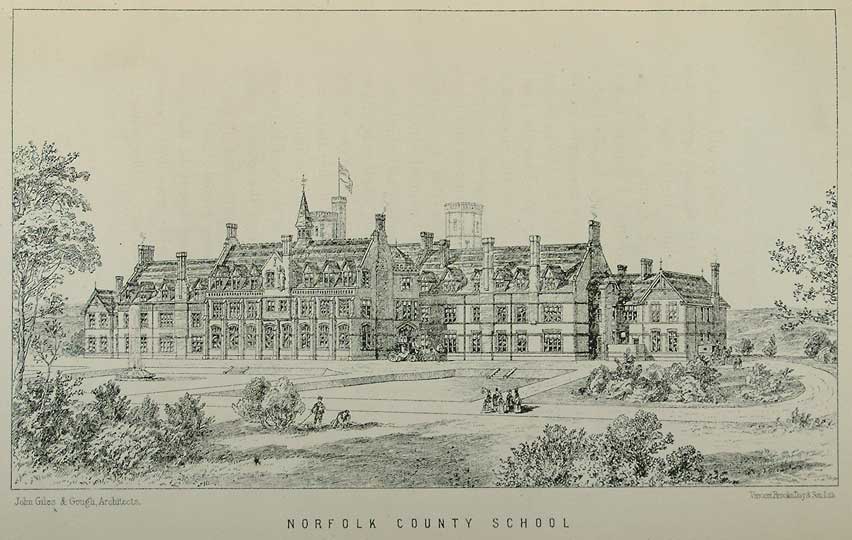
Norfolk County School stood on the summit of a wooded hill with excellent views across the Wensum Valley near the village of North Elmham. It was surrounded by 60 acres (240,000 m2) of land in Bintry parish in the Bintry (or Bintree as it is sometimes written) Hills.
Norfolk County School was a boarding school founded by Prebendary Joseph Lloyd Brereton to serve the educational needs of the sons of farmers & artisans as part of his experiment in County Education. The foundation stone was laid on Easter Monday 1873 by Edward Prince of Wales (later to become King Edward VII). The school opened in 1874. The school also had an open-air swimming pool.
The property consisted of a central building, with a principal's House attached to the north end of the building. A laundry was provided at the south end of the intersection. At the north end of the fifty-four-acre site was a gardener's cottage. The western boundary of the property was marked by the River Wensum, and an open-air 70 ft by 30 ft swimming bath was provided next to the river. A boat house owned by the school also stood on the banks of the river, and a cricket ground was provided on the eastern side of the main building.
A chapel, built of Bath stone, was erected in 1883 and consecrated on 16 October that year. In 1884 Brereton succeeded in getting railway access to the school through the County School railway station built at the foot of the hill. Despite the improved communications, the school roll never reached the 300 for which it was designed, partly as a result of the depression in agriculture.
The school was closed in July 1895. On 4 June 1901 its premises were sold to Edmund Hannay Watts. Following his death, his eldest son, Fenwick Shadforth Watts, had the fabric of the building renovated and furnished, at a cost of several thousand pounds, before handing it over to Dr Barnardo's Homes. As a result, it was turned into a home for up to 300 orphans and destitute boys under the charge of Dr T. J. Barnardo and was opened informally on 9 March 1903. The establishment was then used for the training of selected Barnardo's boys for a life at sea in the Royal Navy or mercantile Marine. The school was opened on 17 April 1906, by Viscount Coke, later Earl of Leicester. It was classified as a Secondary Technical School, with the technical instruction being nautical and with musical training for boys intending on being enlisted in the Royal Marines or other military bands.
The first captain of the school was Commander H. C. Martin, a former captain of the training ship Warspite, working with a staff of fifteen. The rector of Kettlestone was appointed as Honorary Chaplain, and medical care was provided by Dr Rackham from North Elmham. Initially only one hundred boys were sent to the school, with the remaining two hundred arriving in batches of fifty to assist with the establishment of naval discipline.
The building was only slightly altered from its former use as a public school. The central hall was fitted with a heavy glass roof, and a fire escape was added to the eastern side of the building, allowing it to be evacuated within three minutes. Every part of the school was heated with hot water and an acetylene gas supply was installed. The central hall, classrooms, reception rooms and staff rooms were on the ground floor. The first floor was used for staff bedrooms, boys' dormitories, linen and the storage of dry goods. The third floor included the dining hall, kitchens, dining rooms and more dormitories. The bathrooms, engine room (boilers) and offices were located in the basement. The school was also provided with an isolation hospital, built in the grounds.
Hub AI
Watts Naval School AI simulator
(@Watts Naval School_simulator)
Watts Naval School
Watts Naval School was originally the Norfolk County School, a boarding school set up to serve the educational needs of the 'sons of farmers and artisans'. The school was later operated by Dr Barnardo's until closure in 1953.
Norfolk County School stood on the summit of a wooded hill with excellent views across the Wensum Valley near the village of North Elmham. It was surrounded by 60 acres (240,000 m2) of land in Bintry parish in the Bintry (or Bintree as it is sometimes written) Hills.
Norfolk County School was a boarding school founded by Prebendary Joseph Lloyd Brereton to serve the educational needs of the sons of farmers & artisans as part of his experiment in County Education. The foundation stone was laid on Easter Monday 1873 by Edward Prince of Wales (later to become King Edward VII). The school opened in 1874. The school also had an open-air swimming pool.
The property consisted of a central building, with a principal's House attached to the north end of the building. A laundry was provided at the south end of the intersection. At the north end of the fifty-four-acre site was a gardener's cottage. The western boundary of the property was marked by the River Wensum, and an open-air 70 ft by 30 ft swimming bath was provided next to the river. A boat house owned by the school also stood on the banks of the river, and a cricket ground was provided on the eastern side of the main building.
A chapel, built of Bath stone, was erected in 1883 and consecrated on 16 October that year. In 1884 Brereton succeeded in getting railway access to the school through the County School railway station built at the foot of the hill. Despite the improved communications, the school roll never reached the 300 for which it was designed, partly as a result of the depression in agriculture.
The school was closed in July 1895. On 4 June 1901 its premises were sold to Edmund Hannay Watts. Following his death, his eldest son, Fenwick Shadforth Watts, had the fabric of the building renovated and furnished, at a cost of several thousand pounds, before handing it over to Dr Barnardo's Homes. As a result, it was turned into a home for up to 300 orphans and destitute boys under the charge of Dr T. J. Barnardo and was opened informally on 9 March 1903. The establishment was then used for the training of selected Barnardo's boys for a life at sea in the Royal Navy or mercantile Marine. The school was opened on 17 April 1906, by Viscount Coke, later Earl of Leicester. It was classified as a Secondary Technical School, with the technical instruction being nautical and with musical training for boys intending on being enlisted in the Royal Marines or other military bands.
The first captain of the school was Commander H. C. Martin, a former captain of the training ship Warspite, working with a staff of fifteen. The rector of Kettlestone was appointed as Honorary Chaplain, and medical care was provided by Dr Rackham from North Elmham. Initially only one hundred boys were sent to the school, with the remaining two hundred arriving in batches of fifty to assist with the establishment of naval discipline.
The building was only slightly altered from its former use as a public school. The central hall was fitted with a heavy glass roof, and a fire escape was added to the eastern side of the building, allowing it to be evacuated within three minutes. Every part of the school was heated with hot water and an acetylene gas supply was installed. The central hall, classrooms, reception rooms and staff rooms were on the ground floor. The first floor was used for staff bedrooms, boys' dormitories, linen and the storage of dry goods. The third floor included the dining hall, kitchens, dining rooms and more dormitories. The bathrooms, engine room (boilers) and offices were located in the basement. The school was also provided with an isolation hospital, built in the grounds.