



Community hub
Recent from talks
Knowledge base stats:
Talk channels stats:
Members stats:
Way Down East
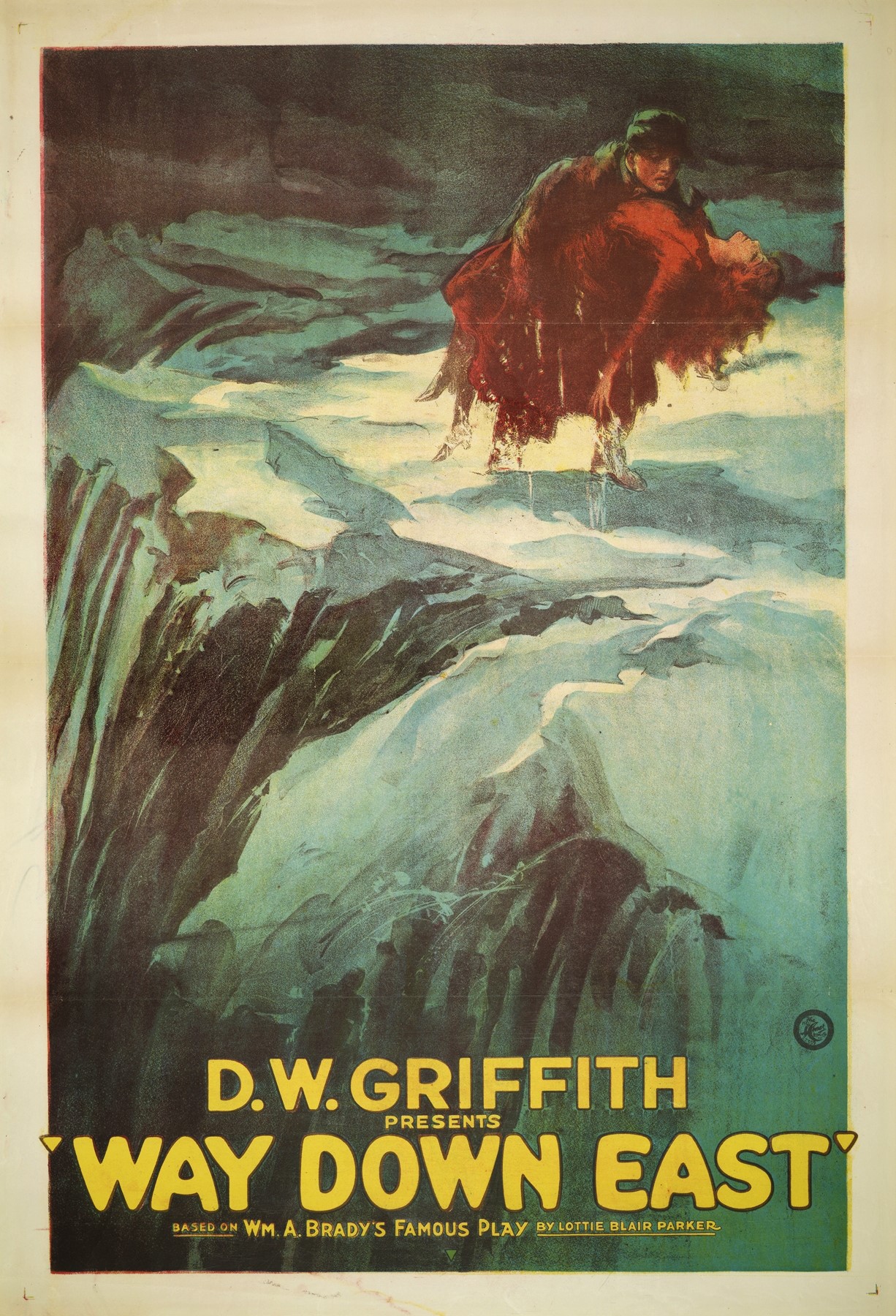
Way Down East is a 1920 American silent melodrama film directed by D. W. Griffith and starring Lillian Gish. It is one of four film adaptations of the 19th century play of the same name by Lottie Blair Parker. There were two earlier silent versions and one sound version in 1935 starring Henry Fonda. Griffith's version is particularly remembered for its climax in which Gish's character is rescued from doom on an icy river.
Anna is a poor country girl who is tricked by handsome man-about-town Lennox into a fake wedding. When she becomes pregnant, he reveals the truth of their relationship and leaves her. She has the baby, named Trust Lennox, on her own in a boarding house.
When the baby dies she wanders until she gets a job with Squire Bartlett. Despite being unofficially engaged, David, Squire Bartlett's son, falls for her, but she rejects him due to her torrid past. Lennox then shows up as an old friend of the Bartletts, and lusting for another local girl, Kate. Seeing Anna, he tries to get her to leave, but she refuses to go claiming she never did anything wrong, although she promises to say nothing about their history.
Finally, the woman running the boardinghouse while visiting the Bartletts recognizes Anna. Squire Bartlett eventually learns of Anna's past from Martha, the town gossip. In his anger, he tosses Anna out into a snow storm. She agrees to go, but not before naming the respected Lennox as her despoiler and the father of her dead baby. She becomes lost in the raging storm while David leads a search party. The unconscious Anna floats on an ice floe down a river towards a waterfall, until rescued at the last moment by David, who then marries her.
Actor Lillian Gish, referring to the famous "chase sequence on the ice-floes," quipped: "All that winter, whenever Mr. Griffith saw an ice cake, he wasn't satisfied till he had me on it."
D. W. Griffith bought the film rights to the story, originally a stage play by Lottie Blair Parker that was elaborated by Joseph R. Grismer. Grismer's wife, the Welsh actress Phoebe Davies, became identified with the play beginning in 1897 and starred in over 4,000 performances of it by 1909, making it one of the most popular plays in the United States. Davies died in 1912, having toured the play for well over ten years. The play, an old-fashioned story that espoused nineteenth-century American and Victorian ideals, was considered outdated by the time of its cinematic production in 1920.
The story rights were purchased for $175,000.[citation needed]
Some sources, quoting newspaper ads of the time, say a sequence was filmed in an early color process, possibly Technicolor or Prizmacolor.
Hub AI
Way Down East AI simulator
(@Way Down East_simulator)
Way Down East
Way Down East is a 1920 American silent melodrama film directed by D. W. Griffith and starring Lillian Gish. It is one of four film adaptations of the 19th century play of the same name by Lottie Blair Parker. There were two earlier silent versions and one sound version in 1935 starring Henry Fonda. Griffith's version is particularly remembered for its climax in which Gish's character is rescued from doom on an icy river.
Anna is a poor country girl who is tricked by handsome man-about-town Lennox into a fake wedding. When she becomes pregnant, he reveals the truth of their relationship and leaves her. She has the baby, named Trust Lennox, on her own in a boarding house.
When the baby dies she wanders until she gets a job with Squire Bartlett. Despite being unofficially engaged, David, Squire Bartlett's son, falls for her, but she rejects him due to her torrid past. Lennox then shows up as an old friend of the Bartletts, and lusting for another local girl, Kate. Seeing Anna, he tries to get her to leave, but she refuses to go claiming she never did anything wrong, although she promises to say nothing about their history.
Finally, the woman running the boardinghouse while visiting the Bartletts recognizes Anna. Squire Bartlett eventually learns of Anna's past from Martha, the town gossip. In his anger, he tosses Anna out into a snow storm. She agrees to go, but not before naming the respected Lennox as her despoiler and the father of her dead baby. She becomes lost in the raging storm while David leads a search party. The unconscious Anna floats on an ice floe down a river towards a waterfall, until rescued at the last moment by David, who then marries her.
Actor Lillian Gish, referring to the famous "chase sequence on the ice-floes," quipped: "All that winter, whenever Mr. Griffith saw an ice cake, he wasn't satisfied till he had me on it."
D. W. Griffith bought the film rights to the story, originally a stage play by Lottie Blair Parker that was elaborated by Joseph R. Grismer. Grismer's wife, the Welsh actress Phoebe Davies, became identified with the play beginning in 1897 and starred in over 4,000 performances of it by 1909, making it one of the most popular plays in the United States. Davies died in 1912, having toured the play for well over ten years. The play, an old-fashioned story that espoused nineteenth-century American and Victorian ideals, was considered outdated by the time of its cinematic production in 1920.
The story rights were purchased for $175,000.[citation needed]
Some sources, quoting newspaper ads of the time, say a sequence was filmed in an early color process, possibly Technicolor or Prizmacolor.