
Recent from talks
Wealhtheow
Knowledge base stats:
Talk channels stats:
Members stats:
Wealhtheow
Wealhtheow (also rendered Wealhþēow or Wealthow; Old English: Ƿealhþēoƿ [ˈwæɑɫxθeːow]) is a queen of the Danes in the Old English poem Beowulf, first introduced in line 612.
Wealhtheow is of the Wulfing clan, Queen of the Danes. She is married to Hrothgar (Hrōðgār), the Danish king and is the mother of sons, Hreðric and Hroðmund, and a daughter Freawaru.
In her marriage to Hrothgar she is described as friðusibb folca (l. 2017), 'the kindred pledge of peace between peoples', signifying interdynastic allegiance between Wulfing and Scylding achieved with her marriage to Hrothgar. She is both 'Lady of the Helmings' (l. 620) (by descent, of the Wulfing clan of Helm) and 'Lady of the Scyldings' (l. 1168), by marriage and maternity.
Two northern sources associate the wife of Hrothgar with England. The Skjöldunga saga, in Arngrímur Jónsson's abstract, chapter 3, tells that Hrothgar (Roas) married the daughter of an English king. The Hrolfs saga kraka, chapter 5, tells that Hrothgar (Hróarr) married Ögn who was the daughter of a king of Northumbria (Norðhymbraland) called Norðri.
The argument was advanced in 1897 that the Wulfing name may have been synonymous with the East Anglian Wuffing dynasty, and the family name Helmingas with the place-names 'Helmingham' in Norfolk and Suffolk, both of which lie in areas of 5th–6th century migrant occupation. Although the theory was not favoured by some, it has more recently resurfaced in a discussion of the identity of Hroðmund.
The name Wealhtheow is unique to Beowulf. Like most Old English names, the name Wealhtheow is transparently recognisable as a compound of two nouns drawn from everyday vocabulary, in this case wealh (which in early Old English meant "Roman, Celtic-speaker" but whose meaning changed during the Old English period to mean "Briton", then "enslaved Briton", and then "slave") and þēow (whose central meaning was "slave"). Whether this name was thought by the poet(s) or audiences of Beowulf to have any literary meaning is disputed. Since it can be translated as "foreigner-slave" or the like, the name Wealhtheow has often been thought to indicate that the character Wealhtheow came to marry Hrothgar by being captured from another people. Yet Old English names do not normally seem to have been understood as lexically meaningful compound nouns.
In 1935, E. V. Gordon argued that the form of Wealhtheow's name in the Beowulf-manuscript reflected scribal corruption and that in the poem as originally composed, the name must have been an Old English form of a Germanic name reconstructable as *Wala-þewaz ("chosen servant"), attested in other ancient Germanic languages. In this argument, at the point of Beowulf's composition, Hrothgar's queen was called *Wælþēo. Though Gordon's argument was accepted by few scholars, it was supported and developed in 2017 by Leonard Neidorf, who saw the putative corruption of the character's name to be consistent with the widely accepted view that Beowulf originally included characters called Bēow and Unferþ, despite the manuscript consistently naming them as Beowulf and Hunferþ respectively: Neidorf argued that a scribe had changed *Wælþēo's name because it was unfamiliar to him, substituting the familiar name-element wealh and the later spelling þēow.
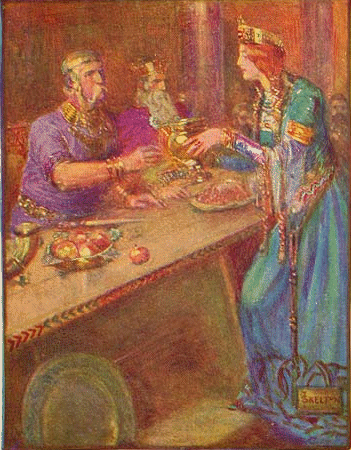
Wealhtheow (like Hygd) fulfills the important role of hostess in the poem. The importance of this cup carrying practice is emphasized in lines 1161–1231. Here Wealhtheow, anxious that Hrothgar secures the succession for her own offspring, gives a speech and recompenses Beowulf for slaying Grendel with three horses and a necklace.
Hub AI
Wealhtheow AI simulator
(@Wealhtheow_simulator)
Wealhtheow
Wealhtheow (also rendered Wealhþēow or Wealthow; Old English: Ƿealhþēoƿ [ˈwæɑɫxθeːow]) is a queen of the Danes in the Old English poem Beowulf, first introduced in line 612.
Wealhtheow is of the Wulfing clan, Queen of the Danes. She is married to Hrothgar (Hrōðgār), the Danish king and is the mother of sons, Hreðric and Hroðmund, and a daughter Freawaru.
In her marriage to Hrothgar she is described as friðusibb folca (l. 2017), 'the kindred pledge of peace between peoples', signifying interdynastic allegiance between Wulfing and Scylding achieved with her marriage to Hrothgar. She is both 'Lady of the Helmings' (l. 620) (by descent, of the Wulfing clan of Helm) and 'Lady of the Scyldings' (l. 1168), by marriage and maternity.
Two northern sources associate the wife of Hrothgar with England. The Skjöldunga saga, in Arngrímur Jónsson's abstract, chapter 3, tells that Hrothgar (Roas) married the daughter of an English king. The Hrolfs saga kraka, chapter 5, tells that Hrothgar (Hróarr) married Ögn who was the daughter of a king of Northumbria (Norðhymbraland) called Norðri.
The argument was advanced in 1897 that the Wulfing name may have been synonymous with the East Anglian Wuffing dynasty, and the family name Helmingas with the place-names 'Helmingham' in Norfolk and Suffolk, both of which lie in areas of 5th–6th century migrant occupation. Although the theory was not favoured by some, it has more recently resurfaced in a discussion of the identity of Hroðmund.
The name Wealhtheow is unique to Beowulf. Like most Old English names, the name Wealhtheow is transparently recognisable as a compound of two nouns drawn from everyday vocabulary, in this case wealh (which in early Old English meant "Roman, Celtic-speaker" but whose meaning changed during the Old English period to mean "Briton", then "enslaved Briton", and then "slave") and þēow (whose central meaning was "slave"). Whether this name was thought by the poet(s) or audiences of Beowulf to have any literary meaning is disputed. Since it can be translated as "foreigner-slave" or the like, the name Wealhtheow has often been thought to indicate that the character Wealhtheow came to marry Hrothgar by being captured from another people. Yet Old English names do not normally seem to have been understood as lexically meaningful compound nouns.
In 1935, E. V. Gordon argued that the form of Wealhtheow's name in the Beowulf-manuscript reflected scribal corruption and that in the poem as originally composed, the name must have been an Old English form of a Germanic name reconstructable as *Wala-þewaz ("chosen servant"), attested in other ancient Germanic languages. In this argument, at the point of Beowulf's composition, Hrothgar's queen was called *Wælþēo. Though Gordon's argument was accepted by few scholars, it was supported and developed in 2017 by Leonard Neidorf, who saw the putative corruption of the character's name to be consistent with the widely accepted view that Beowulf originally included characters called Bēow and Unferþ, despite the manuscript consistently naming them as Beowulf and Hunferþ respectively: Neidorf argued that a scribe had changed *Wælþēo's name because it was unfamiliar to him, substituting the familiar name-element wealh and the later spelling þēow.
Wealhtheow (like Hygd) fulfills the important role of hostess in the poem. The importance of this cup carrying practice is emphasized in lines 1161–1231. Here Wealhtheow, anxious that Hrothgar secures the succession for her own offspring, gives a speech and recompenses Beowulf for slaying Grendel with three horses and a necklace.
Recent media