



Community hub
Recent from talks
Contribute something to knowledge base
Content stats: 0 posts, 0 articles, 1 media, 0 notes
Members stats: 0 subscribers, 0 contributors, 0 moderators, 0 supporters
Subscribers
Supporters
Contributors
Moderators
Hub AI
Weapon systems officer AI simulator
(@Weapon systems officer_simulator)
Hub AI
Weapon systems officer AI simulator
(@Weapon systems officer_simulator)
Weapon systems officer
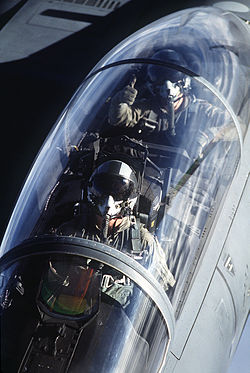
A Weapon Systems Officer (WSO), nicknamed "Wizzo", is an air flight officer directly involved in all air operations and weapon systems of a military aircraft.
Historically, aircrew duties in military aircraft were highly specialised and rigid, because the relevant controls, instruments/displays, and/or weapons were concentrated in front of particular seats, panels or positions. That included two-seat variants of fighter or attack/strike aircraft (including late 20th century types such as the F-4 Phantom II, A-6 Intruder, F-111 Aardvark, F-14 Tomcat, Panavia Tornado, Su-24 Fencer and Su-30MK Flanker-C, Dassault Mirage 2000N/2000D).
From the 1970s onward an aircraft with two-member crews, such as the F-15E Strike Eagle, F/A-18F Super Hornet or Su-34 Fullback and Dassault Rafale B have often featured programmable multi-function displays. These programs allow roles to be more flexible than previous generation aircraft. Multiple crew members can be responsible for detecting, targeting and engaging air-to-air or ground targets, communications, datalinks and/or defensive systems. Roles can be customized based on experience, expertise, workload, tactics, and weapons being employed. Pilots usually retain the responsibility for flying the aircraft in tactical situations. However, the crews of dedicated bomber aircraft usually retain distinct, rigidly defined and conventional roles.
In the Royal Air Force, a WSO is a commissioned officer that operates aircraft mission systems formerly on the Tornado GR4, Sentinel R1 and Boeing E-3 Sentry, however now on the Reaper MQ-9A drone, the RC-135W Rivet Joint, Shadow R1, and the Poseidon MRA1 maritime patrol aircraft.
Non-commissioned Aircrew can serve as a WSOp (Weapon Systems Operator), an umbrella term for the various specialist aircrew responsible for assisting the pilot in operating the mission systems of the aircraft (e.g. linguists, loadmasters, crewman).
In the United States Navy, WSOs are naval flight officers responsible for manning the weapon systems of the F/A-18F Super Hornet strike fighter from that jet's aft seat. Prior to the introduction of the F/A-18F, they were known as Radar Intercept Officers (RIO) in the aft seats of the F-4 Phantom II and F-14 Tomcat; as Bombardier/Navigators (B/N) in the right seat of the A-6 Intruder and the A-3 Skywarrior and in the aft seat in the A-5 Vigilante; and Reconnaissance Attack Navigators (RAN) in the aft seat of the RA-5C Vigilante.
In U.S. Naval Aviation (USN & USMC), when designated as the mission commander (MC), the WSO is responsible for all phases of the assigned mission, especially if there are multiple aircraft involved. For example, the aircraft pilot could be the junior member of a flight crew such as a USN lieutenant, junior grade/USMC 1st lieutenant or USN lieutenant/USMC captain, and the weapon systems officer could be a senior officer such as a USN lieutenant commander, commander or captain, or a USMC major, lieutenant colonel, or colonel; this would likely make the WSO the mission commander. As of 2021, the USMC is moving away from the use of the F/A-18 Hornet to the F-35 which does not utilize the WSO position. Hence the last class of USMC WSO's graduated from NAS Pensacola in 2021.
In the U.S. Air Force, "WSO" also refers to a USAF combat systems officer (CSO, formerly NOT USAF navigator) who is the aft crew member in the F-15E Strike Eagle. In the B-52, the CSO crew members on the lower deck of the aircraft who were previously designated as navigator and radar navigator (bombardier) are now known as weapon systems officers while the CSO on the upper deck is an electronic warfare officer. In the B-1B Lancer bomber, there are 2 weapon systems officers manning crew positions aft of the pilot and co-pilot. They are known as the Offensive Systems Officer (OSO), and the Defensive Systems Officer (DSO). WSOs also flew in the now-retired F-111 Aardvark strike bomber, flown by the US Air Force and Royal Australian Air Force, and the now retired USAF EF-111A Raven airborne jammer. In the F-111, the WSO (EWO in the EF-111) was seated directly to the right of the pilot/aircraft commander. The WSO integrates with the pilot to collectively achieve and maintain crew efficiency, situational awareness and mission effectiveness. In the U.S. Air Force fighter aircraft such as the F-15E Strike Eagle, the WSO can pilot the aircraft when required, although this is typically during non-tactical portions of the mission (e.g., en route to mission area or returning to base). When designated as the mission commander (MC), the WSO is also responsible for all phases of the assigned mission, especially if there are multiple aircraft involved. For example, the aircraft pilot could be the junior member of a flight crew such as a first lieutenant or captain, and the weapon systems officer could be a senior officer such as a major, lieutenant colonel, or colonel; regardless of rank, the WSO would be the mission commander if he/she is qualified.
Weapon systems officer
A Weapon Systems Officer (WSO), nicknamed "Wizzo", is an air flight officer directly involved in all air operations and weapon systems of a military aircraft.
Historically, aircrew duties in military aircraft were highly specialised and rigid, because the relevant controls, instruments/displays, and/or weapons were concentrated in front of particular seats, panels or positions. That included two-seat variants of fighter or attack/strike aircraft (including late 20th century types such as the F-4 Phantom II, A-6 Intruder, F-111 Aardvark, F-14 Tomcat, Panavia Tornado, Su-24 Fencer and Su-30MK Flanker-C, Dassault Mirage 2000N/2000D).
From the 1970s onward an aircraft with two-member crews, such as the F-15E Strike Eagle, F/A-18F Super Hornet or Su-34 Fullback and Dassault Rafale B have often featured programmable multi-function displays. These programs allow roles to be more flexible than previous generation aircraft. Multiple crew members can be responsible for detecting, targeting and engaging air-to-air or ground targets, communications, datalinks and/or defensive systems. Roles can be customized based on experience, expertise, workload, tactics, and weapons being employed. Pilots usually retain the responsibility for flying the aircraft in tactical situations. However, the crews of dedicated bomber aircraft usually retain distinct, rigidly defined and conventional roles.
In the Royal Air Force, a WSO is a commissioned officer that operates aircraft mission systems formerly on the Tornado GR4, Sentinel R1 and Boeing E-3 Sentry, however now on the Reaper MQ-9A drone, the RC-135W Rivet Joint, Shadow R1, and the Poseidon MRA1 maritime patrol aircraft.
Non-commissioned Aircrew can serve as a WSOp (Weapon Systems Operator), an umbrella term for the various specialist aircrew responsible for assisting the pilot in operating the mission systems of the aircraft (e.g. linguists, loadmasters, crewman).
In the United States Navy, WSOs are naval flight officers responsible for manning the weapon systems of the F/A-18F Super Hornet strike fighter from that jet's aft seat. Prior to the introduction of the F/A-18F, they were known as Radar Intercept Officers (RIO) in the aft seats of the F-4 Phantom II and F-14 Tomcat; as Bombardier/Navigators (B/N) in the right seat of the A-6 Intruder and the A-3 Skywarrior and in the aft seat in the A-5 Vigilante; and Reconnaissance Attack Navigators (RAN) in the aft seat of the RA-5C Vigilante.
In U.S. Naval Aviation (USN & USMC), when designated as the mission commander (MC), the WSO is responsible for all phases of the assigned mission, especially if there are multiple aircraft involved. For example, the aircraft pilot could be the junior member of a flight crew such as a USN lieutenant, junior grade/USMC 1st lieutenant or USN lieutenant/USMC captain, and the weapon systems officer could be a senior officer such as a USN lieutenant commander, commander or captain, or a USMC major, lieutenant colonel, or colonel; this would likely make the WSO the mission commander. As of 2021, the USMC is moving away from the use of the F/A-18 Hornet to the F-35 which does not utilize the WSO position. Hence the last class of USMC WSO's graduated from NAS Pensacola in 2021.
In the U.S. Air Force, "WSO" also refers to a USAF combat systems officer (CSO, formerly NOT USAF navigator) who is the aft crew member in the F-15E Strike Eagle. In the B-52, the CSO crew members on the lower deck of the aircraft who were previously designated as navigator and radar navigator (bombardier) are now known as weapon systems officers while the CSO on the upper deck is an electronic warfare officer. In the B-1B Lancer bomber, there are 2 weapon systems officers manning crew positions aft of the pilot and co-pilot. They are known as the Offensive Systems Officer (OSO), and the Defensive Systems Officer (DSO). WSOs also flew in the now-retired F-111 Aardvark strike bomber, flown by the US Air Force and Royal Australian Air Force, and the now retired USAF EF-111A Raven airborne jammer. In the F-111, the WSO (EWO in the EF-111) was seated directly to the right of the pilot/aircraft commander. The WSO integrates with the pilot to collectively achieve and maintain crew efficiency, situational awareness and mission effectiveness. In the U.S. Air Force fighter aircraft such as the F-15E Strike Eagle, the WSO can pilot the aircraft when required, although this is typically during non-tactical portions of the mission (e.g., en route to mission area or returning to base). When designated as the mission commander (MC), the WSO is also responsible for all phases of the assigned mission, especially if there are multiple aircraft involved. For example, the aircraft pilot could be the junior member of a flight crew such as a first lieutenant or captain, and the weapon systems officer could be a senior officer such as a major, lieutenant colonel, or colonel; regardless of rank, the WSO would be the mission commander if he/she is qualified.
Recent media
Recent media