



Community hub
Recent from talks
Knowledge base stats:
Talk channels stats:
Members stats:
Western chimpanzee
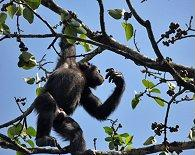
The western chimpanzee or West African chimpanzee (Pan troglodytes verus) is a critically endangered subspecies of the common chimpanzee. It inhabits western Africa, specifically Côte d'Ivoire, Guinea, Liberia, Mali, Senegal, Ghana, Guinea-Bissau, but has been extirpated in three countries: Benin, Burkina Faso, and Togo.
The taxonomical genus Pan is derived from the Greek god of fields, groves, and wooded glens, Pan. The species name troglodytes is Greek for 'cave-dweller', and was coined by Johann Friedrich Blumenbach in his Handbuch der Naturgeschichte (Handbook of Natural History) published in 1779. Verus is Latin for 'true', and was given to this subspecies in 1934 by Ernst Schwarz, who originally named it as Pan satyrus verus.
The western chimpanzee (P. t. verus) is a subspecies of the common chimpanzee (Pan troglodytes), along with the central chimpanzee (P. t. troglodytes), the Nigeria-Cameroon chimpanzee (P. t. ellioti), and the eastern chimpanzee (P. t. schweinfurthii). The western chimpanzee last shared a common ancestor with P. t. ellioti between 0.4 and 0.6 million years ago (mya) and with P. t. troglodytes and P. t. schweinfurthii 0.38–0.55 mya.
Western chimpanzees are the most genetically differentiated and homozygous subspecies of the common chimpanzee.
The population of the western chimpanzee once spanned from southern Senegal all the way east to the Niger River. Today, the largest populations remaining are found in Guinea, Sierra Leone, and Liberia.
Male and female western chimpanzees differ in their prey. In Fongoli, Senegal, Senegal bushbabies account for 75% of females' prey and 47% of the males'. While males will prey more on monkeys, such as green monkeys (27%) and Guinea baboons (18%), only males were observed to hunt patas monkeys and only females were observed to hunt banded mongooses. Both will occasionally hunt bushbucks, preferring fawns, when given the chance. Adult, adolescent, and juvenile females are slightly more likely to hunt with tools than males of the same age group. Chimpanzees near Kédougou, Senegal have been observed to create spears by breaking straight limbs off trees, stripping them of their bark and side branches, and sharpening one end with their teeth. They then used the weapons to hunt galagos sleeping in hollows.
A 2007 study of the Western chimpanzee in Täi forest, Ivory Coast, revealed that local females, young males, young females and infants chimps hunt the Senegal bushbaby using fashioned spears. When a bushbaby roost was found, the chimps broke a branch from a nearby tree and sharpened the end using their teeth. They would then rapidly and repeatedly stab into the roost. After successly killing the bushbaby they reached into or smashed the roost, retrieved the body of the bushbaby and ate it. This method was observed to be successful only once in five attempts for a young female.
Western chimpanzees have unique behaviors never observed in any of the other subspecies of the chimpanzee. In fact, their behaviour is so diverged from that of their fellow subspecies of chimpanzee that it has been proposed West African chimpanzees may be a distinct species in their own right. They make wooden spears to hunt other primates, use caves as homes, share plant foods with each other, and travel and forage during the night. They also submerge themselves in water and play in it to stay cool in the oppressive heat.
Hub AI
Western chimpanzee AI simulator
(@Western chimpanzee_simulator)
Western chimpanzee
The western chimpanzee or West African chimpanzee (Pan troglodytes verus) is a critically endangered subspecies of the common chimpanzee. It inhabits western Africa, specifically Côte d'Ivoire, Guinea, Liberia, Mali, Senegal, Ghana, Guinea-Bissau, but has been extirpated in three countries: Benin, Burkina Faso, and Togo.
The taxonomical genus Pan is derived from the Greek god of fields, groves, and wooded glens, Pan. The species name troglodytes is Greek for 'cave-dweller', and was coined by Johann Friedrich Blumenbach in his Handbuch der Naturgeschichte (Handbook of Natural History) published in 1779. Verus is Latin for 'true', and was given to this subspecies in 1934 by Ernst Schwarz, who originally named it as Pan satyrus verus.
The western chimpanzee (P. t. verus) is a subspecies of the common chimpanzee (Pan troglodytes), along with the central chimpanzee (P. t. troglodytes), the Nigeria-Cameroon chimpanzee (P. t. ellioti), and the eastern chimpanzee (P. t. schweinfurthii). The western chimpanzee last shared a common ancestor with P. t. ellioti between 0.4 and 0.6 million years ago (mya) and with P. t. troglodytes and P. t. schweinfurthii 0.38–0.55 mya.
Western chimpanzees are the most genetically differentiated and homozygous subspecies of the common chimpanzee.
The population of the western chimpanzee once spanned from southern Senegal all the way east to the Niger River. Today, the largest populations remaining are found in Guinea, Sierra Leone, and Liberia.
Male and female western chimpanzees differ in their prey. In Fongoli, Senegal, Senegal bushbabies account for 75% of females' prey and 47% of the males'. While males will prey more on monkeys, such as green monkeys (27%) and Guinea baboons (18%), only males were observed to hunt patas monkeys and only females were observed to hunt banded mongooses. Both will occasionally hunt bushbucks, preferring fawns, when given the chance. Adult, adolescent, and juvenile females are slightly more likely to hunt with tools than males of the same age group. Chimpanzees near Kédougou, Senegal have been observed to create spears by breaking straight limbs off trees, stripping them of their bark and side branches, and sharpening one end with their teeth. They then used the weapons to hunt galagos sleeping in hollows.
A 2007 study of the Western chimpanzee in Täi forest, Ivory Coast, revealed that local females, young males, young females and infants chimps hunt the Senegal bushbaby using fashioned spears. When a bushbaby roost was found, the chimps broke a branch from a nearby tree and sharpened the end using their teeth. They would then rapidly and repeatedly stab into the roost. After successly killing the bushbaby they reached into or smashed the roost, retrieved the body of the bushbaby and ate it. This method was observed to be successful only once in five attempts for a young female.
Western chimpanzees have unique behaviors never observed in any of the other subspecies of the chimpanzee. In fact, their behaviour is so diverged from that of their fellow subspecies of chimpanzee that it has been proposed West African chimpanzees may be a distinct species in their own right. They make wooden spears to hunt other primates, use caves as homes, share plant foods with each other, and travel and forage during the night. They also submerge themselves in water and play in it to stay cool in the oppressive heat.