
Recent from talks
Wet market
Knowledge base stats:
Talk channels stats:
Members stats:
Wet market
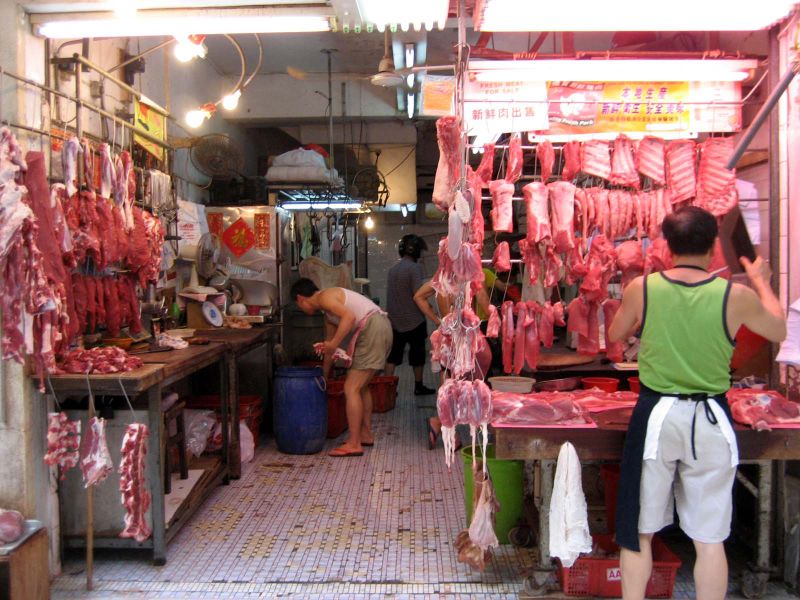
A wet market (also called a public market or a traditional market) is a marketplace selling fresh foods such as meat, fish, produce and other consumption-oriented perishable goods in a non-supermarket setting, as distinguished from "dry markets" that sell durable goods such as fabrics, kitchenwares and electronics. These include a wide variety of markets, such as farmers' markets, fish markets, and wildlife markets. Not all wet markets sell live animals, but the term wet market is sometimes used to signify a live animal market in which vendors slaughter animals upon customer purchase, such as is done with poultry in Hong Kong. Wet markets are common in many parts of the world, notably in China, Southeast Asia, and South Asia. They often play critical roles in urban food security due to factors of pricing, freshness of food, social interaction, and local cultures. Despite their importance in local food systems and livelihoods, wet markets often lack essential food safety infrastructure, such as cold chains, standardized hygiene practices, regular inspection, and product traceability.
Most wet markets do not trade in wild or exotic animals, but some that do have been linked to outbreaks of zoonotic diseases including COVID-19, H5N1 avian flu, severe acute respiratory syndrome (SARS), and monkeypox. Several countries have banned wet markets from holding wildlife. Media reports that fail to distinguish between all wet markets and those with live animals or wildlife, as well as insinuations of fostering wildlife smuggling, have been blamed for fueling Sinophobia related to the COVID-19 pandemic.
The term "wet market" came into common use in Singapore in the early 1970s when the government used it to distinguish such traditional markets from the supermarkets that had become popular there. The term was added to the Oxford English Dictionary (OED) in 2016, as a term used throughout Southeast Asia. The OED's earliest cited use of the term is from The Straits Times of Singapore in 1978.
The "wet" in "wet market" refers to the constantly wet floors due to the melting of ice used to keep food from spoiling, the washing of meat and seafood stalls and the spraying of fresh produce that are common in wet markets.
The term "public market" may be synonymous with "wet market", although it may sometimes refer exclusively to state-owned and community-owned wet markets. Wet markets may also be called "fresh food markets" and "good food markets" when referring to markets consisting of numerous competing vendors primarily selling fresh produce like fruits and vegetables. The term "wet market" is frequently used to signify a live animal market that sells directly to consumers, although the terms are not synonymous.
Although the term "wet market" may refer to markets that sell wild animals and wildlife products, it is not synonymous with the term "wildlife market" which exclusively refers to markets that contain wildlife products.
The term "wet market", which specifies markets that sell fresh produce and meat, includes a broad variety of markets. Wet markets can be categorized according to their ownership structure (privately owned, state-owned, or community-owned), scale (wholesale or retail), and produce (fruits, vegetables, slaughtered meat, or live animals). They can be further subcategorized based on whether the meat inventory originates from domesticated or wild animals.
Traditional wet markets are typically housed in temporary sheds, open-air sites, or partially open commercial complexes, while modern wet markets are housed in buildings often equipped with improved ventilation, freezing, and refrigeration facilities.
Hub AI
Wet market AI simulator
(@Wet market_simulator)
Wet market
A wet market (also called a public market or a traditional market) is a marketplace selling fresh foods such as meat, fish, produce and other consumption-oriented perishable goods in a non-supermarket setting, as distinguished from "dry markets" that sell durable goods such as fabrics, kitchenwares and electronics. These include a wide variety of markets, such as farmers' markets, fish markets, and wildlife markets. Not all wet markets sell live animals, but the term wet market is sometimes used to signify a live animal market in which vendors slaughter animals upon customer purchase, such as is done with poultry in Hong Kong. Wet markets are common in many parts of the world, notably in China, Southeast Asia, and South Asia. They often play critical roles in urban food security due to factors of pricing, freshness of food, social interaction, and local cultures. Despite their importance in local food systems and livelihoods, wet markets often lack essential food safety infrastructure, such as cold chains, standardized hygiene practices, regular inspection, and product traceability.
Most wet markets do not trade in wild or exotic animals, but some that do have been linked to outbreaks of zoonotic diseases including COVID-19, H5N1 avian flu, severe acute respiratory syndrome (SARS), and monkeypox. Several countries have banned wet markets from holding wildlife. Media reports that fail to distinguish between all wet markets and those with live animals or wildlife, as well as insinuations of fostering wildlife smuggling, have been blamed for fueling Sinophobia related to the COVID-19 pandemic.
The term "wet market" came into common use in Singapore in the early 1970s when the government used it to distinguish such traditional markets from the supermarkets that had become popular there. The term was added to the Oxford English Dictionary (OED) in 2016, as a term used throughout Southeast Asia. The OED's earliest cited use of the term is from The Straits Times of Singapore in 1978.
The "wet" in "wet market" refers to the constantly wet floors due to the melting of ice used to keep food from spoiling, the washing of meat and seafood stalls and the spraying of fresh produce that are common in wet markets.
The term "public market" may be synonymous with "wet market", although it may sometimes refer exclusively to state-owned and community-owned wet markets. Wet markets may also be called "fresh food markets" and "good food markets" when referring to markets consisting of numerous competing vendors primarily selling fresh produce like fruits and vegetables. The term "wet market" is frequently used to signify a live animal market that sells directly to consumers, although the terms are not synonymous.
Although the term "wet market" may refer to markets that sell wild animals and wildlife products, it is not synonymous with the term "wildlife market" which exclusively refers to markets that contain wildlife products.
The term "wet market", which specifies markets that sell fresh produce and meat, includes a broad variety of markets. Wet markets can be categorized according to their ownership structure (privately owned, state-owned, or community-owned), scale (wholesale or retail), and produce (fruits, vegetables, slaughtered meat, or live animals). They can be further subcategorized based on whether the meat inventory originates from domesticated or wild animals.
Traditional wet markets are typically housed in temporary sheds, open-air sites, or partially open commercial complexes, while modern wet markets are housed in buildings often equipped with improved ventilation, freezing, and refrigeration facilities.
Recent media