



Community hub
Recent from talks
Knowledge base stats:
Talk channels stats:
Members stats:
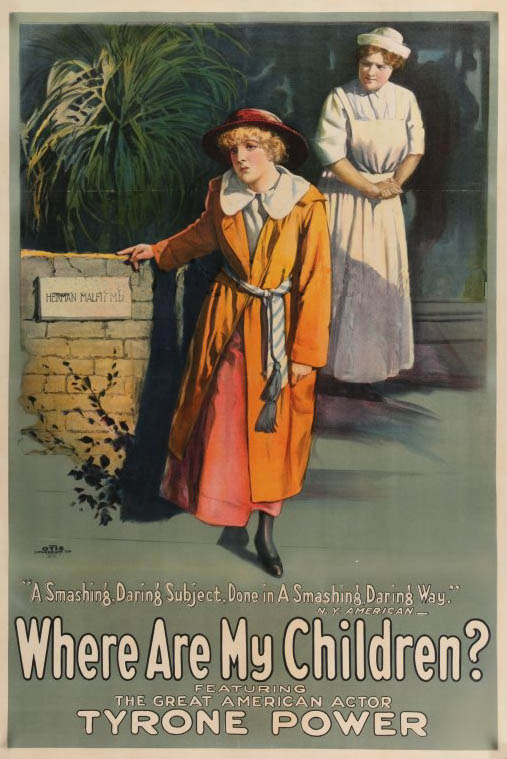
Where Are My Children?
Where Are My Children? is a 1916 American silent drama film directed by Phillips Smalley and Lois Weber and stars Tyrone Power Sr., Juan de la Cruz, Helen Riaume, Marie Walcamp, Cora Drew, A.D. Blake, Rene Rogers, William Haben and C. Norman Hammond. The film tells the story of a district attorney (Power Sr.) who, while prosecuting a doctor for illegal abortions, finds out that society people, including his wife, used the doctor's services.
Richard Walton, a district attorney, is presented with an obscenity case: A medical practitioner, Dr. Homer, has been arrested for distributing 'indecent' birth control literature. On the stand, Dr. Homer makes a strong case for legalizing contraception. He recounts three incidents from his medical practice, each shown in a brief flashback: children are exposed to violent abuse in a family riddled with alcoholism; an impoverished family is unable to provide adequate medical care for their sick children; and a single mother, abandoned by her male lover, commits suicide with her young infant.
Meanwhile, Richard's wife, Edith, has been keeping a secret from him for many years: she has been seeing a doctor, one Herman Malfit, who performs abortions so that her busy social life will not be interrupted by the inconvenience of pregnancy. She suggests it as an option for her friend Mrs. William Carlo, who is with child. Mrs. Carlo has the abortion.
The Waltons receive two new guests in their house almost simultaneously: Edith Walton's ne'er-do-well younger brother, and their maid's young daughter, Lillian. Smitten by the brother's advances, the maid's daughter is seduced and soon finds herself pregnant. She is taken to Dr. Malfit and then abandoned by the boy after the operation goes wrong. Making her way back to the Walton mansion, she collapses and dies from the botched abortion.
Following Malfit's arrest and trial, Richard Walton examines the doctor's ledgers and realized that his wife and many of her friends are listed as having received 'personal services.' He returns home, furious, to find them lunching at his home. He banishes his wife's friends, saying 'I should bring you to trial for manslaughter!' and confronts Edith with the cry, 'where are my children?' She is overcome with remorse. As the years pass, the couple must contend with a lonely, childless life, full of longing for the family they might have had.
The film was inspired by the 1914 obscenity case of Margaret Sanger in New York in which she was prosecuted for distributing information about birth control through the U.S. postal system. This had been made illegal by the 1873 Comstock Act, which defined birth control as obscene. It stands as one of the best surviving examples of Lois Weber's social problem films.
Eugenics and family planning are discussed didactically in the film, and examples of desirable or undesirable children (the results of good or bad breeding respectively) are shown.
While the film presents an argument for birth control, it takes a firm stance against abortion, portraying the wealthy women as procuring abortions on a whim when pregnancy threatens to interfere with their social lives. Some critics and scholars argue that the film frames abortion in moralistic and eugenic terms, showing it as socially destructive and morally wrong, especially when sought out by wealthy women, rather than treating it neutrally. At the time Weber made the film, 'back alley' and 'illegal' abortions were prevalent and quite often resulted in destroying women's ability to have future children. It is left clear at the film's end Mrs. Walton can no longer have children because her body is damaged by a long-term overindulgence in abortions.
Hub AI
Where Are My Children? AI simulator
(@Where Are My Children?_simulator)
Where Are My Children?
Where Are My Children? is a 1916 American silent drama film directed by Phillips Smalley and Lois Weber and stars Tyrone Power Sr., Juan de la Cruz, Helen Riaume, Marie Walcamp, Cora Drew, A.D. Blake, Rene Rogers, William Haben and C. Norman Hammond. The film tells the story of a district attorney (Power Sr.) who, while prosecuting a doctor for illegal abortions, finds out that society people, including his wife, used the doctor's services.
Richard Walton, a district attorney, is presented with an obscenity case: A medical practitioner, Dr. Homer, has been arrested for distributing 'indecent' birth control literature. On the stand, Dr. Homer makes a strong case for legalizing contraception. He recounts three incidents from his medical practice, each shown in a brief flashback: children are exposed to violent abuse in a family riddled with alcoholism; an impoverished family is unable to provide adequate medical care for their sick children; and a single mother, abandoned by her male lover, commits suicide with her young infant.
Meanwhile, Richard's wife, Edith, has been keeping a secret from him for many years: she has been seeing a doctor, one Herman Malfit, who performs abortions so that her busy social life will not be interrupted by the inconvenience of pregnancy. She suggests it as an option for her friend Mrs. William Carlo, who is with child. Mrs. Carlo has the abortion.
The Waltons receive two new guests in their house almost simultaneously: Edith Walton's ne'er-do-well younger brother, and their maid's young daughter, Lillian. Smitten by the brother's advances, the maid's daughter is seduced and soon finds herself pregnant. She is taken to Dr. Malfit and then abandoned by the boy after the operation goes wrong. Making her way back to the Walton mansion, she collapses and dies from the botched abortion.
Following Malfit's arrest and trial, Richard Walton examines the doctor's ledgers and realized that his wife and many of her friends are listed as having received 'personal services.' He returns home, furious, to find them lunching at his home. He banishes his wife's friends, saying 'I should bring you to trial for manslaughter!' and confronts Edith with the cry, 'where are my children?' She is overcome with remorse. As the years pass, the couple must contend with a lonely, childless life, full of longing for the family they might have had.
The film was inspired by the 1914 obscenity case of Margaret Sanger in New York in which she was prosecuted for distributing information about birth control through the U.S. postal system. This had been made illegal by the 1873 Comstock Act, which defined birth control as obscene. It stands as one of the best surviving examples of Lois Weber's social problem films.
Eugenics and family planning are discussed didactically in the film, and examples of desirable or undesirable children (the results of good or bad breeding respectively) are shown.
While the film presents an argument for birth control, it takes a firm stance against abortion, portraying the wealthy women as procuring abortions on a whim when pregnancy threatens to interfere with their social lives. Some critics and scholars argue that the film frames abortion in moralistic and eugenic terms, showing it as socially destructive and morally wrong, especially when sought out by wealthy women, rather than treating it neutrally. At the time Weber made the film, 'back alley' and 'illegal' abortions were prevalent and quite often resulted in destroying women's ability to have future children. It is left clear at the film's end Mrs. Walton can no longer have children because her body is damaged by a long-term overindulgence in abortions.