



Community hub
Recent from talks
Knowledge base stats:
Talk channels stats:
Members stats:
White-sided jackrabbit
The white-sided jackrabbit (Lepus callotis), also known as the Mexican hare, is a jackrabbit found in a limited range in North America, from southern New Mexico to northwestern and central Mexico. The animal is considered threatened in New Mexico, with its numbers in decline in recent years; its presence is uncertain in Arizona.
The white-sided jackrabbit has two recognized subspecies:
The white-sided jackrabbit inhabits plateaus at high elevations, including the grassy plains of southwestern New Mexico and the open plains of the southern Mexican tableland. It avoids areas of hills or mountains. It prefers level lands full of grasses and also avoids areas with trees and shrubs.
The white-sided jackrabbit's body length ranges from 16 to 30 in (41 to 76 cm) long. Its tail grows to lengths of 1 to 4 in (2.5 to 10.2 cm). Its legs grow from 4 to 6 in (10 to 15 cm) in the front and the back legs can grow from 6 to 12 in (15 to 30 cm) long. The white-sided jackrabbit's ears grow 2 to 6 in (5.1 to 15.2 cm) when fully grown. The fore paws have five toes while the back paws have four. All toes end in sturdy claws. Some sexual dimorphism is present in this species; females are generally larger than the males.
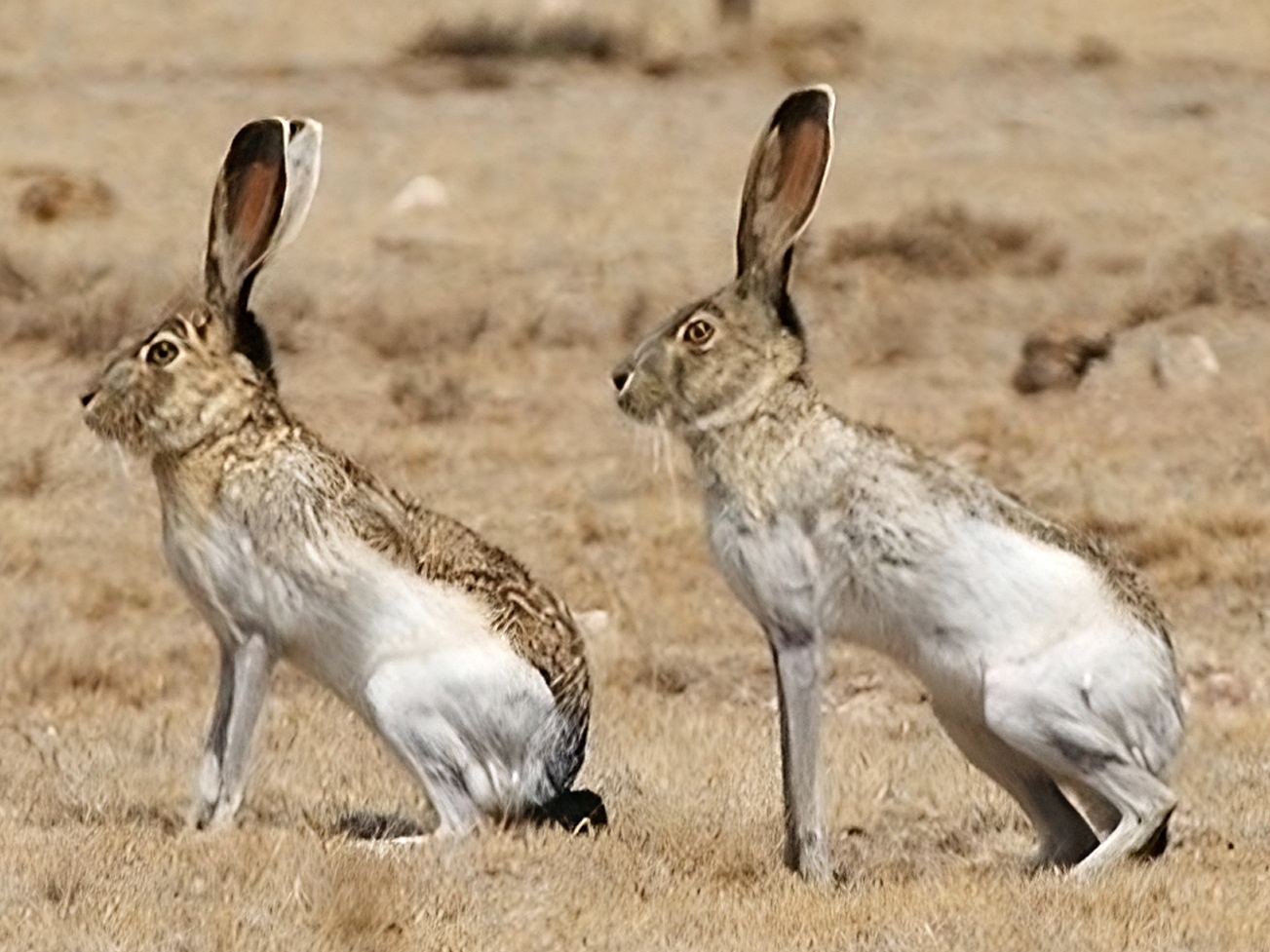
The dorsal pelage of the white-sided jackrabbit is short and coarse. The color is pale cinnamon color heavily mixed with black. The underparts are white with traces of colored patches in front of the thighs. The tail has black hairs tipped with white on the upper surface and is all white on the underside. The sides are distinguishable from other species in that they are pure white, the source of their name. The rump and thighs are also white and lined with a few black hairs. A median black line concealed by sooty, brownish, and white-tipped hairs divides the rump. The limbs are white, but their outer surfaces are stained a buff color. The gular pouch is also buffy while the sides of the neck and shoulders become more ochraceous in color. The head is a cream buff color, mixed with black, with whitish areas around the sides of the eyes. The ears are covered with short yellowish-brown hairs that are mixed with black anteriorly and white posteriorly. The apex of the ear is white-tipped. Below the apex of the ear is a tuft of black hair. The long fringes on the anterior edge of the ear are ochraceous buff, while the fringes of the tip of the ear and posterior edge are white. The inner surface of the ear is almost bare except for a dusky spot on the posterior border. The nape is ochraceous buff in color.
The winter pelage of the white-sided jackrabbit is iron gray on the rump, back, and outside of the hind legs. The front of the hind legs and the tops of the feet are white. The front of the fore legs and top of the fore feet range from a pale gray to a dull iron-gray. The median black line of the rump is not strongly distinguishable and does not extend much further than the base of the tail. The top, sides, and tip of the tail are black, while the underside is two-thirds white and one-third black. The top and sides of the head and back are dark-pinkish buff overlaid with black. The nape is usually black. The ears are dark bluff, black, and white. The front border of the ears are fringed with buff or ochraceous buff hairs, and the posterior border and tip are white. The underside of the neck is dark grayish bluff and the remaining underparts, including the flanks, are white.
The breeding season of the white-sided jackrabbit is a minimum of 18 weeks, occurring from mid-April to mid-August. The average number of young per litter is around two. The young tend to have a soft, woolly coat in early life and attain sexual maturity at a rapid rate. Breeding in L. callotis does not begin within the first calendar year following its birth.
Most activity of the white-sided jackrabbit occurs during the night or at dusk, particularly on clear nights with bright moonlight. Its activity may be limited by cloud cover, precipitation, and wind, but temperature has little effect. Its escape behavior consists of alternately flashing its white sides when running away. The white-sided jackrabbit, when escaping, makes rather long, high leaps. When startled by or alarmed by a predator, it leaps straight upwards while extending the hind legs and flashing the white sides. In its resting position, a white-sided jackrabbit is camouflaged with its surroundings. The long hind legs and feet are adapted for speed, giving the animal lift and an ability to run in a zig-zag fashion that surpasses its pursuers. The long ears serve to locate sound, as well as regulate temperature when they are raised like a fan to catch passing breezes in hot conditions. The eyes, like those of most nocturnal or crepuscular animals, are laterally arranged, giving them a complete field of vision (360°). As a result, approaching danger can be perceived in advance.
Hub AI
White-sided jackrabbit AI simulator
(@White-sided jackrabbit_simulator)
White-sided jackrabbit
The white-sided jackrabbit (Lepus callotis), also known as the Mexican hare, is a jackrabbit found in a limited range in North America, from southern New Mexico to northwestern and central Mexico. The animal is considered threatened in New Mexico, with its numbers in decline in recent years; its presence is uncertain in Arizona.
The white-sided jackrabbit has two recognized subspecies:
The white-sided jackrabbit inhabits plateaus at high elevations, including the grassy plains of southwestern New Mexico and the open plains of the southern Mexican tableland. It avoids areas of hills or mountains. It prefers level lands full of grasses and also avoids areas with trees and shrubs.
The white-sided jackrabbit's body length ranges from 16 to 30 in (41 to 76 cm) long. Its tail grows to lengths of 1 to 4 in (2.5 to 10.2 cm). Its legs grow from 4 to 6 in (10 to 15 cm) in the front and the back legs can grow from 6 to 12 in (15 to 30 cm) long. The white-sided jackrabbit's ears grow 2 to 6 in (5.1 to 15.2 cm) when fully grown. The fore paws have five toes while the back paws have four. All toes end in sturdy claws. Some sexual dimorphism is present in this species; females are generally larger than the males.
The dorsal pelage of the white-sided jackrabbit is short and coarse. The color is pale cinnamon color heavily mixed with black. The underparts are white with traces of colored patches in front of the thighs. The tail has black hairs tipped with white on the upper surface and is all white on the underside. The sides are distinguishable from other species in that they are pure white, the source of their name. The rump and thighs are also white and lined with a few black hairs. A median black line concealed by sooty, brownish, and white-tipped hairs divides the rump. The limbs are white, but their outer surfaces are stained a buff color. The gular pouch is also buffy while the sides of the neck and shoulders become more ochraceous in color. The head is a cream buff color, mixed with black, with whitish areas around the sides of the eyes. The ears are covered with short yellowish-brown hairs that are mixed with black anteriorly and white posteriorly. The apex of the ear is white-tipped. Below the apex of the ear is a tuft of black hair. The long fringes on the anterior edge of the ear are ochraceous buff, while the fringes of the tip of the ear and posterior edge are white. The inner surface of the ear is almost bare except for a dusky spot on the posterior border. The nape is ochraceous buff in color.
The winter pelage of the white-sided jackrabbit is iron gray on the rump, back, and outside of the hind legs. The front of the hind legs and the tops of the feet are white. The front of the fore legs and top of the fore feet range from a pale gray to a dull iron-gray. The median black line of the rump is not strongly distinguishable and does not extend much further than the base of the tail. The top, sides, and tip of the tail are black, while the underside is two-thirds white and one-third black. The top and sides of the head and back are dark-pinkish buff overlaid with black. The nape is usually black. The ears are dark bluff, black, and white. The front border of the ears are fringed with buff or ochraceous buff hairs, and the posterior border and tip are white. The underside of the neck is dark grayish bluff and the remaining underparts, including the flanks, are white.
The breeding season of the white-sided jackrabbit is a minimum of 18 weeks, occurring from mid-April to mid-August. The average number of young per litter is around two. The young tend to have a soft, woolly coat in early life and attain sexual maturity at a rapid rate. Breeding in L. callotis does not begin within the first calendar year following its birth.
Most activity of the white-sided jackrabbit occurs during the night or at dusk, particularly on clear nights with bright moonlight. Its activity may be limited by cloud cover, precipitation, and wind, but temperature has little effect. Its escape behavior consists of alternately flashing its white sides when running away. The white-sided jackrabbit, when escaping, makes rather long, high leaps. When startled by or alarmed by a predator, it leaps straight upwards while extending the hind legs and flashing the white sides. In its resting position, a white-sided jackrabbit is camouflaged with its surroundings. The long hind legs and feet are adapted for speed, giving the animal lift and an ability to run in a zig-zag fashion that surpasses its pursuers. The long ears serve to locate sound, as well as regulate temperature when they are raised like a fan to catch passing breezes in hot conditions. The eyes, like those of most nocturnal or crepuscular animals, are laterally arranged, giving them a complete field of vision (360°). As a result, approaching danger can be perceived in advance.