



Community hub
Recent from talks
Knowledge base stats:
Talk channels stats:
Members stats:
Vienna Stadtbahn
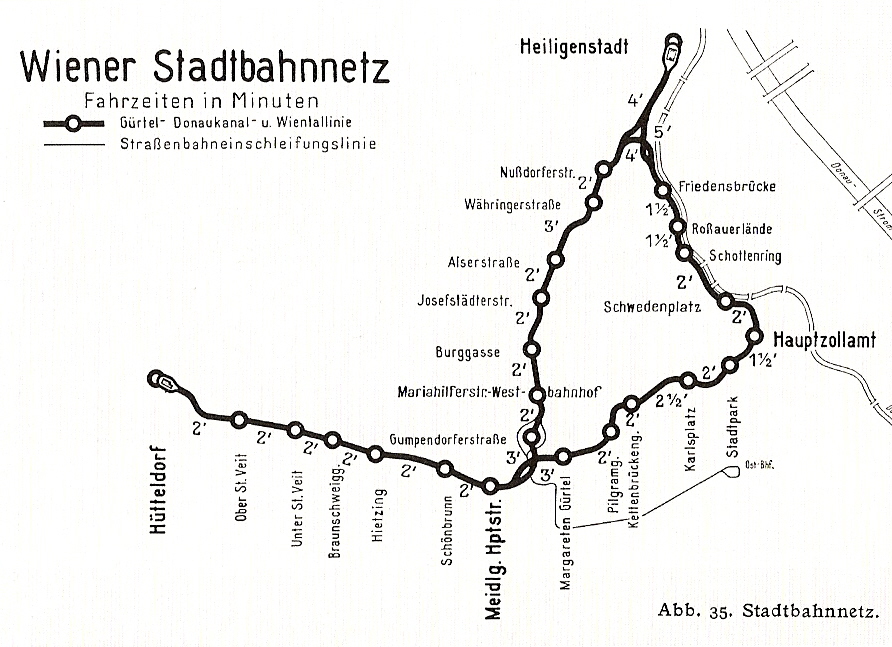
The Vienna Stadtbahn (German: Wiener Stadtbahn) was a rail-based public transportation system operated under this name from 1898 until 1989. Today, the Vienna U-Bahn lines U4 and U6 and the Vienna S-Bahn (commuter rail) run on its former lines.
In 1894, the architect Otto Wagner was hired as the artistic director for the Vienna Stadtbahn project. The Stadtbahn is one of Vienna's better-known examples of early Art Nouveau architecture. Its most famous buildings are the two former station entrances on Karlsplatz, now used as a café and a museum respectively, and the Hofpavillon, a station built specifically for Emperor Franz Joseph, located at the eastern end of Hietzing station. Other preserved historical stations are the elevated stations along the Gürtel and in some of the suburbs.
The use of the term Stadtbahn in the line's name derives from the 19th century usage of the term to simply mean a railway in an urban area, in a similar way to the naming of the roughly contemporaneous Berlin Stadtbahn. It is not related to the usage of the term stadtbahn in post-World War II Germany to mean light rail lines upgraded from street tramways. The use of tram type vehicles on much of the Vienna Stadtbahn after 1925 is entirely coincidental, and happened long after the line got its name.
In Vienna, there were very early relevant projects for railway lines in the city. The oldest dates back to 1844, when the engineer Heinrich Sichrowsky designed an atmospheric railway based on system of George Medhurst and Samuel Clegg and emulating such lines in London and Paris. This new line was to lead from the Lobkowitzplatz below the Vienna Glacis to the Vienna River and to Hütteldorf. Finally, in 1849, Julius Pollack suggested that the Vienna Rail Link, which was still in the planning stage at the time, also be operated atmospherically.
The next plans followed in connection with the first city expansion in 1850, including one in 1852 preferred by the Vienna Construction Company and the Vienna Bank Corporation project. The second proposal, which had already been worked out in detail, was presented by Count Henckel von Donnersmarck in 1867. In 1869, Baurat Baron Carl von Schwarz finally brought in a third proposal. This was the first proposal to use the term Stadtbahn.
By the latter half of the 19th century, there were seven main line railway lines radiating from Vienna. These were the Nordbahn opened in 1837, the Südbahn opened in 1841, the Ostbahn opened in the same year, the Westbahn opened in 1858, the Franz-Josefs-Bahn opened in 1870, the Nordwestbahn opened in 1872 and the Aspangbahn opened in 1881. Each of the seven routes belonged to a different railway company and each had its own train station in the capital, which were, partly for reasons of space, taxation and the military, built far from the city centre. Moreover, six of them were designed as terminal stations, and only the last-opened station, the Aspangbahnhof, was built as through station from the beginning. While the comparatively few passengers who did not have the capital as a starting point or destination were able to switch between the stations via the Vienna tramway, which was set up in 1865, this was much more difficult for transit freight traffic.
In addition, it became apparent in the late 19th century that the main stations themselves - including the Westbahnhof and Franz-Josefs-Bahnhof - urgently needed to be relieved. In the long run, they no longer met the complicated demands of parallel long-distance and local traffic and would have to be rebuilt without the construction of a metropolitan railway.
While the rival railway companies at that time had no interest in a central urban solution - the present-day Vienna Hauptbahnhof finally went into operation in 2012 - the Austrian military, after the March Revolution of 1848, demanded measures to prevent a recurrence of such events. Although the commissioning of the Verbindungsbahn from 1859, the Donauländebahn from 1872 and the Donauuferbahn from 1875 provided some relief, the heavy losses of the Battle of Königgrätz in 1866 showed that further connections between the long-distance railways were needed. After 1867, only 18 kilometers of the Austrian railway network - including the Verbindungsbahn - were in state hands, so in 1874 a renewed nationalization wave began. The de-privatization of operations combined with the new connections in the capital would make it possible, in case of mobilization - especially in case of a two-front war - to move troops, weapons and ammunition more easily. But also the so-called Approvisionierungsverkehr - that is, the supply of the city and the soldiers with food - played a major role in the future of the Vienna Stadtbahn. Equally important was the possibility to connect the large inner-city barracks to the main lines in the event of war, including, in particular between 1849 and 1856, the Arsenal, built as a consequence of the March Revolution.
Hub AI
Vienna Stadtbahn AI simulator
(@Vienna Stadtbahn_simulator)
Vienna Stadtbahn
The Vienna Stadtbahn (German: Wiener Stadtbahn) was a rail-based public transportation system operated under this name from 1898 until 1989. Today, the Vienna U-Bahn lines U4 and U6 and the Vienna S-Bahn (commuter rail) run on its former lines.
In 1894, the architect Otto Wagner was hired as the artistic director for the Vienna Stadtbahn project. The Stadtbahn is one of Vienna's better-known examples of early Art Nouveau architecture. Its most famous buildings are the two former station entrances on Karlsplatz, now used as a café and a museum respectively, and the Hofpavillon, a station built specifically for Emperor Franz Joseph, located at the eastern end of Hietzing station. Other preserved historical stations are the elevated stations along the Gürtel and in some of the suburbs.
The use of the term Stadtbahn in the line's name derives from the 19th century usage of the term to simply mean a railway in an urban area, in a similar way to the naming of the roughly contemporaneous Berlin Stadtbahn. It is not related to the usage of the term stadtbahn in post-World War II Germany to mean light rail lines upgraded from street tramways. The use of tram type vehicles on much of the Vienna Stadtbahn after 1925 is entirely coincidental, and happened long after the line got its name.
In Vienna, there were very early relevant projects for railway lines in the city. The oldest dates back to 1844, when the engineer Heinrich Sichrowsky designed an atmospheric railway based on system of George Medhurst and Samuel Clegg and emulating such lines in London and Paris. This new line was to lead from the Lobkowitzplatz below the Vienna Glacis to the Vienna River and to Hütteldorf. Finally, in 1849, Julius Pollack suggested that the Vienna Rail Link, which was still in the planning stage at the time, also be operated atmospherically.
The next plans followed in connection with the first city expansion in 1850, including one in 1852 preferred by the Vienna Construction Company and the Vienna Bank Corporation project. The second proposal, which had already been worked out in detail, was presented by Count Henckel von Donnersmarck in 1867. In 1869, Baurat Baron Carl von Schwarz finally brought in a third proposal. This was the first proposal to use the term Stadtbahn.
By the latter half of the 19th century, there were seven main line railway lines radiating from Vienna. These were the Nordbahn opened in 1837, the Südbahn opened in 1841, the Ostbahn opened in the same year, the Westbahn opened in 1858, the Franz-Josefs-Bahn opened in 1870, the Nordwestbahn opened in 1872 and the Aspangbahn opened in 1881. Each of the seven routes belonged to a different railway company and each had its own train station in the capital, which were, partly for reasons of space, taxation and the military, built far from the city centre. Moreover, six of them were designed as terminal stations, and only the last-opened station, the Aspangbahnhof, was built as through station from the beginning. While the comparatively few passengers who did not have the capital as a starting point or destination were able to switch between the stations via the Vienna tramway, which was set up in 1865, this was much more difficult for transit freight traffic.
In addition, it became apparent in the late 19th century that the main stations themselves - including the Westbahnhof and Franz-Josefs-Bahnhof - urgently needed to be relieved. In the long run, they no longer met the complicated demands of parallel long-distance and local traffic and would have to be rebuilt without the construction of a metropolitan railway.
While the rival railway companies at that time had no interest in a central urban solution - the present-day Vienna Hauptbahnhof finally went into operation in 2012 - the Austrian military, after the March Revolution of 1848, demanded measures to prevent a recurrence of such events. Although the commissioning of the Verbindungsbahn from 1859, the Donauländebahn from 1872 and the Donauuferbahn from 1875 provided some relief, the heavy losses of the Battle of Königgrätz in 1866 showed that further connections between the long-distance railways were needed. After 1867, only 18 kilometers of the Austrian railway network - including the Verbindungsbahn - were in state hands, so in 1874 a renewed nationalization wave began. The de-privatization of operations combined with the new connections in the capital would make it possible, in case of mobilization - especially in case of a two-front war - to move troops, weapons and ammunition more easily. But also the so-called Approvisionierungsverkehr - that is, the supply of the city and the soldiers with food - played a major role in the future of the Vienna Stadtbahn. Equally important was the possibility to connect the large inner-city barracks to the main lines in the event of war, including, in particular between 1849 and 1856, the Arsenal, built as a consequence of the March Revolution.