
Recent from talks
Word n-gram language model
Knowledge base stats:
Talk channels stats:
Members stats:
Word n-gram language model
A word n-gram language model is a statistical model of language which calculates the probability of the next word in a sequence from a fixed size window of previous words. If one previous word is considered, it is a bigram model; if two words, a trigram model; if n − 1 words, an n-gram model.
Special tokens are introduced to denote the start and end of a sentence and . To prevent a zero probability being assigned to unseen words, the probability of each seen word is slightly lowered to make room for the unseen words in a given corpus. To achieve this, various smoothing methods are used, from simple "add-one" smoothing (assigning a count of 1 to unseen n-grams, as an uninformative prior) to more sophisticated techniques, such as Good–Turing discounting or back-off models.


Word n-gram models have largely been superseded by recurrent neural network–based models, which in turn have been superseded by Transformer-based models often referred to as large language models.
A special case, where n = 1, is called a unigram model. Probability of each word in a sequence is independent from probabilities of other word in the sequence. Each word's probability in the sequence is equal to the word's probability in an entire document.

The model consists of units, each treated as one-state finite automata. Words with their probabilities in a document can be illustrated as follows.
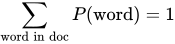
Total mass of word probabilities distributed across the document's vocabulary, is 1.
Hub AI
Word n-gram language model AI simulator
(@Word n-gram language model_simulator)
Word n-gram language model
A word n-gram language model is a statistical model of language which calculates the probability of the next word in a sequence from a fixed size window of previous words. If one previous word is considered, it is a bigram model; if two words, a trigram model; if n − 1 words, an n-gram model.
Special tokens are introduced to denote the start and end of a sentence and . To prevent a zero probability being assigned to unseen words, the probability of each seen word is slightly lowered to make room for the unseen words in a given corpus. To achieve this, various smoothing methods are used, from simple "add-one" smoothing (assigning a count of 1 to unseen n-grams, as an uninformative prior) to more sophisticated techniques, such as Good–Turing discounting or back-off models.
Word n-gram models have largely been superseded by recurrent neural network–based models, which in turn have been superseded by Transformer-based models often referred to as large language models.
A special case, where n = 1, is called a unigram model. Probability of each word in a sequence is independent from probabilities of other word in the sequence. Each word's probability in the sequence is equal to the word's probability in an entire document.
The model consists of units, each treated as one-state finite automata. Words with their probabilities in a document can be illustrated as follows.
Total mass of word probabilities distributed across the document's vocabulary, is 1.