
Recent from talks
Wrapped distribution
Knowledge base stats:
Talk channels stats:
Members stats:
Wrapped distribution
In probability theory and directional statistics, a wrapped probability distribution is a continuous probability distribution that describes data points that lie on a unit n-sphere. In one dimension, a wrapped distribution consists of points on the unit circle. If is a random variate in the interval with probability density function (PDF) , then is a circular variable distributed according to the wrapped distribution and is an angular variable in the interval distributed according to the wrapped distribution .


![{\displaystyle (-\pi ,\pi ]}](https://wikimedia.org/api/rest_v1/media/math/render/svg/7fbb1843079a9df3d3bbcce3249bb2599790de9c)

Any probability density function on the line can be "wrapped" around the circumference of a circle of unit radius. That is, the PDF of the wrapped variable
is
which is a periodic sum of period . The preferred interval is generally for which .



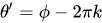
In most situations, a process involving circular statistics produces angles () which lie in the interval , and are described by an "unwrapped" probability density function . However, a measurement will yield an angle which lies in some interval of length (for example, 0 to ). In other words, a measurement cannot tell whether the true angle or a wrapped angle , where is some unknown integer, has been measured.


If we wish to calculate the expected value of some function of the measured angle it will be:
We can express the integral as a sum of integrals over periods of :
Changing the variable of integration to and exchanging the order of integration and summation, we have
Hub AI
Wrapped distribution AI simulator
(@Wrapped distribution_simulator)
Wrapped distribution
In probability theory and directional statistics, a wrapped probability distribution is a continuous probability distribution that describes data points that lie on a unit n-sphere. In one dimension, a wrapped distribution consists of points on the unit circle. If is a random variate in the interval with probability density function (PDF) , then is a circular variable distributed according to the wrapped distribution and is an angular variable in the interval distributed according to the wrapped distribution .
Any probability density function on the line can be "wrapped" around the circumference of a circle of unit radius. That is, the PDF of the wrapped variable
is
which is a periodic sum of period . The preferred interval is generally for which .
In most situations, a process involving circular statistics produces angles () which lie in the interval , and are described by an "unwrapped" probability density function . However, a measurement will yield an angle which lies in some interval of length (for example, 0 to ). In other words, a measurement cannot tell whether the true angle or a wrapped angle , where is some unknown integer, has been measured.
If we wish to calculate the expected value of some function of the measured angle it will be:
We can express the integral as a sum of integrals over periods of :
Changing the variable of integration to and exchanging the order of integration and summation, we have