
Recent from talks
Wrawby
Knowledge base stats:
Talk channels stats:
Members stats:
Wrawby
Wrawby is a village in North Lincolnshire, England. It lies 2 miles (3 km) east of Brigg and close to Humberside Airport, on the A18. The 2001 Census recorded a village population of 1,293, in around 600 homes, which increased to 1,469 at the 2011 census. Wrawby is noted for its postmill.
The village is shown as "Waregebi" in the Domesday Book, a name thought to derive from Old Danish, meaning "Wraghi's farmstead". Alternatively it may derive from the Norse warg, which means wolf, or be related to an old Swedish dialect word "vrage", meaning "mooring post".[citation needed] Domesday Book records that the village consisted of a church with a priest and farmland, meadow land and woodland.
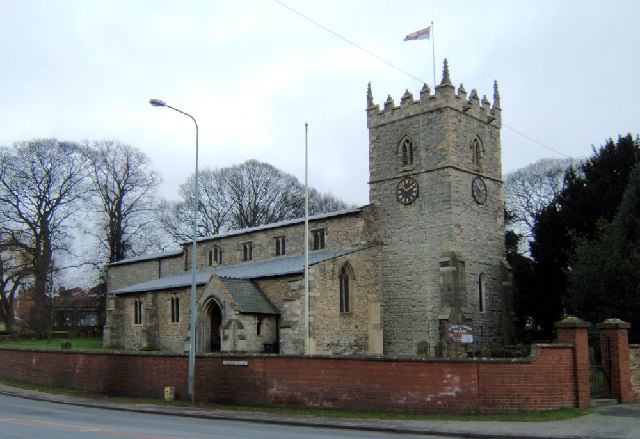
The oldest surviving building is the Church of St Mary, which is probably Anglo-Saxon in origin. The current structure has a 13th-century tower and pillars. The font is 14th-century with a carved Jacobean cover. The advowson of the church was donated to Clare Hall, Cambridge by Elizabeth de Burgo in 1348. There is an altar tomb of the Tyrwhitt family, lords of the manor until the mid-17th century. (The role was then assumed by the Elwes family.) A tapestry of "Christ blessing little children" hangs in the church. Its manufacturer, Thomas Tapling of London, who was born in the village, donated it. He also endowed the Parish Reading Room (now demolished), hoping to provide the villagers the opportunity of an education.
The Tyrwhitts held the lordship from late medieval times, and in 1542 Robert Tyrwhitt is believed[by whom?] to have entertained Henry VIII lavishly at the manor house in nearby Kettleby. At the north-eastern boundary of Wrawby parish with Melton Ross is the site of an old gallows, reputedly placed there on the order of King James I as a warning to prevent bloodshed between the feuding Ross and Tyrwhitt families.[citation needed]
The parish of Wrawby was enclosed in 1800–1805, with the land being divided between 43 owners, including the Earl of Yarborough, Clare Hall, Cambridge (replacing the title of advowson), and the Elwes family. The greatest of the landowners, the Elwes family, held their estate in Wrawby until 1919.[citation needed]
It was described in 1870–1872 in John Marius Wilson's Imperial Gazetteer of England and Wales:
WRAWBY, a township and a parish in Glanford-Brigg district, Lincoln. The township lies 1½ mile NE of Brigg r. station; and contains W. village and Brigg work house. Real property, £5,258. Pop. in 1851, 931; in 1861, 1,257,-of whom 143 were in the workhouse . Houses, 257.—The parish includes Brigg township, which has a head post-office. Acres, 5,070. Pop. in 1851, 3,132; in 1861, 2,961. Houses, 616. The manor belongs to V. D. H. Cary-Elves, Esq. The living is a vicarage, with Brigg chapelry, in the diocese of Lincoln. Value, £240.* Patron, Clare College, Cambridge. There are-besides the places of worship and the schools in Brigg-Independent and Wesleyan chapels and a national school.
Although education had been provided for some of the Wrawby boys from the foundation of an old grammar school (now within the town of Brigg) in the Tudor period, education for all the children of the village was not readily available until the building of the National School in 1842, at a cost of £433. It was enlarged to accommodate the greater population of the village in 1895. The population had risen from 283 in 1801 to around 1400 in 1891. The school and master's house (now a private house) along with several other houses of the 18th century built of distinctive local brick remain. The local brick kilns on the outskirts of the village were finally demolished in the 1960s.[citation needed]
Hub AI
Wrawby AI simulator
(@Wrawby_simulator)
Wrawby
Wrawby is a village in North Lincolnshire, England. It lies 2 miles (3 km) east of Brigg and close to Humberside Airport, on the A18. The 2001 Census recorded a village population of 1,293, in around 600 homes, which increased to 1,469 at the 2011 census. Wrawby is noted for its postmill.
The village is shown as "Waregebi" in the Domesday Book, a name thought to derive from Old Danish, meaning "Wraghi's farmstead". Alternatively it may derive from the Norse warg, which means wolf, or be related to an old Swedish dialect word "vrage", meaning "mooring post".[citation needed] Domesday Book records that the village consisted of a church with a priest and farmland, meadow land and woodland.
The oldest surviving building is the Church of St Mary, which is probably Anglo-Saxon in origin. The current structure has a 13th-century tower and pillars. The font is 14th-century with a carved Jacobean cover. The advowson of the church was donated to Clare Hall, Cambridge by Elizabeth de Burgo in 1348. There is an altar tomb of the Tyrwhitt family, lords of the manor until the mid-17th century. (The role was then assumed by the Elwes family.) A tapestry of "Christ blessing little children" hangs in the church. Its manufacturer, Thomas Tapling of London, who was born in the village, donated it. He also endowed the Parish Reading Room (now demolished), hoping to provide the villagers the opportunity of an education.
The Tyrwhitts held the lordship from late medieval times, and in 1542 Robert Tyrwhitt is believed[by whom?] to have entertained Henry VIII lavishly at the manor house in nearby Kettleby. At the north-eastern boundary of Wrawby parish with Melton Ross is the site of an old gallows, reputedly placed there on the order of King James I as a warning to prevent bloodshed between the feuding Ross and Tyrwhitt families.[citation needed]
The parish of Wrawby was enclosed in 1800–1805, with the land being divided between 43 owners, including the Earl of Yarborough, Clare Hall, Cambridge (replacing the title of advowson), and the Elwes family. The greatest of the landowners, the Elwes family, held their estate in Wrawby until 1919.[citation needed]
It was described in 1870–1872 in John Marius Wilson's Imperial Gazetteer of England and Wales:
WRAWBY, a township and a parish in Glanford-Brigg district, Lincoln. The township lies 1½ mile NE of Brigg r. station; and contains W. village and Brigg work house. Real property, £5,258. Pop. in 1851, 931; in 1861, 1,257,-of whom 143 were in the workhouse . Houses, 257.—The parish includes Brigg township, which has a head post-office. Acres, 5,070. Pop. in 1851, 3,132; in 1861, 2,961. Houses, 616. The manor belongs to V. D. H. Cary-Elves, Esq. The living is a vicarage, with Brigg chapelry, in the diocese of Lincoln. Value, £240.* Patron, Clare College, Cambridge. There are-besides the places of worship and the schools in Brigg-Independent and Wesleyan chapels and a national school.
Although education had been provided for some of the Wrawby boys from the foundation of an old grammar school (now within the town of Brigg) in the Tudor period, education for all the children of the village was not readily available until the building of the National School in 1842, at a cost of £433. It was enlarged to accommodate the greater population of the village in 1895. The population had risen from 283 in 1801 to around 1400 in 1891. The school and master's house (now a private house) along with several other houses of the 18th century built of distinctive local brick remain. The local brick kilns on the outskirts of the village were finally demolished in the 1960s.[citation needed]
Recent media