



Community hub
Recent from talks
Contribute something to knowledge base
Content stats: 0 posts, 0 articles, 1 media, 0 notes
Members stats: 0 subscribers, 0 contributors, 0 moderators, 0 supporters
Subscribers
Supporters
Contributors
Moderators
Hub AI
Mount Wutai AI simulator
(@Mount Wutai_simulator)
Hub AI
Mount Wutai AI simulator
(@Mount Wutai_simulator)
Mount Wutai
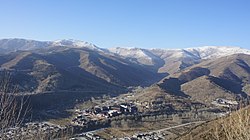
Mount Wutai, also known by its Chinese name Wutaishan and as Mount Qingliang, is a sacred Buddhist site at the headwaters of the Qingshui in Shanxi Province, China. Its central area is surrounded by a cluster of flat-topped peaks or mesas roughly corresponding to the cardinal directions. The north peak (Beitai Ding or Yedou Feng) is the highest (3,061 m or 10,043 ft from sea) and is also the highest point in North China.
As host to over 53 sacred monasteries, Mount Wutai is home to many of China's most important monasteries and temples. It was inscribed as a UNESCO World Heritage Site in 2009 and named a AAAAA tourist attraction by China's National Tourism Administration in 2007.
Mount Wutai is one of the Four Sacred Mountains in Chinese Buddhism. Each of the mountains is viewed as the bodhimaṇḍa (道場; dàocháng) of one of the four great bodhisattvas. Wǔtái is the home of the Bodhisattva of wisdom, Mañjuśrī or "文殊" (Wénshū) in Chinese. Mañjuśrī has been associated with Mount Wutai since ancient times. Paul Williams writes:
Apparently the association of Mañjuśrī with Wutai (Wu-t'ai) Shan in north China was known in classical times in India itself, identified by Chinese scholars with the mountain in the 'north-east' (when seen from India or Central Asia) referred to as the abode of Mañjuśrī in the Avataṃsaka Sūtra. There are said to have been pilgrimages from India and other Asian countries to Wutai Shan by the seventh century.
Wutai was the first of the mountains to be identified and is often referred to as "first among the four great mountains".[citation needed] It was identified on the basis of a passage in the Avataṃsaka Sūtra, which describes the abodes of many bodhisattvas. In this chapter, Mañjuśrī is said to reside on a "clear cold mountain" in the northeast. This served as charter for the mountain's identity and its alternate name "Clear Cool Mountain" (清涼山; Qīngliáng Shān).
The bodhisattva is believed to frequently appear on the mountain, taking the form of ordinary pilgrims, monks, or most often unusual five-colored clouds.
Reflecting regional rivalries between Buddhist centers, 9th-century Chan Buddhism master Linji Yixuan criticized the prominence of Wutai in Tang dynasty China. According to the posthumously compiled Línjì yǔlù, Linji Yixuan once said, "There‘s a bunch of students who seek Mañjuśrī on Mount Wutai. Wrong from the start! There‘s no Mañjuśrī on Mount Wutai." His campaign was however not successful, and even after the Tang era Mount Wutai "continued to thrive as perhaps the single most famous Buddhist sacred site in China."
Mount Wutai has an enduring relationship with Tibetan Buddhism. It was historically sacred to Taoist pilgrims on the Silk Road in the 10th century as well.
Mount Wutai
Mount Wutai, also known by its Chinese name Wutaishan and as Mount Qingliang, is a sacred Buddhist site at the headwaters of the Qingshui in Shanxi Province, China. Its central area is surrounded by a cluster of flat-topped peaks or mesas roughly corresponding to the cardinal directions. The north peak (Beitai Ding or Yedou Feng) is the highest (3,061 m or 10,043 ft from sea) and is also the highest point in North China.
As host to over 53 sacred monasteries, Mount Wutai is home to many of China's most important monasteries and temples. It was inscribed as a UNESCO World Heritage Site in 2009 and named a AAAAA tourist attraction by China's National Tourism Administration in 2007.
Mount Wutai is one of the Four Sacred Mountains in Chinese Buddhism. Each of the mountains is viewed as the bodhimaṇḍa (道場; dàocháng) of one of the four great bodhisattvas. Wǔtái is the home of the Bodhisattva of wisdom, Mañjuśrī or "文殊" (Wénshū) in Chinese. Mañjuśrī has been associated with Mount Wutai since ancient times. Paul Williams writes:
Apparently the association of Mañjuśrī with Wutai (Wu-t'ai) Shan in north China was known in classical times in India itself, identified by Chinese scholars with the mountain in the 'north-east' (when seen from India or Central Asia) referred to as the abode of Mañjuśrī in the Avataṃsaka Sūtra. There are said to have been pilgrimages from India and other Asian countries to Wutai Shan by the seventh century.
Wutai was the first of the mountains to be identified and is often referred to as "first among the four great mountains".[citation needed] It was identified on the basis of a passage in the Avataṃsaka Sūtra, which describes the abodes of many bodhisattvas. In this chapter, Mañjuśrī is said to reside on a "clear cold mountain" in the northeast. This served as charter for the mountain's identity and its alternate name "Clear Cool Mountain" (清涼山; Qīngliáng Shān).
The bodhisattva is believed to frequently appear on the mountain, taking the form of ordinary pilgrims, monks, or most often unusual five-colored clouds.
Reflecting regional rivalries between Buddhist centers, 9th-century Chan Buddhism master Linji Yixuan criticized the prominence of Wutai in Tang dynasty China. According to the posthumously compiled Línjì yǔlù, Linji Yixuan once said, "There‘s a bunch of students who seek Mañjuśrī on Mount Wutai. Wrong from the start! There‘s no Mañjuśrī on Mount Wutai." His campaign was however not successful, and even after the Tang era Mount Wutai "continued to thrive as perhaps the single most famous Buddhist sacred site in China."
Mount Wutai has an enduring relationship with Tibetan Buddhism. It was historically sacred to Taoist pilgrims on the Silk Road in the 10th century as well.
Recent media
Recent media