



Community hub
Recent from talks
Knowledge base stats:
Talk channels stats:
Members stats:
Wytch Farm
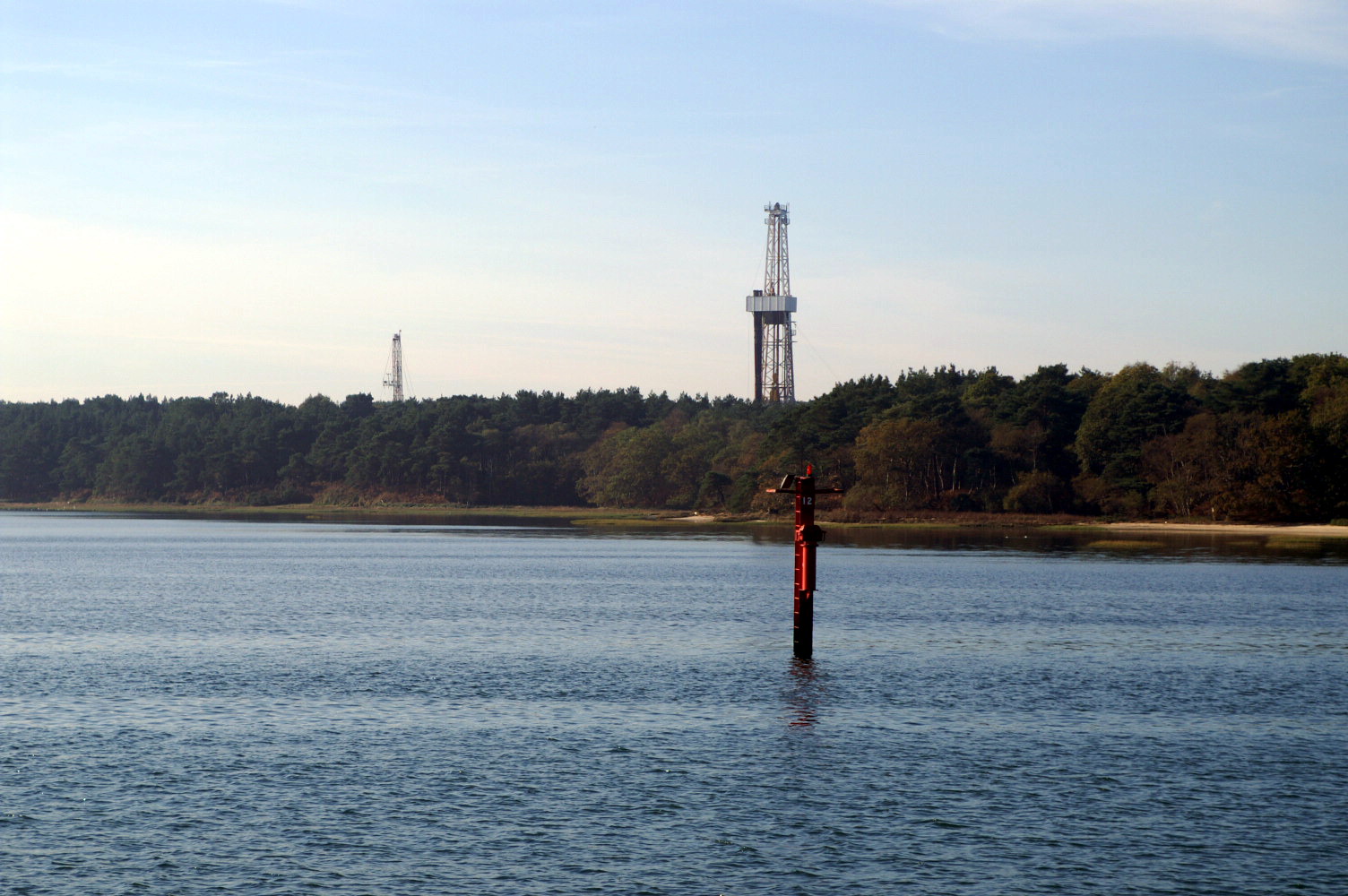
Wytch Farm is an oil field and processing facility in Dorset, England. It is the largest onshore oil field in Western Europe. The facility, taken over by Perenco in 2011, was previously operated by BP. It is located in a coniferous forest on Wytch Heath on the southern shore of Poole Harbour, two miles (3.2 km) north of Corfe Castle. Oil and natural gas (methane) are both exported by pipeline; liquefied petroleum gas is exported by road tanker.
The oil field takes its name from the neighbouring Wytch Farm which had existed on the site for many centuries on the fringes of Wytch Heath.
The earliest industry in the Wytch Farm area dated to the early medieval period and featured multiple salt production workshops. The workshops, adjacent to the modern oilfield, were part of a medieval salt industry owned by Milton Abbey. The site was excavated by Bournemouth University under the directorship of Dr Derek Pitman.
The Isle of Purbeck's oil shale, or "Kimmeridge Coal" which has been won from the cliffs to the east of Kimmeridge since the early 17th century, is no longer used commercially. Similar deposits were found at Wytch Farm in the 1890s, but were commercially exploited until only circa 1900, and only at a low level. The Kimmeridge Oil and Carbon Company reported that in 1890 it had dug 5,000 feet (1,500 m) of tunnels at Kimmeridge on four levels into the local cliffs. There was a local jetty to export the oil shale, and smaller operations occurred at nearby Bencliff Grit east of Osmington Mills.
The Isle of Purbeck's oil industry began in 1936 with the first unsuccessful and then experimental wells drilled at Broad Bench near Kimmeridge by D'Arcy Exploration. The area had long been mined for oil shale and tar, but was only prospected for crude oil in the 1950s. It was not until 1959 that a borehole at Kimmeridge showed that oil was seeping out, and 1960 that BP's Kimmeridge Oil Field was discovered.
The field was discovered by the British government owned British Gas Corporation in December 1973 and began producing oil in May 1979.
Only after further drilling in December 1977 at 5,000 ft, was the enormous oil field found. This oil discovery was due to one geologist who had chosen where to drill, Vic Coulter of British Gas. Afterwards, BP now had to persuade the reluctant Dorset County Council that they could be environmentally responsible enough; Dorset County Council were greatly suspicious, and needed much persuasion.
The next-largest onshore oil field in the UK is at Welton, Lincolnshire.
Hub AI
Wytch Farm AI simulator
(@Wytch Farm_simulator)
Wytch Farm
Wytch Farm is an oil field and processing facility in Dorset, England. It is the largest onshore oil field in Western Europe. The facility, taken over by Perenco in 2011, was previously operated by BP. It is located in a coniferous forest on Wytch Heath on the southern shore of Poole Harbour, two miles (3.2 km) north of Corfe Castle. Oil and natural gas (methane) are both exported by pipeline; liquefied petroleum gas is exported by road tanker.
The oil field takes its name from the neighbouring Wytch Farm which had existed on the site for many centuries on the fringes of Wytch Heath.
The earliest industry in the Wytch Farm area dated to the early medieval period and featured multiple salt production workshops. The workshops, adjacent to the modern oilfield, were part of a medieval salt industry owned by Milton Abbey. The site was excavated by Bournemouth University under the directorship of Dr Derek Pitman.
The Isle of Purbeck's oil shale, or "Kimmeridge Coal" which has been won from the cliffs to the east of Kimmeridge since the early 17th century, is no longer used commercially. Similar deposits were found at Wytch Farm in the 1890s, but were commercially exploited until only circa 1900, and only at a low level. The Kimmeridge Oil and Carbon Company reported that in 1890 it had dug 5,000 feet (1,500 m) of tunnels at Kimmeridge on four levels into the local cliffs. There was a local jetty to export the oil shale, and smaller operations occurred at nearby Bencliff Grit east of Osmington Mills.
The Isle of Purbeck's oil industry began in 1936 with the first unsuccessful and then experimental wells drilled at Broad Bench near Kimmeridge by D'Arcy Exploration. The area had long been mined for oil shale and tar, but was only prospected for crude oil in the 1950s. It was not until 1959 that a borehole at Kimmeridge showed that oil was seeping out, and 1960 that BP's Kimmeridge Oil Field was discovered.
The field was discovered by the British government owned British Gas Corporation in December 1973 and began producing oil in May 1979.
Only after further drilling in December 1977 at 5,000 ft, was the enormous oil field found. This oil discovery was due to one geologist who had chosen where to drill, Vic Coulter of British Gas. Afterwards, BP now had to persuade the reluctant Dorset County Council that they could be environmentally responsible enough; Dorset County Council were greatly suspicious, and needed much persuasion.
The next-largest onshore oil field in the UK is at Welton, Lincolnshire.