
Recent from talks
XYY syndrome
Knowledge base stats:
Talk channels stats:
Members stats:
XYY syndrome
XYY syndrome, also known as Jacobs syndrome and Superman syndrome, is an aneuploid genetic condition in which a male has an extra Y chromosome. There are usually few symptoms. These may include being taller than average and an increased risk of learning disabilities. The person is generally otherwise normal, including typical rates of fertility.
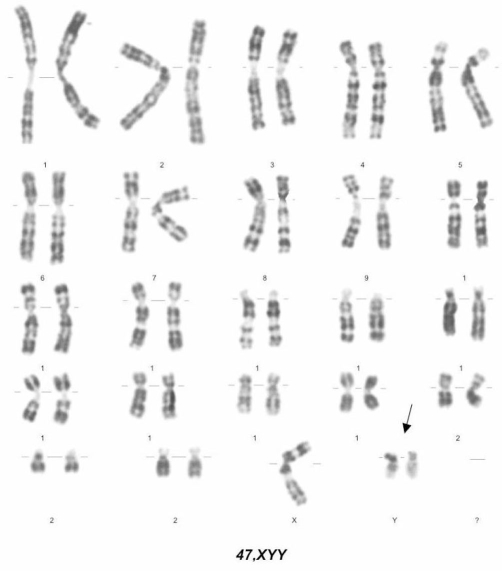
The condition is generally not inherited but rather occurs as a result of a random event during sperm development. Diagnosis is by a chromosomal analysis, but most of those affected are not diagnosed within their lifetime. There are 47 chromosomes, instead of the usual 46, giving a 47,XYY karyotype.
Treatment may include speech therapy or extra help with schoolwork, and outcomes are generally positive. The condition occurs in about 1 in 1,000 male births. Many people with the condition are unaware that they have it. The condition was first described in 1961.
People with the 47,XYY karyotype have an increased growth rate from early childhood, with an average final height approximately 7 centimetres (2+3⁄4 in) above expected final height. In Edinburgh, Scotland, eight 47,XYY boys born 1967–1972 and identified in a newborn screening programme had an average height of 188.1 cm (6 ft 2 in) at age 18—their fathers' average height was 174.1 cm (5 ft 8+1⁄2 in), their mothers' average height was 162.8 cm (5 ft 4+1⁄8 in). The increased gene dosage of three X/Y chromosome pseudoautosomal region (PAR1) SHOX genes has been postulated as a cause of the increased stature seen in all three sex chromosome trisomies: 47,XXX, 47,XXY, and 47,XYY. Severe acne was noted in a very few early case reports, but dermatologists specializing in acne now doubt the existence of a relationship with 47,XYY.
Prenatal testosterone levels are normal in 47,XYY males. Most 47,XYY males have normal sexual development and have normal fertility.
In contrast to the other common sex chromosome aneuploidies—47,XXX and 47,XXY (Klinefelter syndrome)—the average of the IQ scores of 47,XYY boys identified by newborn screening programs was not reduced compared to the general population. In a summary of six prospective studies of 47,XYY boys identified by newborn screening programmes, twenty-eight 47,XYY boys had an average 100.76 verbal IQ, 108.79 performance IQ, and 105.00 full-scale IQ. In a systematic review including two prospective studies of 47,XYY boys identified by newborn screening programs and one retrospective study of 47,XYY men identified by screening men over 184 cm (6 ft 1⁄2 in) in height, forty-two 47,XYY boys and men had an average 99.5 verbal IQ and 106.4 performance IQ.
In prospective studies of 47,XYY boys identified by newborn screening programs, the IQ scores of 47,XYY boys were usually slightly lower than those of their siblings. In Edinburgh, fifteen 47,XYY boys with siblings identified in a newborn screening program had an average 104.0 verbal IQ and 106.7 performance IQ, while their siblings had an average 112.9 verbal IQ and 114.6 performance IQ.
Approximately half of 47,XYY boys identified by newborn screening programs had learning difficulties—a higher proportion than found among siblings and above-average-IQ control groups. In Edinburgh, 54% of 47,XYY boys (7 of 13) identified in a newborn screening program received remedial reading teaching compared to 18% (4 of 22) in an above-average-IQ control group of 46,XY boys matched by their father's social class. In Boston, USA 55% of 47,XYY boys (6 of 11) identified in a newborn screening program had learning difficulties and received part-time resource room help compared to 11% (1 of 9) in an above-average-IQ control group of 46,XY boys with familial balanced autosomal chromosome translocations.
Hub AI
XYY syndrome AI simulator
(@XYY syndrome_simulator)
XYY syndrome
XYY syndrome, also known as Jacobs syndrome and Superman syndrome, is an aneuploid genetic condition in which a male has an extra Y chromosome. There are usually few symptoms. These may include being taller than average and an increased risk of learning disabilities. The person is generally otherwise normal, including typical rates of fertility.
The condition is generally not inherited but rather occurs as a result of a random event during sperm development. Diagnosis is by a chromosomal analysis, but most of those affected are not diagnosed within their lifetime. There are 47 chromosomes, instead of the usual 46, giving a 47,XYY karyotype.
Treatment may include speech therapy or extra help with schoolwork, and outcomes are generally positive. The condition occurs in about 1 in 1,000 male births. Many people with the condition are unaware that they have it. The condition was first described in 1961.
People with the 47,XYY karyotype have an increased growth rate from early childhood, with an average final height approximately 7 centimetres (2+3⁄4 in) above expected final height. In Edinburgh, Scotland, eight 47,XYY boys born 1967–1972 and identified in a newborn screening programme had an average height of 188.1 cm (6 ft 2 in) at age 18—their fathers' average height was 174.1 cm (5 ft 8+1⁄2 in), their mothers' average height was 162.8 cm (5 ft 4+1⁄8 in). The increased gene dosage of three X/Y chromosome pseudoautosomal region (PAR1) SHOX genes has been postulated as a cause of the increased stature seen in all three sex chromosome trisomies: 47,XXX, 47,XXY, and 47,XYY. Severe acne was noted in a very few early case reports, but dermatologists specializing in acne now doubt the existence of a relationship with 47,XYY.
Prenatal testosterone levels are normal in 47,XYY males. Most 47,XYY males have normal sexual development and have normal fertility.
In contrast to the other common sex chromosome aneuploidies—47,XXX and 47,XXY (Klinefelter syndrome)—the average of the IQ scores of 47,XYY boys identified by newborn screening programs was not reduced compared to the general population. In a summary of six prospective studies of 47,XYY boys identified by newborn screening programmes, twenty-eight 47,XYY boys had an average 100.76 verbal IQ, 108.79 performance IQ, and 105.00 full-scale IQ. In a systematic review including two prospective studies of 47,XYY boys identified by newborn screening programs and one retrospective study of 47,XYY men identified by screening men over 184 cm (6 ft 1⁄2 in) in height, forty-two 47,XYY boys and men had an average 99.5 verbal IQ and 106.4 performance IQ.
In prospective studies of 47,XYY boys identified by newborn screening programs, the IQ scores of 47,XYY boys were usually slightly lower than those of their siblings. In Edinburgh, fifteen 47,XYY boys with siblings identified in a newborn screening program had an average 104.0 verbal IQ and 106.7 performance IQ, while their siblings had an average 112.9 verbal IQ and 114.6 performance IQ.
Approximately half of 47,XYY boys identified by newborn screening programs had learning difficulties—a higher proportion than found among siblings and above-average-IQ control groups. In Edinburgh, 54% of 47,XYY boys (7 of 13) identified in a newborn screening program received remedial reading teaching compared to 18% (4 of 22) in an above-average-IQ control group of 46,XY boys matched by their father's social class. In Boston, USA 55% of 47,XYY boys (6 of 11) identified in a newborn screening program had learning difficulties and received part-time resource room help compared to 11% (1 of 9) in an above-average-IQ control group of 46,XY boys with familial balanced autosomal chromosome translocations.
Recent media