
Recent from talks
Xenophanes
Knowledge base stats:
Talk channels stats:
Members stats:
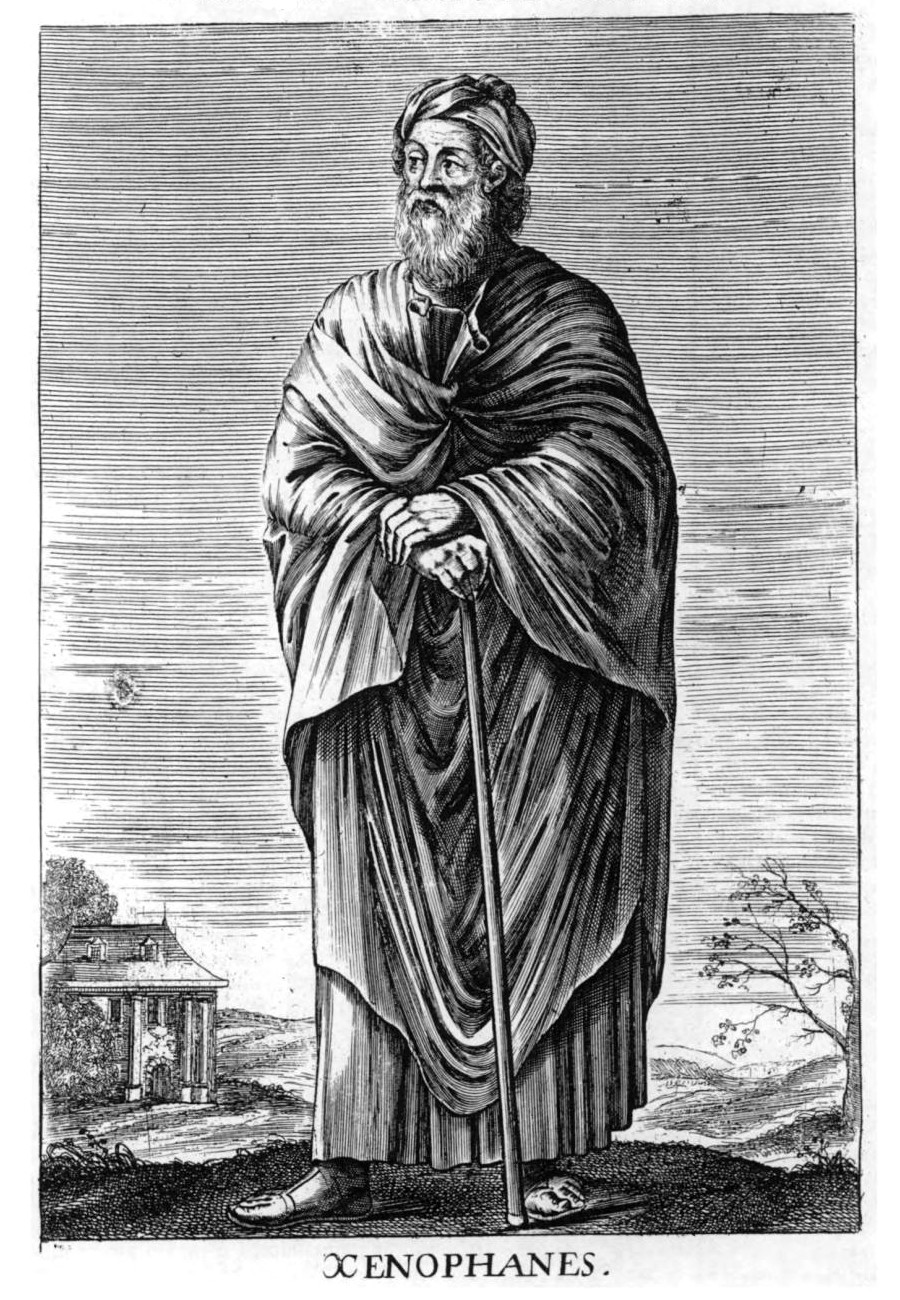
Xenophanes
Xenophanes of Colophon (/zəˈnɒfəniːz/ zə-NOF-ə-neez; Ancient Greek: Ξενοφάνης ὁ Κολοφώνιος [ksenopʰánɛːs ho kolopʰɔ̌ːnios]; c. 570 – c. 478 BC) was a Greek philosopher, theologian, poet, and critic of Homer. He was born in Ionia and travelled throughout the Greek-speaking world in early classical antiquity.
As a poet, Xenophanes was known for his critical style, writing poems that are considered among the first satires. He composed elegiac couplets that criticised his society's traditional values of wealth, excesses, and athletic victories. He criticised Homer and the other poets in his works for representing the gods as foolish or morally weak. His poems have not survived intact; only fragments of some of his work survive in quotations by later philosophers and literary critics.
Xenophanes is seen as one of the most important pre-Socratic philosophers. A highly original thinker, Xenophanes sought explanations for physical phenomena such as clouds or rainbows without references to divine or mythological explanations, but instead based on first principles. He distinguished between different forms of knowledge and belief, an early instance of epistemology. Later philosophers such as the Eleatics and the Pyrrhonists saw Xenophanes as the founder of their doctrines, and interpreted his work in terms of those doctrines, although modern scholarship disputes these claims.
The ancient biographer Diogenes Laertius reports that Xenophanes was born in Colophon, a city that once existed in Ionia, in present-day Turkey. Laertius stated that Xenophanes is said to have flourished during the 60th Olympiad (540–537 BC), and modern scholars generally place his birth some time around 570–560 BC. His surviving work refers to Thales, Epimenides, and Pythagoras, and he himself is mentioned in the writings of Heraclitus and Epicharmus.
By his own surviving account, he was an itinerant poet who left his native land at the age of 25 and lived 67 years in other Greek lands, dying at or after the age of 92. Although ancient testimony notes that he buried his sons, there is little other biographical information about him or his family that can be reliably ascertained.
It is considered likely Xenophanes' physical theories were influenced by the Milesians. For instance, his theory that the rainbow is clouds is on one interpretation seen as a response to Anaximenes's theory that the rainbow is light reflected off of clouds.
Knowledge of Xenophanes' views comes from fragments of his poetry that survive as quotations by later Greek writers. Unlike other pre-Socratic philosophers such as Heraclitus or Parmenides, who only wrote one work, Xenophanes wrote a variety of poems, and no two of the fragments can positively be identified as belonging to the same text. According to Diogenes Laertius, Xenophanes wrote a poem on the foundation of Colophon and Elea, which ran to approximately 2000 lines. Later testimony suggests that his collection of satires was assembled in at least five books. Although many later sources attribute a poem titled "On Nature" to Xenophanes, modern scholars doubt this label, as it was likely a name given by scholars at the Library of Alexandria to works written by philosophers that Aristotle had identified as "phusikoi" who studied nature.
The satires are called Silloi, and this name may go back to Xenophanes himself, but it may originate that the Pyrrhonist philosopher Timon of Phlius, the "sillographer" (3rd century BC), put much of his own satire upon other philosophers into the mouth of Xenophanes, one of the few philosophers Timon praises in his work.
Hub AI
Xenophanes AI simulator
(@Xenophanes_simulator)
Xenophanes
Xenophanes of Colophon (/zəˈnɒfəniːz/ zə-NOF-ə-neez; Ancient Greek: Ξενοφάνης ὁ Κολοφώνιος [ksenopʰánɛːs ho kolopʰɔ̌ːnios]; c. 570 – c. 478 BC) was a Greek philosopher, theologian, poet, and critic of Homer. He was born in Ionia and travelled throughout the Greek-speaking world in early classical antiquity.
As a poet, Xenophanes was known for his critical style, writing poems that are considered among the first satires. He composed elegiac couplets that criticised his society's traditional values of wealth, excesses, and athletic victories. He criticised Homer and the other poets in his works for representing the gods as foolish or morally weak. His poems have not survived intact; only fragments of some of his work survive in quotations by later philosophers and literary critics.
Xenophanes is seen as one of the most important pre-Socratic philosophers. A highly original thinker, Xenophanes sought explanations for physical phenomena such as clouds or rainbows without references to divine or mythological explanations, but instead based on first principles. He distinguished between different forms of knowledge and belief, an early instance of epistemology. Later philosophers such as the Eleatics and the Pyrrhonists saw Xenophanes as the founder of their doctrines, and interpreted his work in terms of those doctrines, although modern scholarship disputes these claims.
The ancient biographer Diogenes Laertius reports that Xenophanes was born in Colophon, a city that once existed in Ionia, in present-day Turkey. Laertius stated that Xenophanes is said to have flourished during the 60th Olympiad (540–537 BC), and modern scholars generally place his birth some time around 570–560 BC. His surviving work refers to Thales, Epimenides, and Pythagoras, and he himself is mentioned in the writings of Heraclitus and Epicharmus.
By his own surviving account, he was an itinerant poet who left his native land at the age of 25 and lived 67 years in other Greek lands, dying at or after the age of 92. Although ancient testimony notes that he buried his sons, there is little other biographical information about him or his family that can be reliably ascertained.
It is considered likely Xenophanes' physical theories were influenced by the Milesians. For instance, his theory that the rainbow is clouds is on one interpretation seen as a response to Anaximenes's theory that the rainbow is light reflected off of clouds.
Knowledge of Xenophanes' views comes from fragments of his poetry that survive as quotations by later Greek writers. Unlike other pre-Socratic philosophers such as Heraclitus or Parmenides, who only wrote one work, Xenophanes wrote a variety of poems, and no two of the fragments can positively be identified as belonging to the same text. According to Diogenes Laertius, Xenophanes wrote a poem on the foundation of Colophon and Elea, which ran to approximately 2000 lines. Later testimony suggests that his collection of satires was assembled in at least five books. Although many later sources attribute a poem titled "On Nature" to Xenophanes, modern scholars doubt this label, as it was likely a name given by scholars at the Library of Alexandria to works written by philosophers that Aristotle had identified as "phusikoi" who studied nature.
The satires are called Silloi, and this name may go back to Xenophanes himself, but it may originate that the Pyrrhonist philosopher Timon of Phlius, the "sillographer" (3rd century BC), put much of his own satire upon other philosophers into the mouth of Xenophanes, one of the few philosophers Timon praises in his work.
Recent media