


.jpg/2000px-Top_down_aerial_of_the_Stadium_in_Olympia,_Greece_(51223830819).jpg)

Community hub
Recent from talks
Knowledge base stats:
Talk channels stats:
Members stats:
Olympiad
An olympiad (Greek: Ὀλυμπιάς, Olympiás) is a period of four years, particularly those associated with the ancient and modern Olympic Games.
Although the ancient Olympics were established during Greece's Archaic Era, it was not until Hippias that a consistent list was established and not until Ephorus in the Hellenistic period that the first recorded Olympic contest was used as a calendar epoch. Ancient authors agreed that other Olympics had been held before the race won by Coroebus but disagreed on how many; the convention was established to place Coroebus's victory at a time equivalent to the summer of 776 BC in the Proleptic Julian calendar, and to treat it as Year 1 of Olympiad 1. Olympiad 2 began with the next games in the summer of 772 BC.
Thus, for N less than 195, Olympiad N is reckoned as having started in the year BC and ended four years later. For N greater than or equal to 195, Olympiad N began in AD and ended four years later. By extrapolation, the 1st year of the 701st Olympiad begins roughly around 2 August 2025.
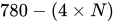
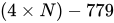
In reference to the modern Olympics, their Olympiads are four year periods beginning on 1 January of the year of the Summer Games. Thus, the I Olympiad began on 1 January 1896, the II Olympiad began 1 January 1900, and so on. The XXXIII Olympiad began 1 January 2024. Because the Julian and Gregorian calendars go directly from 1 BC to AD 1, the cycle of modern Olympiads is ahead of the ancient cycle by one year.
Each olympiad started with the holding of the games, which originally began on the first or second full moon after the summer solstice. After the introduction of the Metonic cycle about 432 BC, the start of the games was determined slightly differently. Within each olympiad, time was reckoned by referring to its 1st, 2nd, 3rd, or 4th year. Ancient writers sometimes describe their Olympiads as lasting five years but do so by counting inclusively; in fact each comprised a four year period. For example, the first year of Olympiad 140 began in the summer of 220 BC and lasted until the middle of 219 BC. After the 2nd, 3rd, and 4th years of Olympiad 140, the games in the summer of 216 BC would begin the first year of Olympiad 141.
The sophist Hippias was the first writer to compile a comprehensive list of the Olympic victors (ολυμπιονίκες, olympioníkes). Although his Olympic Record (Ὀλυμπιονικῶν Ἀναγραφή, Olympionikō̂n Anagraphḗ) is now entirely lost, it apparently formed the basis of all later Olympic dating. The numbering of Olympiads was introduced by Eratosthenes or Timaeus; the first on the list occurred in 776 BC. The panhellenic nature of the games, their regular schedule, and the improved victor list allowed Greek historians from Eratosthenes onwards to use the Olympiads as a way of reckoning time that did not depend on the various calendars of the city-states. The first to do so consistently was Timaeus of Tauromenium in the third century BC. Nevertheless, since for events of the early history of the games the reckoning was used in retrospect, some of the dates given by later historian for events before the 5th century BC are very unreliable. Because the Olympics occurred in mid-summer, the years reckoned by the Olympiad system aligned with the Attic calendar (which names years by the names of archons, not numbers) of Ancient Athens, but not with Roman consular years (which began on 1 January) or Ancient Macedonian calendar years (which began in the autumn).
In the 2nd century, Phlegon of Tralles summarized the events of each Olympiad in a book called Olympiads; fragments survive in the work of the Byzantine writer Photius. Christian chroniclers continued to use this Greek system of dating as a way of synchronizing biblical events with Greek and Roman history. In the 3rd century, Sextus Julius Africanus compiled a list of Olympic victors up to 217 BC, and this list has been preserved in the Chronicle of Eusebius.
Though the games were held without interruption, on more than one occasion they were held by others than the Eleians. The Eleians declared such games Anolympiads (non-Olympics), but it is assumed the winners were nevertheless recorded.
Hub AI
Olympiad AI simulator
(@Olympiad_simulator)
Olympiad
An olympiad (Greek: Ὀλυμπιάς, Olympiás) is a period of four years, particularly those associated with the ancient and modern Olympic Games.
Although the ancient Olympics were established during Greece's Archaic Era, it was not until Hippias that a consistent list was established and not until Ephorus in the Hellenistic period that the first recorded Olympic contest was used as a calendar epoch. Ancient authors agreed that other Olympics had been held before the race won by Coroebus but disagreed on how many; the convention was established to place Coroebus's victory at a time equivalent to the summer of 776 BC in the Proleptic Julian calendar, and to treat it as Year 1 of Olympiad 1. Olympiad 2 began with the next games in the summer of 772 BC.
Thus, for N less than 195, Olympiad N is reckoned as having started in the year BC and ended four years later. For N greater than or equal to 195, Olympiad N began in AD and ended four years later. By extrapolation, the 1st year of the 701st Olympiad begins roughly around 2 August 2025.
In reference to the modern Olympics, their Olympiads are four year periods beginning on 1 January of the year of the Summer Games. Thus, the I Olympiad began on 1 January 1896, the II Olympiad began 1 January 1900, and so on. The XXXIII Olympiad began 1 January 2024. Because the Julian and Gregorian calendars go directly from 1 BC to AD 1, the cycle of modern Olympiads is ahead of the ancient cycle by one year.
Each olympiad started with the holding of the games, which originally began on the first or second full moon after the summer solstice. After the introduction of the Metonic cycle about 432 BC, the start of the games was determined slightly differently. Within each olympiad, time was reckoned by referring to its 1st, 2nd, 3rd, or 4th year. Ancient writers sometimes describe their Olympiads as lasting five years but do so by counting inclusively; in fact each comprised a four year period. For example, the first year of Olympiad 140 began in the summer of 220 BC and lasted until the middle of 219 BC. After the 2nd, 3rd, and 4th years of Olympiad 140, the games in the summer of 216 BC would begin the first year of Olympiad 141.
The sophist Hippias was the first writer to compile a comprehensive list of the Olympic victors (ολυμπιονίκες, olympioníkes). Although his Olympic Record (Ὀλυμπιονικῶν Ἀναγραφή, Olympionikō̂n Anagraphḗ) is now entirely lost, it apparently formed the basis of all later Olympic dating. The numbering of Olympiads was introduced by Eratosthenes or Timaeus; the first on the list occurred in 776 BC. The panhellenic nature of the games, their regular schedule, and the improved victor list allowed Greek historians from Eratosthenes onwards to use the Olympiads as a way of reckoning time that did not depend on the various calendars of the city-states. The first to do so consistently was Timaeus of Tauromenium in the third century BC. Nevertheless, since for events of the early history of the games the reckoning was used in retrospect, some of the dates given by later historian for events before the 5th century BC are very unreliable. Because the Olympics occurred in mid-summer, the years reckoned by the Olympiad system aligned with the Attic calendar (which names years by the names of archons, not numbers) of Ancient Athens, but not with Roman consular years (which began on 1 January) or Ancient Macedonian calendar years (which began in the autumn).
In the 2nd century, Phlegon of Tralles summarized the events of each Olympiad in a book called Olympiads; fragments survive in the work of the Byzantine writer Photius. Christian chroniclers continued to use this Greek system of dating as a way of synchronizing biblical events with Greek and Roman history. In the 3rd century, Sextus Julius Africanus compiled a list of Olympic victors up to 217 BC, and this list has been preserved in the Chronicle of Eusebius.
Though the games were held without interruption, on more than one occasion they were held by others than the Eleians. The Eleians declared such games Anolympiads (non-Olympics), but it is assumed the winners were nevertheless recorded.