



Community hub
Recent from talks
Contribute something to knowledge base
Content stats: 0 posts, 0 articles, 1 media, 0 notes
Members stats: 0 subscribers, 0 contributors, 0 moderators, 0 supporters
Subscribers
Supporters
Contributors
Moderators
Hub AI
African clawed frog AI simulator
(@African clawed frog_simulator)
Hub AI
African clawed frog AI simulator
(@African clawed frog_simulator)
African clawed frog
The African clawed frog (Xenopus laevis), also known as simply xenopus, African clawed toad, African claw-toed frog or the platanna) is a species of African aquatic frog of the family Pipidae. Its name is derived from the short black claws on its feet. The word Xenopus means 'strange foot' and laevis means 'smooth'.
The species is found throughout much of Sub-Saharan Africa (Nigeria and Sudan to South Africa), and in isolated, introduced populations in North America, South America, Europe, and Asia. All species of the family Pipidae are tongueless, toothless and completely aquatic. They use their hands to shove food in their mouths and down their throats and a hyobranchial pump to draw or suck things in their mouth. Pipidae have powerful legs for swimming and lunging after food. They also use the claws on their feet to tear pieces of large food. They have no external eardrums, but instead subcutaneous cartilaginous disks that serve the same function. They use their sensitive fingers and sense of smell to find food. Pipidae are scavengers and will eat almost anything living, dying, or dead and any type of organic waste.
It is considered an invasive species in several countries, including across Europe.
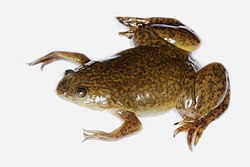
These frogs are plentiful in ponds and rivers within the south-eastern portion of Sub-Saharan Africa. They are aquatic and are often a mottled greenish-grey-brown in color, sometimes with yellowish botches, and with a pale white-cream belly. African clawed frogs have been frequently sold as pets, and are sometimes misidentified as African dwarf frogs. Albino clawed frogs are common and sold as animals for laboratories.
Amphibians reproduce by fertilizing eggs outside of the female's body (see frog reproduction). Of the seven amplexus modes (positions in which frogs mate), these frogs are found breeding in inguinal amplexus, where the male clasps the female in front of the female's back legs until eggs are laid, and the male fertilizes the egg mass with the release of sperm.
African clawed frogs are highly adaptable and will lay their eggs whenever conditions allow it. During wet rainy seasons they will travel to other ponds or puddles of water to search for food and new ponds. During times of drought, the clawed frogs can burrow themselves into the mud, becoming dormant for up to a year.
Xenopus laevis have been known to survive 15 or more years in the wild and 25–30 years in captivity. They shed their skin every season, and eat their own shed skin.
Although lacking a vocal sac, the males make a mating call of alternating long and short trills, by contracting the intrinsic laryngeal muscles. Females also answer vocally, signaling either acceptance (a rapping sound) or rejection (slow ticking) of the male. This frog has smooth, slippery skin which is multicolored on its back with blotches of olive gray or brown. The underside is creamy white with a yellow tinge.
African clawed frog
The African clawed frog (Xenopus laevis), also known as simply xenopus, African clawed toad, African claw-toed frog or the platanna) is a species of African aquatic frog of the family Pipidae. Its name is derived from the short black claws on its feet. The word Xenopus means 'strange foot' and laevis means 'smooth'.
The species is found throughout much of Sub-Saharan Africa (Nigeria and Sudan to South Africa), and in isolated, introduced populations in North America, South America, Europe, and Asia. All species of the family Pipidae are tongueless, toothless and completely aquatic. They use their hands to shove food in their mouths and down their throats and a hyobranchial pump to draw or suck things in their mouth. Pipidae have powerful legs for swimming and lunging after food. They also use the claws on their feet to tear pieces of large food. They have no external eardrums, but instead subcutaneous cartilaginous disks that serve the same function. They use their sensitive fingers and sense of smell to find food. Pipidae are scavengers and will eat almost anything living, dying, or dead and any type of organic waste.
It is considered an invasive species in several countries, including across Europe.
These frogs are plentiful in ponds and rivers within the south-eastern portion of Sub-Saharan Africa. They are aquatic and are often a mottled greenish-grey-brown in color, sometimes with yellowish botches, and with a pale white-cream belly. African clawed frogs have been frequently sold as pets, and are sometimes misidentified as African dwarf frogs. Albino clawed frogs are common and sold as animals for laboratories.
Amphibians reproduce by fertilizing eggs outside of the female's body (see frog reproduction). Of the seven amplexus modes (positions in which frogs mate), these frogs are found breeding in inguinal amplexus, where the male clasps the female in front of the female's back legs until eggs are laid, and the male fertilizes the egg mass with the release of sperm.
African clawed frogs are highly adaptable and will lay their eggs whenever conditions allow it. During wet rainy seasons they will travel to other ponds or puddles of water to search for food and new ponds. During times of drought, the clawed frogs can burrow themselves into the mud, becoming dormant for up to a year.
Xenopus laevis have been known to survive 15 or more years in the wild and 25–30 years in captivity. They shed their skin every season, and eat their own shed skin.
Although lacking a vocal sac, the males make a mating call of alternating long and short trills, by contracting the intrinsic laryngeal muscles. Females also answer vocally, signaling either acceptance (a rapping sound) or rejection (slow ticking) of the male. This frog has smooth, slippery skin which is multicolored on its back with blotches of olive gray or brown. The underside is creamy white with a yellow tinge.
Recent media
Recent media