
Recent from talks
Xi'an JH-7
Knowledge base stats:
Talk channels stats:
Members stats:
Xi'an JH-7
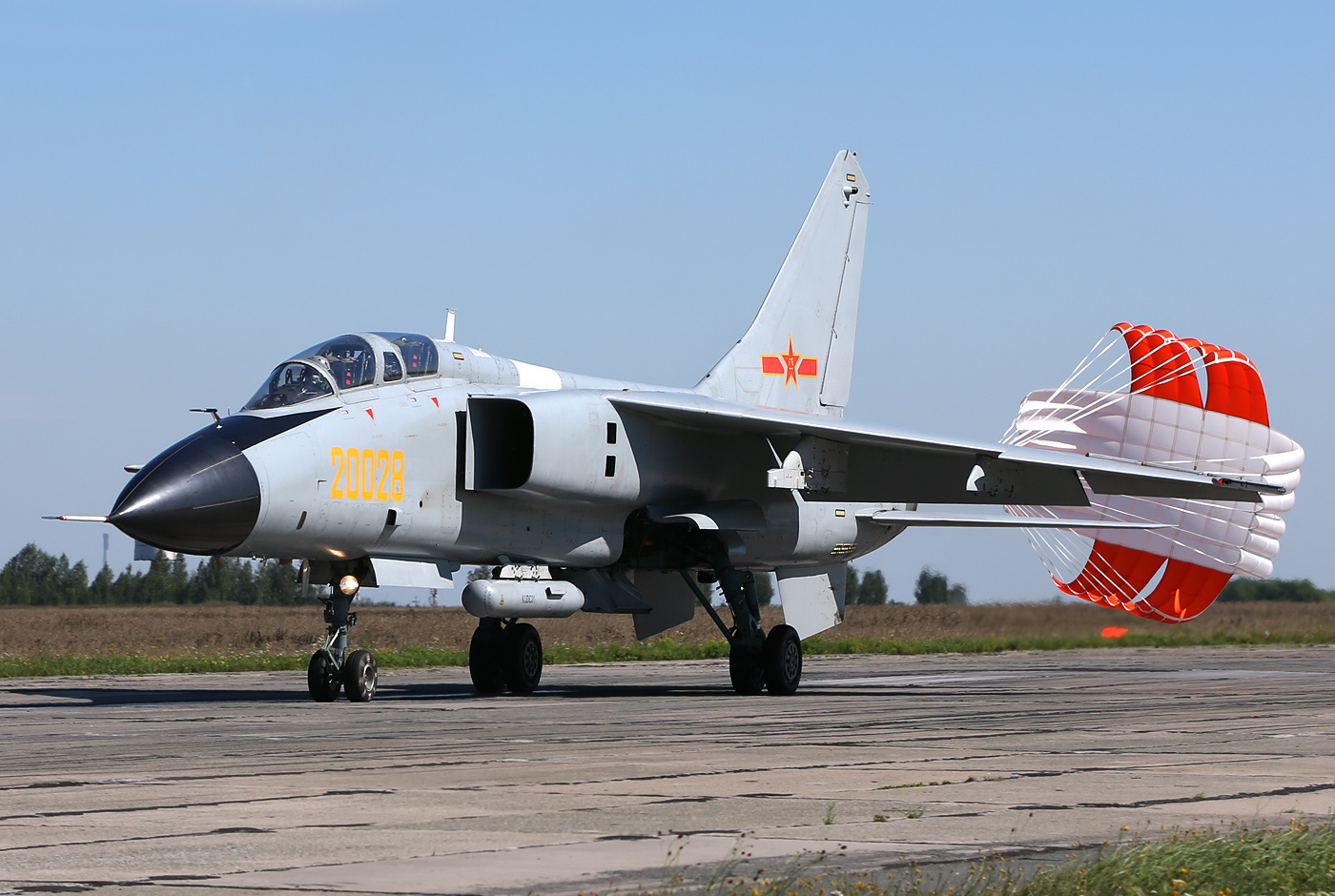
The Xi'an JH-7 (simplified Chinese: 歼轰-7; traditional Chinese: 殲轟-7; pinyin: jiān hōng qī – fighter-bomber; NATO reporting name Flounder), also known as the FBC-1 (Fighter/Bomber China-1) Flying Leopard, is a Chinese tandem two-seat, twin-engine fighter-bomber in service with the People's Liberation Army Naval Air Force (PLANAF), and the People's Liberation Army Air Force (PLAAF). The aircraft is produced by the Xi'an Aircraft Industrial Corporation (XAC); the design was developed with the 603 Institute (later the Xi'an Aviation Design and Research Institute).
The JH-7 entered service with the PLANAF in 1994. The JH-7A entered service with the People's Liberation Army Air Force (PLAAF) in 2004.
In the early 1970s, China started a program to replace the Nanchang Q-5 for the PLAAF and the PLANAF. XAC's proposal in November 1977 was for a large two-seat aircraft comparable to the General Dynamics F-111 Aardvark, Sukhoi Su-24, and Panavia Tornado. XAC intended to produce a variant for each end-user - the H-7 tactical bomber for the PLAAF and the JH-7 fighter-bomber for the PLANAF - to accommodate the differing requirements. By 1980, XAC was still attempting to find an acceptable baseline for both. The program began to receive lower priority. The Falklands War renewed interest in a naval fighter-bomber; in November 1982, the JH-7 became the main focus of development with the H-7 eventually being cancelled. In 1983, the Rolls-Royce RB.168 Spey Mk 202 turbofan—to be license produced as the WS-9—was chosen as the power plant over the domestic WS-6; the latter's development program failed.
Five prototypes, a static test article were built, and 12 or 18 pre-production aircraft were produced by 1992. All were powered by the Spey due to problems with the WS-9. The fourth prototype crashed in 1995 or 1996 due to engine failure. The aircraft's KF-1 fly-by-wire control system was tested on a modified Shenyang JJ-6.
The first flight occurred on 14 December 1988; it ended in an emergency landing after vibration disabled instrumentation. The first supersonic flight was on 17 November 1989. The live fire tests with the YJ-8 anti-ship missile occurred in 1996. Initial operating capability was reached in 1994 when pre-production aircraft entered PLANAF service, and the aircraft received its type certificate in 1998.
Full production was delayed by continuing problems with the WS-9. Rolls-Royce assisted Liming Aero Engines in 1997-1998. XAC considered replacing the engine with the Lyulka AL-31F or the Snecma M53; these were not pursued to avoid further delays. The delivery of production aircraft started in 2001. The delays caused the PLAAF to order the Sukhoi Su-30MKK.
When the PLA examined the future role of air forces, it identified a need for precision air-to-surface capability. An improved JH-7, the JH-7A, was designed to meet this requirement. The JH-7A's general and deputy general designers were Tang Changhong (唐长红) and Wu Jieqin (吴介琴) respectively.
The JH-7A had a lighter and stronger airframe than the JH-7, allowing the newer aircraft to carry a maximum ordnance load of 9,000 kg. In PLANAF, this allowed four YJ-81 anti-ship missiles to be carried, compared to the two on the JH-7.
Hub AI
Xi'an JH-7 AI simulator
(@Xi'an JH-7_simulator)
Xi'an JH-7
The Xi'an JH-7 (simplified Chinese: 歼轰-7; traditional Chinese: 殲轟-7; pinyin: jiān hōng qī – fighter-bomber; NATO reporting name Flounder), also known as the FBC-1 (Fighter/Bomber China-1) Flying Leopard, is a Chinese tandem two-seat, twin-engine fighter-bomber in service with the People's Liberation Army Naval Air Force (PLANAF), and the People's Liberation Army Air Force (PLAAF). The aircraft is produced by the Xi'an Aircraft Industrial Corporation (XAC); the design was developed with the 603 Institute (later the Xi'an Aviation Design and Research Institute).
The JH-7 entered service with the PLANAF in 1994. The JH-7A entered service with the People's Liberation Army Air Force (PLAAF) in 2004.
In the early 1970s, China started a program to replace the Nanchang Q-5 for the PLAAF and the PLANAF. XAC's proposal in November 1977 was for a large two-seat aircraft comparable to the General Dynamics F-111 Aardvark, Sukhoi Su-24, and Panavia Tornado. XAC intended to produce a variant for each end-user - the H-7 tactical bomber for the PLAAF and the JH-7 fighter-bomber for the PLANAF - to accommodate the differing requirements. By 1980, XAC was still attempting to find an acceptable baseline for both. The program began to receive lower priority. The Falklands War renewed interest in a naval fighter-bomber; in November 1982, the JH-7 became the main focus of development with the H-7 eventually being cancelled. In 1983, the Rolls-Royce RB.168 Spey Mk 202 turbofan—to be license produced as the WS-9—was chosen as the power plant over the domestic WS-6; the latter's development program failed.
Five prototypes, a static test article were built, and 12 or 18 pre-production aircraft were produced by 1992. All were powered by the Spey due to problems with the WS-9. The fourth prototype crashed in 1995 or 1996 due to engine failure. The aircraft's KF-1 fly-by-wire control system was tested on a modified Shenyang JJ-6.
The first flight occurred on 14 December 1988; it ended in an emergency landing after vibration disabled instrumentation. The first supersonic flight was on 17 November 1989. The live fire tests with the YJ-8 anti-ship missile occurred in 1996. Initial operating capability was reached in 1994 when pre-production aircraft entered PLANAF service, and the aircraft received its type certificate in 1998.
Full production was delayed by continuing problems with the WS-9. Rolls-Royce assisted Liming Aero Engines in 1997-1998. XAC considered replacing the engine with the Lyulka AL-31F or the Snecma M53; these were not pursued to avoid further delays. The delivery of production aircraft started in 2001. The delays caused the PLAAF to order the Sukhoi Su-30MKK.
When the PLA examined the future role of air forces, it identified a need for precision air-to-surface capability. An improved JH-7, the JH-7A, was designed to meet this requirement. The JH-7A's general and deputy general designers were Tang Changhong (唐长红) and Wu Jieqin (吴介琴) respectively.
The JH-7A had a lighter and stronger airframe than the JH-7, allowing the newer aircraft to carry a maximum ordnance load of 9,000 kg. In PLANAF, this allowed four YJ-81 anti-ship missiles to be carried, compared to the two on the JH-7.
Recent media