


Community hub
Recent from talks
Contribute something to knowledge base
Content stats: 0 posts, 0 articles, 1 media, 0 notes
Members stats: 0 subscribers, 0 contributors, 0 moderators, 0 supporters
Subscribers
Supporters
Contributors
Moderators
Hub AI
Yajna AI simulator
(@Yajna_simulator)
Hub AI
Yajna AI simulator
(@Yajna_simulator)
Yajna
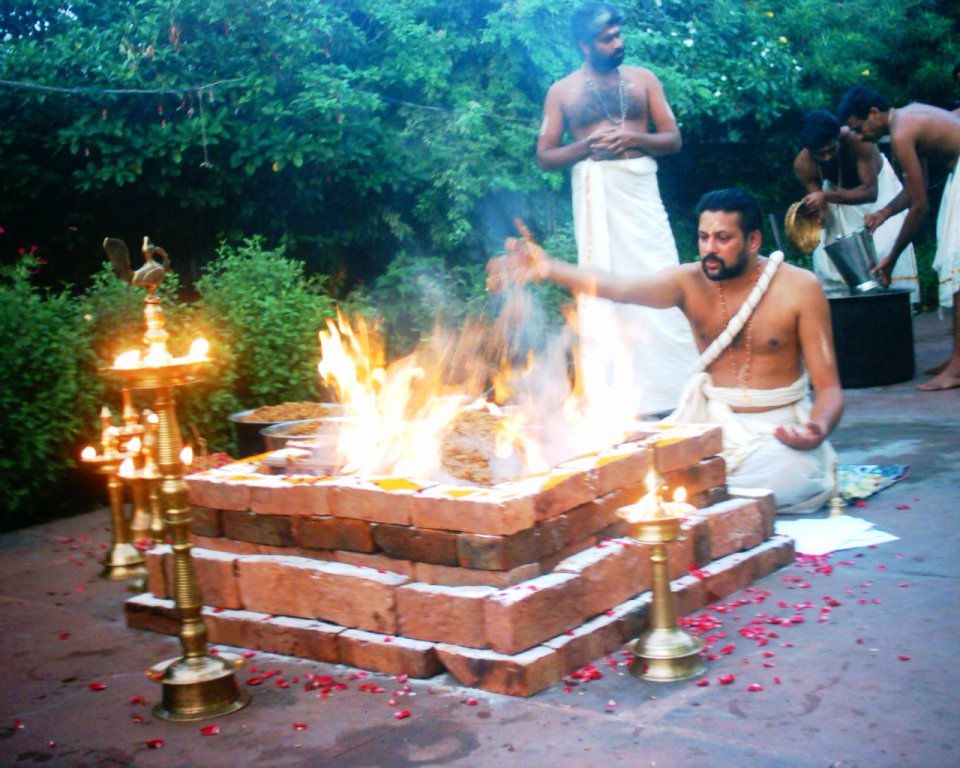
In Hinduism, Yajna or Yagna (Sanskrit: यज्ञ, lit. 'act of devotion, worship, offering in fire', IAST: yajña) also known as Hawan, is a ritual done in front of a sacred fire, often with mantras. Yajna has been a Vedic tradition, described in a layer of Vedic literature called Brahmanas, as well as Yajurveda. The tradition has evolved from offering oblations and libations into sacred fire to symbolic offerings in the presence of sacred fire (Agni).
Yajna rituals-related texts have been called the Karma-kanda (ritual works) portion of the Vedic literature, in contrast to the Jnana-kanda (knowledge) portion found in the Vedic Upanishads. The proper completion of Yajna-like rituals was the focus of Mimansa school of Hindu philosophy. Yajna have continued to play a central role in a Hindu's rites of passage, such as weddings. Modern major Hindu temple ceremonies, Hindu community celebrations, or monastic initiations may also include Vedic Yajna rites, or alternatively be based on Agamic rituals.
The word yajna (Sanskrit: यज्ञ, romanized: yajña) has its root in the Sanskrit yaj meaning 'to worship, adore, honour, revere' and appears in the early Vedic literature, composed in 2nd millennium BCE. In Rigveda, Yajurveda (itself a derivative of this root) and others, it means "worship, devotion to anything, prayer and praise, an act of worship or devotion, a form of offering or oblation, and sacrifice". In post-Vedic literature, the term meant any form of rite, ceremony or devotion with an actual or symbolic offering or effort.
A yajna included major ceremonial devotions, with or without a sacred fire, sometimes with feasts and community events. It has, states Nigal, a threefold meaning of worship of the deities (devapujana), unity (sangatikarana) and charity (dána).
The Sanskrit word is related to the Avestan term yasna of Zoroastrianism. Unlike the Vedic yajna, however, the Yasna is the name of a specific religious service, not a class of rituals, and they have "to do with water rather than fire". The Sanskrit word is further related to Ancient Greek ἅζομαι (házomai), "to revere", deriving from the Proto-Indo-European root *Hyeh₂ǵ- ("to worship").
Yajna has been a part of an individual or social ritual since Vedic times. When the ritual fire – the divine Agni, the god of fire and the messenger of gods – was deployed in a Yajna, mantras were chanted. The hymns and songs sung and oblations offered into the fire were a form of hospitality towards the Vedic gods. The offerings were believed to be carried by Agni to the gods; the gods in return were expected to grant boons and benedictions, and thus the ritual served as a means of spiritual exchange between gods and human beings. The Vedangas, or auxiliary sciences attached to the Vedic literature, define Yajna as follows:
Definition of a Vedic sacrifice
Yajña, sacrifice, is an act by which we surrender something for the sake of the gods. Such an act must rest on a sacred authority (āgama), and serve for man's salvation (śreyortha). The nature of the gift is of less importance. It may be cake (puroḍāśa), pulse (karu), mixed milk (sāṃnāyya), an animal (paśu), the juice of soma-plant (soma), etc; nay, the smallest offerings of butter, flour, and milk may serve for the purpose of a sacrifice.
Yajna
In Hinduism, Yajna or Yagna (Sanskrit: यज्ञ, lit. 'act of devotion, worship, offering in fire', IAST: yajña) also known as Hawan, is a ritual done in front of a sacred fire, often with mantras. Yajna has been a Vedic tradition, described in a layer of Vedic literature called Brahmanas, as well as Yajurveda. The tradition has evolved from offering oblations and libations into sacred fire to symbolic offerings in the presence of sacred fire (Agni).
Yajna rituals-related texts have been called the Karma-kanda (ritual works) portion of the Vedic literature, in contrast to the Jnana-kanda (knowledge) portion found in the Vedic Upanishads. The proper completion of Yajna-like rituals was the focus of Mimansa school of Hindu philosophy. Yajna have continued to play a central role in a Hindu's rites of passage, such as weddings. Modern major Hindu temple ceremonies, Hindu community celebrations, or monastic initiations may also include Vedic Yajna rites, or alternatively be based on Agamic rituals.
The word yajna (Sanskrit: यज्ञ, romanized: yajña) has its root in the Sanskrit yaj meaning 'to worship, adore, honour, revere' and appears in the early Vedic literature, composed in 2nd millennium BCE. In Rigveda, Yajurveda (itself a derivative of this root) and others, it means "worship, devotion to anything, prayer and praise, an act of worship or devotion, a form of offering or oblation, and sacrifice". In post-Vedic literature, the term meant any form of rite, ceremony or devotion with an actual or symbolic offering or effort.
A yajna included major ceremonial devotions, with or without a sacred fire, sometimes with feasts and community events. It has, states Nigal, a threefold meaning of worship of the deities (devapujana), unity (sangatikarana) and charity (dána).
The Sanskrit word is related to the Avestan term yasna of Zoroastrianism. Unlike the Vedic yajna, however, the Yasna is the name of a specific religious service, not a class of rituals, and they have "to do with water rather than fire". The Sanskrit word is further related to Ancient Greek ἅζομαι (házomai), "to revere", deriving from the Proto-Indo-European root *Hyeh₂ǵ- ("to worship").
Yajna has been a part of an individual or social ritual since Vedic times. When the ritual fire – the divine Agni, the god of fire and the messenger of gods – was deployed in a Yajna, mantras were chanted. The hymns and songs sung and oblations offered into the fire were a form of hospitality towards the Vedic gods. The offerings were believed to be carried by Agni to the gods; the gods in return were expected to grant boons and benedictions, and thus the ritual served as a means of spiritual exchange between gods and human beings. The Vedangas, or auxiliary sciences attached to the Vedic literature, define Yajna as follows:
Definition of a Vedic sacrifice
Yajña, sacrifice, is an act by which we surrender something for the sake of the gods. Such an act must rest on a sacred authority (āgama), and serve for man's salvation (śreyortha). The nature of the gift is of less importance. It may be cake (puroḍāśa), pulse (karu), mixed milk (sāṃnāyya), an animal (paśu), the juice of soma-plant (soma), etc; nay, the smallest offerings of butter, flour, and milk may serve for the purpose of a sacrifice.
Recent media
Recent media