


Community hub
Recent from talks
Contribute something to knowledge base
Content stats: 0 posts, 0 articles, 1 media, 0 notes
Members stats: 0 subscribers, 0 contributors, 0 moderators, 0 supporters
Subscribers
Supporters
Contributors
Moderators
Hub AI
Yajnavalkya AI simulator
(@Yajnavalkya_simulator)
Hub AI
Yajnavalkya AI simulator
(@Yajnavalkya_simulator)
Yajnavalkya
Yajnavalkya or Yagyavalkya (Sanskrit: याज्ञवल्क्य, IAST:Yājñavalkya) is a Hindu Vedic sage prominently mentioned in the Brihadaranyaka Upanishad (c. 700 BCE) and Tattiriya Upanishad. Yajnavalkya proposes and debates metaphysical questions about the nature of existence, consciousness and impermanence, and expounds the epistemic doctrine of neti neti ("not this, not this") to discover the universal Self and Ātman. Texts attributed to him include the Yajnavalkya Smriti, Yoga Yajnavalkya and some texts of the Vedanta school. He is also mentioned in the Mahabharata as well as various Puranas, Brahmanas and Aranyakas.
The name Yajnavalkya is derived from yajna, which connotes ritual.
Yajnavalkya was a pupil of Vaisampayana and the compiler of the Shukla Yajurveda Samhita. Yajnavalkya was the pupil of Uddālaka Āruṇi, whom he defeated in debate.
Within both the Sukla Yajur Veda and the Brihadaranyaka Upanishad, he is depicted as being blunt, provocative and sarcastic. In the first verse of the Yajnavalkya Smriti, Yajnavalkya is described as the "yogesvara: meaning "the king of yogis."
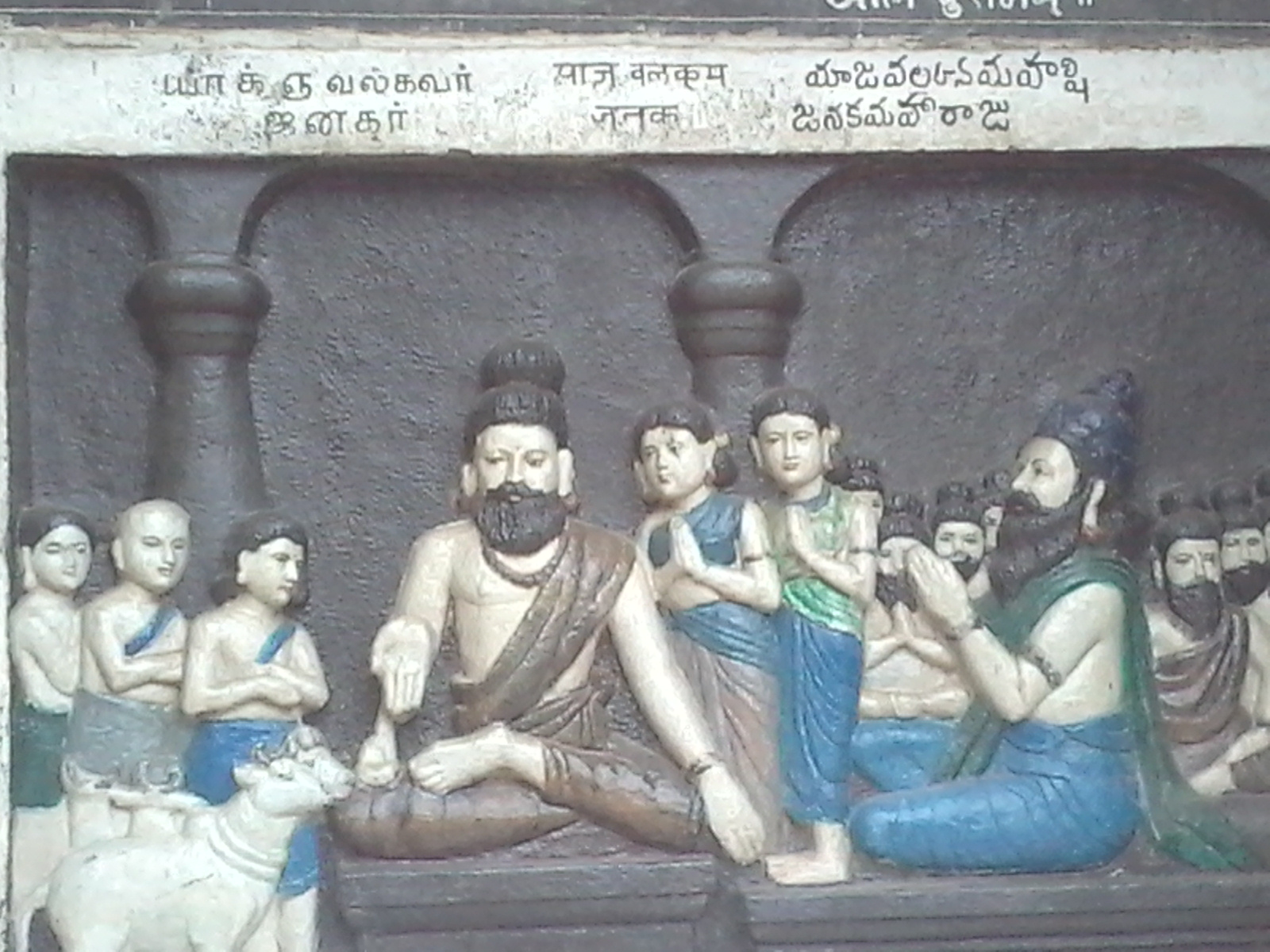
Yajnavalkya plays a central position in a debate known as Bahudakshina Yajna hosted by King Janaka in Mithila, Videha, which is in the Southern Nepal near Janakpur, where Yajnavalkya defeats philosophers from all around the country. The debate ended with Gargi, a female scholar and one of the nine gems of King Janaka’s court, clearly asserting Yajnavalkya as the most superior brahmin of them all.
In the Brihadaranyaka Upanishad, a set of dialogues portrays Yajnavalkya as having two wives, Maitreyi and Katyayani. Maitreyi, as opposed to Katyayani, was more intrigued to gain spiritual knowledge. Maitreyi was known as a brahmavadini, a discusser of Brahman. Katyayani is merely described as "striprajna," which translates to "woman-like knowledge;" this can be interpreted as one who is well-versed in traditionally females roles. While Yajnavalkya and Katyayani lived in contented domesticity, Maitreyi studied metaphysics and engaged in theological dialogues with her husband in addition to "making self-inquiries of introspection." In contrast to the Brihadaranyaka Upanishad, the epic Mahabharata states Maitreyi is a young beauty who is an Advaita scholar but never marries.
Scharfstein considers Yajnavalkya to be one of the earliest philosophers in recorded history. Yajnavalkya is credited by Witzel for coining the term Advaita (non-duality of Atman and Brahman). The ideas attributed to him for renunciation of worldly attachments have been important to Hindu sannyasa traditions.
Yajnavalkya is associated with several major ancient texts in Sanskrit, namely the Shukla Yajurveda, the Shatapatha Brahmana, the Brihadaranyaka Upanishad, the Taittiriya Upanishad, the dharma sastra named Yājñavalkya Smṛti, Vriddha Yajnavalkya, and Brihad Yajnavalkya. He is also mentioned in the Mahabharata, Puranas, as well as in ancient Jainism texts such as the Isibhasiyaim. In the Jainism text Isibhasiyaim, the sage Yajnavalkya is also known as Jannavakka.
Yajnavalkya
Yajnavalkya or Yagyavalkya (Sanskrit: याज्ञवल्क्य, IAST:Yājñavalkya) is a Hindu Vedic sage prominently mentioned in the Brihadaranyaka Upanishad (c. 700 BCE) and Tattiriya Upanishad. Yajnavalkya proposes and debates metaphysical questions about the nature of existence, consciousness and impermanence, and expounds the epistemic doctrine of neti neti ("not this, not this") to discover the universal Self and Ātman. Texts attributed to him include the Yajnavalkya Smriti, Yoga Yajnavalkya and some texts of the Vedanta school. He is also mentioned in the Mahabharata as well as various Puranas, Brahmanas and Aranyakas.
The name Yajnavalkya is derived from yajna, which connotes ritual.
Yajnavalkya was a pupil of Vaisampayana and the compiler of the Shukla Yajurveda Samhita. Yajnavalkya was the pupil of Uddālaka Āruṇi, whom he defeated in debate.
Within both the Sukla Yajur Veda and the Brihadaranyaka Upanishad, he is depicted as being blunt, provocative and sarcastic. In the first verse of the Yajnavalkya Smriti, Yajnavalkya is described as the "yogesvara: meaning "the king of yogis."
Yajnavalkya plays a central position in a debate known as Bahudakshina Yajna hosted by King Janaka in Mithila, Videha, which is in the Southern Nepal near Janakpur, where Yajnavalkya defeats philosophers from all around the country. The debate ended with Gargi, a female scholar and one of the nine gems of King Janaka’s court, clearly asserting Yajnavalkya as the most superior brahmin of them all.
In the Brihadaranyaka Upanishad, a set of dialogues portrays Yajnavalkya as having two wives, Maitreyi and Katyayani. Maitreyi, as opposed to Katyayani, was more intrigued to gain spiritual knowledge. Maitreyi was known as a brahmavadini, a discusser of Brahman. Katyayani is merely described as "striprajna," which translates to "woman-like knowledge;" this can be interpreted as one who is well-versed in traditionally females roles. While Yajnavalkya and Katyayani lived in contented domesticity, Maitreyi studied metaphysics and engaged in theological dialogues with her husband in addition to "making self-inquiries of introspection." In contrast to the Brihadaranyaka Upanishad, the epic Mahabharata states Maitreyi is a young beauty who is an Advaita scholar but never marries.
Scharfstein considers Yajnavalkya to be one of the earliest philosophers in recorded history. Yajnavalkya is credited by Witzel for coining the term Advaita (non-duality of Atman and Brahman). The ideas attributed to him for renunciation of worldly attachments have been important to Hindu sannyasa traditions.
Yajnavalkya is associated with several major ancient texts in Sanskrit, namely the Shukla Yajurveda, the Shatapatha Brahmana, the Brihadaranyaka Upanishad, the Taittiriya Upanishad, the dharma sastra named Yājñavalkya Smṛti, Vriddha Yajnavalkya, and Brihad Yajnavalkya. He is also mentioned in the Mahabharata, Puranas, as well as in ancient Jainism texts such as the Isibhasiyaim. In the Jainism text Isibhasiyaim, the sage Yajnavalkya is also known as Jannavakka.
Recent media
Recent media