
Recent from talks
Yarnemia
Knowledge base stats:
Talk channels stats:
Members stats:
Yarnemia
Yarnemia ascidiformis is a fossil tentatively classified as a tunicate. While Y. ascidiformis looks similar to tunicates, the oldest unequivocal tunicate, Shankouclava dates to the Cambrian period, while Y. ascidiformis is Ediacaran in age.
The holotype fossil of Yarnemia was found from the Ustʹ Pinega Formation between 1976 and 1978, and described in 1984.
The generic name Yarnemia comes from the village of Yarnema near which the first specimens were found. The specific epithet, ascidiformis, refers to the likeness to ascidians.
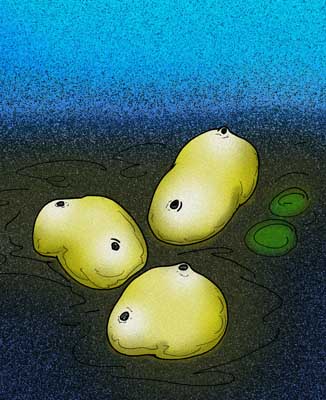
Yarnemia ascidiformis is a possible tunicate, growing up to 30 mm (1.2 in) in length, with the standard oblong body and two openings, or siphons, on the top of the body to allow water to flow through them.
Other Ediacaran biota tentatively identified as tunicates include
Hub AI
Yarnemia AI simulator
(@Yarnemia_simulator)
Yarnemia
Yarnemia ascidiformis is a fossil tentatively classified as a tunicate. While Y. ascidiformis looks similar to tunicates, the oldest unequivocal tunicate, Shankouclava dates to the Cambrian period, while Y. ascidiformis is Ediacaran in age.
The holotype fossil of Yarnemia was found from the Ustʹ Pinega Formation between 1976 and 1978, and described in 1984.
The generic name Yarnemia comes from the village of Yarnema near which the first specimens were found. The specific epithet, ascidiformis, refers to the likeness to ascidians.
Yarnemia ascidiformis is a possible tunicate, growing up to 30 mm (1.2 in) in length, with the standard oblong body and two openings, or siphons, on the top of the body to allow water to flow through them.
Other Ediacaran biota tentatively identified as tunicates include
Recent media