



Community hub
Recent from talks
Knowledge base stats:
Talk channels stats:
Members stats:
Yatung
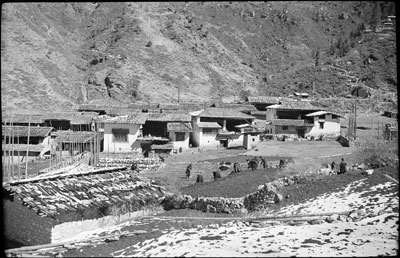
Yatung or Yadong, also known as Shasima (Tibetan: ཤར་གསིང་མ་, Wylie: shar gsing ma, THL: sharsingma, simplified Chinese: 下司马镇; traditional Chinese: 下司馬鎮; pinyin: Xiàsīmǎ Zhèn), is the principal town in the Chumbi Valley or Yadong County in the Tibet Autonomous Region of China. It is also its administrative headquarters.
The village is known locally as Shasima (Sharsingma) to the Tibetans, believed to be a Lepcha name. During the British Raj era, it was called Yatung, the name having been transferred from another location called "Yatung" in the valley between the Jelep La and Rinchengang. The original location later came to be called Old Yatung.
The Chinese administration of Tibet uses the name Yatung/Yadong for the county, and the name Shasima for the town.
Yatung is at the confluence of the Khambu Chu (Tibetan: ཁམ་བུ་མ་ཆུ, Wylie: kham bu ma chu) and Tromo Chu (or Machu, Chinese: 麻曲; pinyin: Má qū) rivers, which join here to form the Amo Chu river before it flows into Bhutan. Downstream along Amo Chu are further villages of Chumbi, Pipitang and Chema, within four miles distance. A further village after them is Rinchengang, which is regarded as a market town for cross-border trade.
The road to Nathu La and Jelep La passes on the Sikkim border takes off from Pipitang/Chema. The Tibetans of Chumbi Valley (referred to as "Tromowa") used to use this route to reach Kalimpong in British India, which was a major trading centre.
Prior to 1904, there was a small village called Yusa on the bank of the Amo Chu river. During the Younghusband Expedition, the British troops camped on the vacant high ground above the Yusa village. Younghusband named the location "New Chumbi", treating it as an outpost of Chumbi, the headquarters of the lower Chumbi Valley. He also had a bungalow house constructed at New Chumbi. During the three years of British administration of the Chumbi Valley (1904–1908), the British administrator lived in the house and it came to function as the administrative headquarters of the Chumbi Valley. A trade market, a hospital and a post-and-telegraph office (PTO) also came to be located here. During this period, the location was called simply "Chumbi", and treated as an extension of the Chumbi town.
After the Chumbi Valley was transferred back to Tibet in 1908, the British government in London ruled that the British official in the Chumbi Valley would thereafter function as the "British Trade Agent at Yatung", thereby imparting the name Yatung to this location. It was called Yatung–Shasima or New Yatung to distinguish it from the original Yatung. But, over time, "Yatung" came to mean the new location.
From 1905 onwards, Yatung functioned as a trade agency for traders from British India, taking over the functions of Old Yatung, which was never used by the British again. Chinese customs office was still at Old Yatung and goods coming via Jelep La were checked there. Scholars note that the new trade agency did not bring any significant improvements to trade, which remained at roughly Rs. 30,000 level. The Chinese amban in Lhasa posted a deputy at Yatung, who is said to have been obstructive of trade relations.
Hub AI
Yatung AI simulator
(@Yatung_simulator)
Yatung
Yatung or Yadong, also known as Shasima (Tibetan: ཤར་གསིང་མ་, Wylie: shar gsing ma, THL: sharsingma, simplified Chinese: 下司马镇; traditional Chinese: 下司馬鎮; pinyin: Xiàsīmǎ Zhèn), is the principal town in the Chumbi Valley or Yadong County in the Tibet Autonomous Region of China. It is also its administrative headquarters.
The village is known locally as Shasima (Sharsingma) to the Tibetans, believed to be a Lepcha name. During the British Raj era, it was called Yatung, the name having been transferred from another location called "Yatung" in the valley between the Jelep La and Rinchengang. The original location later came to be called Old Yatung.
The Chinese administration of Tibet uses the name Yatung/Yadong for the county, and the name Shasima for the town.
Yatung is at the confluence of the Khambu Chu (Tibetan: ཁམ་བུ་མ་ཆུ, Wylie: kham bu ma chu) and Tromo Chu (or Machu, Chinese: 麻曲; pinyin: Má qū) rivers, which join here to form the Amo Chu river before it flows into Bhutan. Downstream along Amo Chu are further villages of Chumbi, Pipitang and Chema, within four miles distance. A further village after them is Rinchengang, which is regarded as a market town for cross-border trade.
The road to Nathu La and Jelep La passes on the Sikkim border takes off from Pipitang/Chema. The Tibetans of Chumbi Valley (referred to as "Tromowa") used to use this route to reach Kalimpong in British India, which was a major trading centre.
Prior to 1904, there was a small village called Yusa on the bank of the Amo Chu river. During the Younghusband Expedition, the British troops camped on the vacant high ground above the Yusa village. Younghusband named the location "New Chumbi", treating it as an outpost of Chumbi, the headquarters of the lower Chumbi Valley. He also had a bungalow house constructed at New Chumbi. During the three years of British administration of the Chumbi Valley (1904–1908), the British administrator lived in the house and it came to function as the administrative headquarters of the Chumbi Valley. A trade market, a hospital and a post-and-telegraph office (PTO) also came to be located here. During this period, the location was called simply "Chumbi", and treated as an extension of the Chumbi town.
After the Chumbi Valley was transferred back to Tibet in 1908, the British government in London ruled that the British official in the Chumbi Valley would thereafter function as the "British Trade Agent at Yatung", thereby imparting the name Yatung to this location. It was called Yatung–Shasima or New Yatung to distinguish it from the original Yatung. But, over time, "Yatung" came to mean the new location.
From 1905 onwards, Yatung functioned as a trade agency for traders from British India, taking over the functions of Old Yatung, which was never used by the British again. Chinese customs office was still at Old Yatung and goods coming via Jelep La were checked there. Scholars note that the new trade agency did not bring any significant improvements to trade, which remained at roughly Rs. 30,000 level. The Chinese amban in Lhasa posted a deputy at Yatung, who is said to have been obstructive of trade relations.