
Recent from talks
Yueqin
Knowledge base stats:
Talk channels stats:
Members stats:
Yueqin
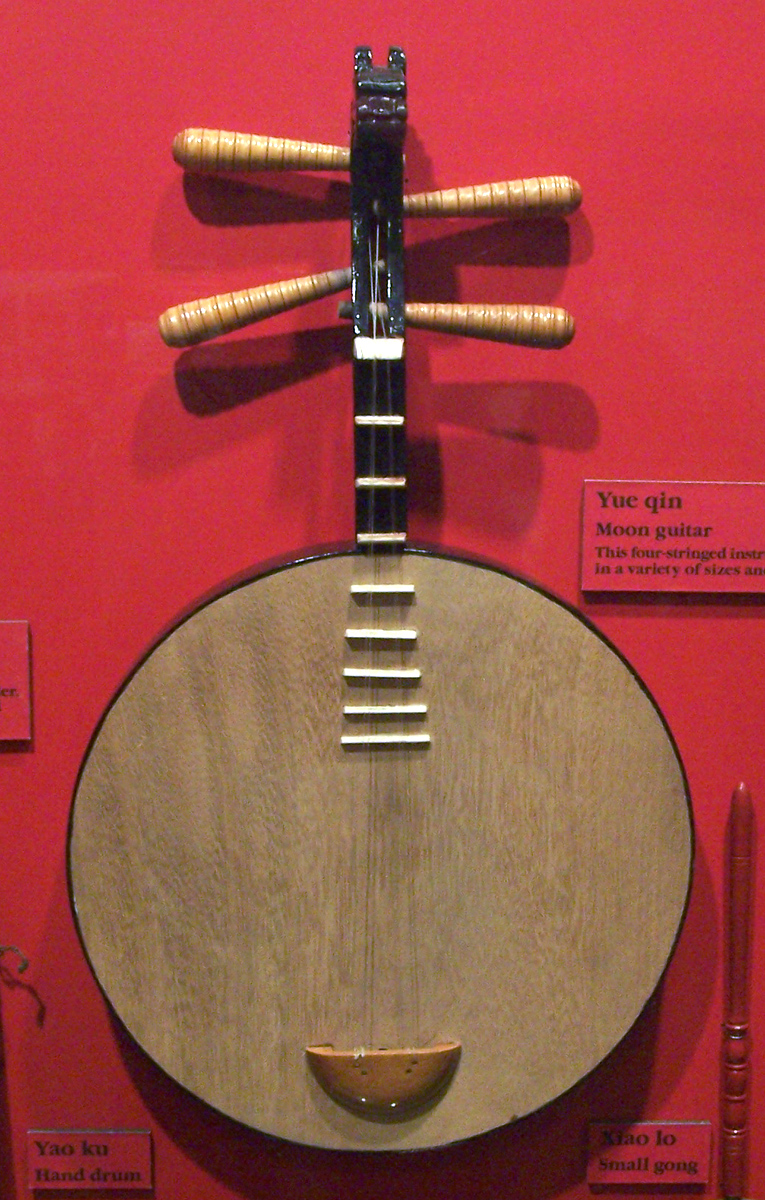
The yueqin (Chinese: 月琴; pinyin: Yuèqín; Japanese: 月琴, romanized: Gekkin; Korean: 월금/月琴, romanized: Wolgeum; Vietnamese: Nguyệt cầm/月琴 or Vietnamese: Đàn nguyệt/彈月), also called a moon lute or moon guitar, is a traditional Chinese string instrument. It is a lute with a round, hollow soundboard, a short fretted neck, and usually four strings. It is an important instrument in the Peking opera orchestra, often taking the role of main melodic instrument in lieu of the bowed string section.
The instrument was invented in China in the 3rd to 5th centuries AD, during the Jin dynasty. The ruan, another Chinese instrument, is the ancestor of the yueqin. The name yueqin once applied to all instruments with a moon-shaped soundboard, including the ruan; however, "yueqin" now applies to a separate category from the ruan family.
The word yueqin is made of two characters, yuè (月; "moon") and qín (琴; "stringed instrument, zither"). Its name in Korean (wolgeum), Japanese (gekkin) and Vietnamese (nguyệt cầm) mean the same thing, and are Sinoxenic words, meaning they were borrowed from Chinese, but pronounced in the local way.
The yueqin originated from the ruan, a similar stringed instrument that may have been invented as early as the 2nd century BC, during the Western Han dynasty. It grew popular during the Jin Dynasty (265–420), and has been known by its current name since the Tang dynasty. The instrument was introduced to Japan during the Tang Dynasty, and reached its peak in the 1830s. Yueqin was banned in Japan during the Second World War, and it was restored after the war. Another very similar instrument, called đàn đoản or đàn tứ, is occasionally used in Vietnam.
The yueqin typically has a round soundboard with no sound-hole, but inside the sound box are one or more strands of wire attached only at one end, so that they vibrate, giving the instrument a particular timbre and resonance. Occasionally, the body of the yueqin may be octagonal in shape.
The yueqin has a short fretted neck. Frets on all Chinese lutes are high so that the fingers never touch the actual body—distinctively different from western fretted instruments. This allows for a greater control over timbre and intonation than their western counterparts, but makes chordal playing more difficult. The frets were formerly arranged rather like those on a mountain dulcimer, so that the instrument is diatonic; however, the fret size is high enough that any pitch may be bent up a minor 3rd. Modern yueqin have frets tuned in semitones.
Most yueqin have four strings, although others have two or three. Yueqin used for Beijing opera have two strings, only one of which is actually used, the lower string being there purely for sympathetic resonance. In Taiwan, the yueqin has a longer neck, and two or three strings.
The strings on the traditional form of the instrument were made of silk, though nylon is generally used today. The anchor on a modern yueqin may have up to five holes, so it can be strung and tuned as a three or four-stringed instrument. The nut, at the peghead end of the instrument, is filed with notches appropriate to the number and position of the strings. There is no bridge or saddle; the strings are simply attached to the anchor at the base of the instrument.
Hub AI
Yueqin AI simulator
(@Yueqin_simulator)
Yueqin
The yueqin (Chinese: 月琴; pinyin: Yuèqín; Japanese: 月琴, romanized: Gekkin; Korean: 월금/月琴, romanized: Wolgeum; Vietnamese: Nguyệt cầm/月琴 or Vietnamese: Đàn nguyệt/彈月), also called a moon lute or moon guitar, is a traditional Chinese string instrument. It is a lute with a round, hollow soundboard, a short fretted neck, and usually four strings. It is an important instrument in the Peking opera orchestra, often taking the role of main melodic instrument in lieu of the bowed string section.
The instrument was invented in China in the 3rd to 5th centuries AD, during the Jin dynasty. The ruan, another Chinese instrument, is the ancestor of the yueqin. The name yueqin once applied to all instruments with a moon-shaped soundboard, including the ruan; however, "yueqin" now applies to a separate category from the ruan family.
The word yueqin is made of two characters, yuè (月; "moon") and qín (琴; "stringed instrument, zither"). Its name in Korean (wolgeum), Japanese (gekkin) and Vietnamese (nguyệt cầm) mean the same thing, and are Sinoxenic words, meaning they were borrowed from Chinese, but pronounced in the local way.
The yueqin originated from the ruan, a similar stringed instrument that may have been invented as early as the 2nd century BC, during the Western Han dynasty. It grew popular during the Jin Dynasty (265–420), and has been known by its current name since the Tang dynasty. The instrument was introduced to Japan during the Tang Dynasty, and reached its peak in the 1830s. Yueqin was banned in Japan during the Second World War, and it was restored after the war. Another very similar instrument, called đàn đoản or đàn tứ, is occasionally used in Vietnam.
The yueqin typically has a round soundboard with no sound-hole, but inside the sound box are one or more strands of wire attached only at one end, so that they vibrate, giving the instrument a particular timbre and resonance. Occasionally, the body of the yueqin may be octagonal in shape.
The yueqin has a short fretted neck. Frets on all Chinese lutes are high so that the fingers never touch the actual body—distinctively different from western fretted instruments. This allows for a greater control over timbre and intonation than their western counterparts, but makes chordal playing more difficult. The frets were formerly arranged rather like those on a mountain dulcimer, so that the instrument is diatonic; however, the fret size is high enough that any pitch may be bent up a minor 3rd. Modern yueqin have frets tuned in semitones.
Most yueqin have four strings, although others have two or three. Yueqin used for Beijing opera have two strings, only one of which is actually used, the lower string being there purely for sympathetic resonance. In Taiwan, the yueqin has a longer neck, and two or three strings.
The strings on the traditional form of the instrument were made of silk, though nylon is generally used today. The anchor on a modern yueqin may have up to five holes, so it can be strung and tuned as a three or four-stringed instrument. The nut, at the peghead end of the instrument, is filed with notches appropriate to the number and position of the strings. There is no bridge or saddle; the strings are simply attached to the anchor at the base of the instrument.
Recent media