Hubbry Logo
logo
Yukie Chiri
Community hub

Yukie Chiri

logo
0 subscribers
Read side by side
from Wikipedia

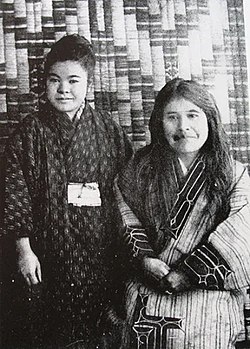
Yukie Chiri, left, with her aunt Imekanu

Key Information


Yukie Chiri (知里 幸恵, Chiri Yukie; June 8, 1903 – September 18, 1922) was an Ainu transcriber and translator of Yukar (Ainu epic tales).

Life

[edit]

Yukie Chiri was born into an Ainu family in Noboribetsu, Hokkaidō during the Meiji era. At the time, the colonial government of Hokkaido rapidly increased immigration of ethnic Japanese people to Hokkaidō, forcibly relocating many Ainu communities and depriving them of their traditional means of livelihood. The Meiji government adopted extensive policies designed to discourage or ban Ainu cultural practices while encouraging or forcing their assimilation into Japanese society. By the turn of the century, some Ainu writers came to argue that assimilation was the only viable method of survival for Ainu communities.[1][2]

Chiri was sent to her aunt Imekanu in Chikabumi, on the outskirts of Asahikawa, when she was six years old, presumably to lessen the financial burden on her parents. Imekanu lived with her aged mother, Monashinouku, a seasoned teller of Ainu tales who spoke very little Japanese. Chiri thus grew to be completely bilingual in Japanese and Ainu, and had a familiarity with Ainu oral literature that was becoming less and less common by that time. Although she had to endure bullying in school, she excelled in her studies, particularly in language arts. However, due to anti-Ainu prejudice, she suffered from an ethnic inferiority complex that afflicted many of her generation.[3]

Chiri's personal conception of cultural assimilation was complex. In one letter written during her teens, she remarked, "In a twinkling the natural landscape as it had been since the ancient past has vanished; what has become of the folk who joyfully made their living in its fields and mountains? The few of us fellow kinspeople who remain simply stare wide-eyed, astonished by the state of the world as it continues to advance."[4]

Work

[edit]

Chiri was in her mid-teens when she first met Japanese linguist and Ainu language scholar Kyōsuke Kindaichi during the nation's Taishō period. He was traveling around Hokkaidō in search of Ainu transmitters of oral literature, and had come to seek out Imekanu and Monashinouku. Upon meeting Chiri, who was still living with Imekanu, Kindaichi immediately recognized her potential and spoke to her about his work. When Kindaichi explained the value he saw in preserving Ainu folklore and traditions to Chiri, she decided to dedicate the rest of her life to studying, recording, and translating yukar.[5]

Kindaichi eventually returned to Tokyo, but sent Chiri blank notebooks so she could record whatever came to mind about Ainu culture and language. She chose to record the tales her grandmother chanted, using romaji to express the Ainu sounds, and then translated the transcribed yukar into Japanese. Eventually, Kindaichi persuaded her to join him in Tokyo to assist him in his work collecting and translating yukar. However, only months after arriving in Tokyo and on the same night she completed her first yukar anthology, she suddenly died from heart failure at the age of 19.[3]

Legacy

[edit]
A Collection of the Ainu Epics of the gods

Chiri's anthology was published the following year under the title Ainu Shinyōshū (A Collection of the Ainu Epics of the gods). Although her patron Kindaichi and series editor Kunio Yanagita must have taken the late Chiri's manuscript to press, they did not put their names anywhere on it; the preface and content are written entirely by her. Her book contains both Japanese translations and, invaluably, the original Ainu, in Roman script. It received great popular acclaim in the period press, creating a newfound respect for Ainu culture among Japanese readers, and remains the most important source for yukar today.

Her younger brother, Chiri Mashiho, later pursued his education under Kindaichi's sponsorship and became a respected scholar of Ainu studies. Both Chiri and her younger brother were secretly sponsored by Keizo Shibusawa, heir of Shibusawa Eiichi, through anonymous donations.[6] Imekanu also continued the work of transcribing and translating yukar.

References

[edit]
[edit]
Revisions and contributorsEdit on WikipediaRead on Wikipedia
from Grokipedia
Yukie Chiri (知里 幸恵; June 8, 1903 – September 18, 1922) was an Ainu woman from Hokkaido, Japan, recognized for her pioneering role in transcribing and translating traditional Ainu epic tales, known as yukar, into written Japanese.[1][2] Born in Noboribetsu to Ainu parents amid Japan's assimilation policies toward the indigenous population, Chiri was raised partly by her aunt Kannari Matsu and grandmother Monasinouk, both skilled oral storytellers who imparted Ainu folklore and chants to her from a young age.[1][2] Without formal anthropological training, she attended Japanese schools, including Asahikawa Girls Vocational School, while immersing herself in Ainu oral traditions.[1] Her most significant achievement was the compilation of Ainu Shin'yōshū (Ainu Chants of the Gods), a collection of 13 kamuy yukar (divine epics) featuring narratives like the owl god's song, which she rendered into Japanese prose and verse; published posthumously in 1923, it marked the first such transliteration and translation by an Ainu individual, preserving elements of Ainu cosmology and reverence for nature during a period of rapid cultural erosion.[2][3] Chiri died of heart disease in Tokyo at age 19, shortly after completing the manuscript, leaving a legacy that influenced subsequent Ainu cultural revival efforts and scholarly studies.[1][3]

Early Life

Family Background and Birth

Yukie Chiri was born on June 8, 1903, in Horobetsu, a village in Hokkaido that has since been incorporated into the city of Noboribetsu.[2] Her parents were Chiri Takakichi, an Ainu man who later served as a soldier and received military decorations including the Order of the Golden Kite, and Nami, also of Ainu descent.[2][4] The Chiri family traced its roots to traditional Ainu lineages, with Nami being the daughter of a Hokkaido Ainu elder, indicative of historical prominence among Ainu chieftains and community leaders prior to extensive Japanese settlement.[2] Takakichi hailed from the Chiri line, while Nami connected to the Kanetomi family, both associated with Ainu heritage in the region.[5] This birth occurred amid Japan's Meiji-era colonization of Hokkaido, where policies such as the annexation of Ainu territories as Crown land from 1869 onward systematically dispossessed indigenous groups of traditional hunting, fishing, and foraging grounds to facilitate Japanese agricultural expansion and modernization.[6] The 1899 Hokkaido Former Aborigines Protection Act further enforced assimilation by allocating minimal farmland to Ainu households—up to about 12 acres per family—while prohibiting customary land use and promoting Japanese-style farming, contributing to widespread economic marginalization for Ainu families despite nominal protections.[7][8]

Childhood Upbringing and Exposure to Ainu Oral Traditions

In 1909, at the age of six, Chiri was sent from her family home in Horobetsu to live with her paternal aunt, Kannari Matsu (Ainu name: Imekanu), due to economic hardships faced by her parents.[9][10] Kannari Matsu, a proficient oral storyteller, and Chiri's grandmother Monashnouk provided a direct link to enduring Ainu folklore, residing together in a setting conducive to traditional recitations.[11] This relocation immersed Chiri in the causal transmission of Ainu oral knowledge, where she learned the Ainu language, termed itak, and committed to memory yukar—heroic epics recited by elders to convey cultural memory amid encroaching linguistic decline.[12][13] The yukar traditions, preserved through verbatim repetition and familial instruction, countered the suppression of Ainu verbal practices under Japanese colonial policies favoring assimilation.[14] Through her aunt's and grandmother's performances, Chiri encountered the animistic ontology embedded in yukar, depicting interactions between humans and kamuy—divine spirits embodying natural phenomena such as animals, weather, and landscapes—as active agents in a relational cosmos rather than passive symbols.[11][2] This firsthand exposure to recited narratives, unmediated by written forms, underscored the epics' role in maintaining Ainu cosmological realism against eroding communal transmission.[13]

Formal Education and Cultural Assimilation Pressures

Chiri commenced formal education in an elementary school in Asahikawa in 1910, at around age seven, following her relocation to live with relatives in the area.[1] This schooling occurred amid Japan's assimilation policies under the 1899 Hokkaido Former Aborigines Protection Act, which mandated Japanese-language instruction for Ainu children, prohibited traditional attire and customs in schools, and aimed to integrate them into the dominant society's agricultural and labor frameworks.[15] [16] The Act's provisions, including land allotments tied to farming and compulsory education, sought pragmatically to equip Ainu for wage labor in Hokkaido's developing economy, reflecting a causal emphasis on economic utility over cultural preservation.[15] [16] In 1917, at age 14, Chiri enrolled in Asahikawa District Vocational School, graduating in 1920, though she encountered ethnic-based rejection from her preferred institution and subsequent ostracization from peers, which she later cited as severe enough to dissuade a younger Ainu acquaintance from pursuing further studies.[1] Despite institutionalized prejudice in these Japanese-medium environments, where Ainu students often faced unpreparedness for advanced curricula due to linguistic and socioeconomic gaps, Chiri excelled academically and achieved functional bilingualism in Japanese and Ainu itak, facilitated initially by her mother's prior mission school exposure.[1] [17] These assimilation imperatives, combined with familial economic constraints common among Ainu households transitioning from traditional livelihoods, posed barriers to higher education access, as Japanese authorities rarely anticipated or supported Ainu advancement beyond basic vocational training.[18] [19] Chiri thus supplemented her schooling by self-teaching transcription techniques, navigating resource limitations such as the absence of Ainu-Japanese dictionaries through improvised methods like marginal annotations.[1] Over time, such policies accelerated a language shift, with younger Ainu generations exhibiting diminished fluency in itak as Japanese dominance in education and employment eroded oral proficiency.[15] [17]

Scholarly Work and Contributions

Acquisition of Linguistic Skills

Chiri Yukie developed her Ainu linguistic proficiency through direct immersion in familial oral traditions during childhood. Sent to reside with her aunt Kannari Matsu (Ainu name: Imekanu), a proficient yukar performer and storyteller, Chiri absorbed the Horobetsu dialect of Ainu-itak alongside memorized epics and chants passed down generationally.[13][1] This exposure equipped her with native fluency, enabling precise recall of rhythmic oral structures central to Ainu narrative forms.[12] Complementing this, Chiri gained Japanese literacy via her mother's mission school background and formal education under assimilationist policies, fostering bilingual competence by early adolescence.[1] In the 1910s, as Meiji-era monolingual mandates accelerated elder attrition and dialect erosion—evident in fewer successors mastering itak—Chiri independently applied these skills to transcribe oral variants, prioritizing phonetic accuracy over adaptation.[12][1] Her approach drew on Ainu mnemonic conventions, such as repetitive phrasing and prosody, to capture verbatim content amid vanishing transmission chains.[13]

Transcription and Translation of Yukar Epics

Chiri Yukie transcribed thirteen kamuy yukar—epic chants narrated from the first-person perspective of Ainu spirits (kamuy)—primarily drawing from the oral recitations of her grandmother, Imekanu Itak, supplemented by consultations with other elders in the Horobetsu dialect during the early 1920s.[20] These transcriptions captured the animistic worldview of the Ainu, where kamuy engage in direct causal interactions with humans predicated on ritual reciprocity, such as offerings of food or prayer, influencing outcomes like prosperity or misfortune without interpretive overlays.[21] Among the recorded epics is "The Song the Owl God Himself Sang" (Kim-un-kamuy-kara-yukar), in which the owl deity observes a family's diligent provisions, intervenes to ensure their abundance by warding off scarcity, and departs satisfied, exemplifying empirical spirit-human causation tied to observed behaviors.[22] To ensure phonetic fidelity, Chiri employed romaji (Romanized script) rather than standard Japanese kana, which lacked symbols for Ainu-specific sounds like uvular fricatives and certain vowels, thereby prioritizing auditory realism over adaptation to Japanese orthographic conventions.[14] This methodological choice preserved the rhythmic and intonational qualities of the chanted performances, as yukar were traditionally delivered in a distinctive, elongated vocal style emphasizing narrative flow and divine agency.[23] The resulting texts rendered the kamuy's interventions as mechanistic responses to human actions—such as neglect leading to retribution or observance yielding favor—reflecting a causal ontology where spiritual entities operate through tangible, reciprocal exchanges rather than abstract symbolism.[24]

Publication of Ainu Shinyōshū

Ainu Shin'yōshū, compiled by Yukie Chiri, was published posthumously in 1923 by Kyōdo Kenkyūsha, a press associated with ethnographic studies during Japan's Taishō era folklore revival.[22] The volume presented 13 yukar—sacred oral epics recited by Ainu shamans—with Chiri's romanized transcriptions of the original Ainu language alongside her literal Japanese translations and explanatory footnotes, marking the first such bilingual edition produced by an Ainu author.[2] This format preserved phonetic and semantic fidelity to the source material, countering tendencies in contemporaneous Japanese scholarship to paraphrase or exoticize indigenous narratives.[20] Chiri's preface, composed in 1922, articulated acute awareness of accelerating cultural erosion under Japanese assimilation policies, which prioritized Ainu linguistic abandonment in favor of state-imposed Japanese education and settlement.[1] She described the epics as echoes of a vanishing worldview, where kamuy (spirits) inhabited natural phenomena, underscoring the urgency of transcription amid elders' declining numbers and oral transmission's disruption.[12] Released amid growing domestic interest in minzokugaku (folklore studies) yet before any policy acknowledgment of Ainu distinctiveness, the work functioned as an empirical archive against the foreseeable extinction of unrecorded traditions.[22] The initial print comprised a limited run suitable for scholarly circulation rather than mass distribution, reflecting resource constraints and niche audience in interwar Japan. Subsequent reissues in 1926 sustained availability, but the original edition's scarcity amplified its status as a foundational text bridging Ainu insider perspective with external documentation efforts.

Personal Struggles and Death

Experiences of Discrimination and Social Marginalization

Despite excelling academically in elementary school, Chiri was rejected from her preferred secondary institution in 1916, a decision attributed to her Ainu ethnicity amid prevailing prejudices that viewed indigenous people as unfit for advanced education.[1] She subsequently enrolled in a missionary school in Asahikawa, one of the few options available to Ainu students facing systemic exclusion from mainstream Japanese schooling.[1] Within Japanese educational settings, Chiri encountered direct discrimination, where her Ainu heritage evoked shame and social ostracism, reinforcing colonial ethnological stereotypes of Ainu as primitive and inferior.[12] Such biases stemmed from Meiji-era policies, including the 1899 Hokkaido Former Aborigines Protection Act, which mandated assimilation through forced adoption of Japanese farming practices ill-suited to Ainu traditional economies reliant on salmon fishing and foraging, resulting in widespread poverty in Ainu kotan villages.[12] [25] These policies, intended to integrate Ainu into modern Japanese society, causally displaced indigenous land use by reallocating uncultivated territories to Japanese settlers after 15 years, exacerbating economic marginalization without providing adequate support for transition.[26] Chiri's family, residing in such impoverished kotan near Urakawa, contended with these hardships, yet she demonstrated personal agency by self-educating in Ainu oral traditions amid limited formal opportunities, countering passive depictions of Ainu subjugation.[10] [12]

Health Decline and Untimely Demise

Chiri Yukie suffered from a congenital heart condition, a ailment also afflicting her father, which persisted throughout her brief life and limited her physical exertions.[1] Despite apprehensions regarding her fragile health, she departed Hokkaido for Tokyo in May 1922, seeking the milder climate and opportunities to refine her Ainu epic transcriptions under linguist Kyōsuke Kindaichi's guidance.[11] Her condition deteriorated during the ensuing months in Tokyo, culminating in her death from heart failure on September 18, 1922, at age 19.[22][27] This occurred shortly after she finalized the manuscript for Ainu Shin'yōshū, which saw posthumous publication in 1923.[22][13] No contemporary medical records detail specific interventions, though her case reflects the era's constrained diagnostic and therapeutic options for cardiac anomalies, independent of ethnic factors.

Broader Legacy and Influence

Impact on Ainu Language Preservation

Yukie Chiri's Ainu Shinyōshū, published in 1923, documented thirteen kamuy yukar—epic chants invoking bear and owl deities—transcribed in romaji to replicate Ainu phonetics and syntax from her grandmother Imekanu's recitations. This native-speaker transcription preserved a dialect variant from the Sarobetsu region, capturing idiomatic expressions and rhythmic structures that eluded non-native collectors. As Ainu oral traditions relied on memory and performance, Chiri's fixed textual record offered an archival anchor for linguistic features lost to generational transmission.[21][20] The collection's value intensified amid Japan's assimilation policies, which from the Meiji era onward suppressed Ainu language use in schools and daily life, accelerating its decline; by the mid-20th century, fluent speakers numbered in the dozens, with dialects varying by locality now extinct orally. Chiri's work enabled phonetic reconstructions and comparative studies of itak (Ainu speech) absent living informants, safeguarding causal narratives like reciprocal pacts between humans and kamuy (spirit beings) that encoded Ainu worldview mechanics. These elements, embedded in yukar's repetitive invocations and animistic causality, persisted in writing despite oral erosion.[28][29] Without Chiri's initiative, the yukar corpus would depend predominantly on Japanese ethnographers' approximations, prone to interpretive overlays from outsider perspectives that occasionally distorted animistic agency or ritual efficacy. Her dual-language edition, prioritizing Ainu fidelity over Japanese idiomaticity, minimized such filters, yielding a primary source for verifying ontological claims like kamuy interventions in human affairs. This authenticity underpinned later efforts to revive dialectal forms, averting interpretive monopolies by non-Ainu scholars.[30][31]

Influence on Subsequent Ainu Scholarship

Chiri Mashiho (1909–1961), Yukie Chiri's younger brother and a trained linguist at Tokyo Imperial University, extended her foundational transcriptions from Ainu Shinyōshū into systematic grammatical studies and lexical resources, establishing key reference points for Ainu morphology and syntax.[32] Drawing directly from the familial oral traditions captured in her 1922 collection, Mashiho incorporated Shinyōshū's phonetic and semantic data to compile etymological analyses and place-name dictionaries, such as his Chimei Ainugo Shōjiten (Small Dictionary of Ainu Place Names), which prioritized indigenous linguistic structures over external approximations.[33] This approach yielded verifiable continuities, including derivations of terms like yaieyukar (self-referential epic), where Mashiho's explications built on her romaji renderings to clarify verb forms and narrative conventions.[34] Her Shinyōshū also underpinned later lexicographical efforts, serving as the textual basis for specialized dictionaries like Hideo Kirikae's Ainu Shin'yōshū Jiten (Lexicon to Ainu Shinyōshū), which includes grammatical annotations derived from her epics to reconstruct dialectal variations and syntactic patterns.[35] These resources provided empirical baselines for 20th-century Ainu linguistics, enabling scholars to cross-reference her insider transcriptions against earlier ethnographic records, such as those by Bronisław Piłsudski (1866–1918), whose successor works benefited from her authentic yukar (epic) corpus to refine phonemic inventories and avoid overreliance on non-native interpretations.[20] By documenting adaptive cultural expressions—evident in the epics' portrayal of kamuy (spirits) interactions amid human agency—Chiri's output challenged reductive depictions of Ainu as static cultural relics, instead evidencing internal scholarly drive toward linguistic self-documentation during assimilation eras.[2] This intellectual lineage persisted in computational linguistics applications, where digitized versions of Shinyōshū-derived lexicons formed the core dictionary for part-of-speech taggers and dependency parsers in Ainu natural language processing tools, ensuring data fidelity to primary sources over secondary syntheses.[36] Such extensions underscore Shinyōshū's role not as isolated folklore but as a causal pivot for rigorous, evidence-based advancements in Ainu philology, prioritizing verifiable derivations from original chants.

Modern Recognition and Memorialization

Chiri Yukie's Ainu Shinyōshū continues to be regarded as a foundational text in Ainu studies, with scholars such as Sarah M. Strong analyzing its cultural and linguistic significance in publications like Ainu Spirits Singing: The Living World of Chiri Yukie's Ainu Shinyōshū (2011), which highlights her intuitive transcription methods and their role in bridging oral traditions with written records.[37] Her work has inspired ongoing efforts in Ainu language revitalization, as noted in contemporary discussions of indigenous cultural preservation amid Japan's 2019 Ainu Promotion Act, which emphasizes heritage documentation.[12] The Chiri Yukie Memorial Museum, located in Asahikawa, Hokkaido, serves as a dedicated site for commemorating her life and contributions, displaying original manuscripts, family artifacts, and exhibits on her transcription process since its establishment as part of regional Ainu cultural facilities.[38] This museum, situated near the National Ainu Museum and Park (Upopoy), integrates her legacy into broader public education on Ainu history, attracting visitors interested in indigenous narratives.[39] Recent media coverage, including a 2024 Japan Times article, underscores her enduring symbolic role in highlighting Ainu resilience against assimilation pressures, positioning her as a pivotal figure in narratives of cultural survival.[3] While no formal awards bear her name, her story informs contemporary Ainu advocacy, with references in outlets like Unseen Japan emphasizing her premature death's irony against her lasting documentation of epic traditions.[1]

References

User Avatar
No comments yet.