
Recent from talks
Yukon River
Knowledge base stats:
Talk channels stats:
Members stats:
Yukon River
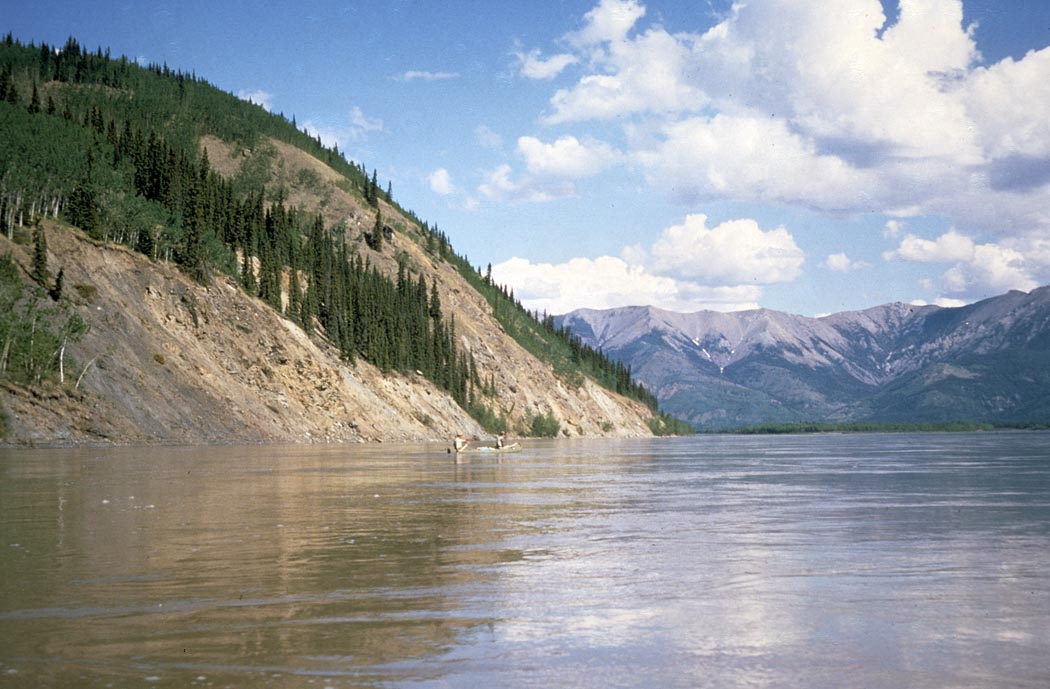
The Yukon River is a major watercourse of northwestern North America. From its source in British Columbia, it flows through Canada's territory of Yukon (itself named after the river). The lower half of the river continues westward through the U.S. state of Alaska. The river is 3,190 kilometres (1,980 mi) long and empties into the Bering Sea at the Yukon–Kuskokwim Delta. The average flow is 6,400–7,000 m3/s (230,000–250,000 cu ft/s). The total drainage area is 854,700 km2 (330,000 sq mi), of which 323,800 km2 (125,000 sq mi) lies in Canada. The total area is more than 25% larger than Texas or Alberta.
The longest river in Alaska and Yukon, it was one of the principal means of transportation during the 1896–1903 Klondike Gold Rush. A portion of the river in Yukon—"The Thirty Mile" section, from Lake Laberge to the Teslin River—is a national heritage river and a unit of Klondike Gold Rush International Historical Park. Paddle-wheel riverboats continued to ply the river until the 1950s, when the Klondike Highway was completed. After the purchase of Alaska by the United States in 1867, the Alaska Commercial Company acquired the assets of the Russian-American Company and constructed several posts at various locations on the Yukon River.
The Yukon River has a recent history of pollution from military installations, dumps, wastewater, and other sources.[failed verification][citation needed] However, the Environmental Protection Agency does not list the Yukon River among its impaired watersheds, and water-quality data from the U.S. Geological Survey shows relatively good levels of turbidity, metals, and dissolved oxygen. The Yukon and Mackenzie rivers have much higher suspended sediment concentrations than the great Siberian Arctic rivers.
The Yukon River Inter-Tribal Watershed Council, a cooperative effort of 70 First Nations and tribes in Alaska and Canada, has the goal of making the river and its tributaries safe to drink from again by supplementing and scrutinizing government data.
The name Yukon, or ųųg han, is a contraction of the words in the Gwich'in phrase chųų gąįį han, which means white water river and refers to "the pale colour" of glacial runoff in the Yukon River. The contraction is Ųųg Han, if the /ųų/ remains nasalized, or Yuk Han, if there is no vowel nasalization. In the 1840s, the various Dene nations had differing opinions as to the literal meaning of Yukon. In 1843, the Holikachuks had told the Russian-American Company that their name for the river was Yukkhana and that this name meant big river. However, Yukkhana does not literally correspond to a Holikachuk phrase that means big river. Then, two years later, the Gwich'ins told the Hudson's Bay Company that their name for the river was Yukon and that the name meant white water river. White water river in fact corresponds to Gwich'in words that can be shortened to form Yukon. Because the Holikachuks had been trading regularly with both the Gwich’ins and the Yup'iks, the Holikachuks were in a position to borrow the Gwich'in contraction and to conflate its meaning with the meaning of Kuig-pak [River-big], which is the Yup'ik name for the same river. For that reason, the documentary evidence suggests that the Holikachuks had borrowed the contraction Ųųg Han [White Water River] from Gwich'in, and erroneously assumed that this contraction had the same literal meaning as the corresponding Yup'ik name Kuig-pak [River-big].
The Lewes River is the former name of the upper course of the Yukon, from Marsh Lake to the confluence of the Pelly River at Fort Selkirk.
The generally accepted source of the Yukon River is the Llewellyn Glacier at the southern end of Atlin Lake in British Columbia. Others suggest that the source is Lake Lindeman at the northern end of the Chilkoot Trail. Either way, Atlin Lake flows into Tagish Lake (via the Atlin River), as eventually does Lake Lindeman after flowing into Bennett Lake. Tagish Lake then flows into Marsh Lake (via the Tagish River). The Yukon River proper starts at the northern end of Marsh Lake, just south of Whitehorse.
Some argue that the source of the Yukon River should really be Teslin Lake and the Teslin River, which has a larger flow when it reaches the Yukon at Hootalinqua. The upper end of the Yukon River was originally known as the Lewes River until it was established that it actually was the Yukon. North of Whitehorse, the Yukon River widens into Lake Laberge, made famous by Robert W. Service's "The Cremation of Sam McGee". Other large lakes that are part of the Yukon River system include Kusawa Lake (into the Takhini River) and Kluane Lake (into the Kluane and then White River).
Hub AI
Yukon River AI simulator
(@Yukon River_simulator)
Yukon River
The Yukon River is a major watercourse of northwestern North America. From its source in British Columbia, it flows through Canada's territory of Yukon (itself named after the river). The lower half of the river continues westward through the U.S. state of Alaska. The river is 3,190 kilometres (1,980 mi) long and empties into the Bering Sea at the Yukon–Kuskokwim Delta. The average flow is 6,400–7,000 m3/s (230,000–250,000 cu ft/s). The total drainage area is 854,700 km2 (330,000 sq mi), of which 323,800 km2 (125,000 sq mi) lies in Canada. The total area is more than 25% larger than Texas or Alberta.
The longest river in Alaska and Yukon, it was one of the principal means of transportation during the 1896–1903 Klondike Gold Rush. A portion of the river in Yukon—"The Thirty Mile" section, from Lake Laberge to the Teslin River—is a national heritage river and a unit of Klondike Gold Rush International Historical Park. Paddle-wheel riverboats continued to ply the river until the 1950s, when the Klondike Highway was completed. After the purchase of Alaska by the United States in 1867, the Alaska Commercial Company acquired the assets of the Russian-American Company and constructed several posts at various locations on the Yukon River.
The Yukon River has a recent history of pollution from military installations, dumps, wastewater, and other sources.[failed verification][citation needed] However, the Environmental Protection Agency does not list the Yukon River among its impaired watersheds, and water-quality data from the U.S. Geological Survey shows relatively good levels of turbidity, metals, and dissolved oxygen. The Yukon and Mackenzie rivers have much higher suspended sediment concentrations than the great Siberian Arctic rivers.
The Yukon River Inter-Tribal Watershed Council, a cooperative effort of 70 First Nations and tribes in Alaska and Canada, has the goal of making the river and its tributaries safe to drink from again by supplementing and scrutinizing government data.
The name Yukon, or ųųg han, is a contraction of the words in the Gwich'in phrase chųų gąįį han, which means white water river and refers to "the pale colour" of glacial runoff in the Yukon River. The contraction is Ųųg Han, if the /ųų/ remains nasalized, or Yuk Han, if there is no vowel nasalization. In the 1840s, the various Dene nations had differing opinions as to the literal meaning of Yukon. In 1843, the Holikachuks had told the Russian-American Company that their name for the river was Yukkhana and that this name meant big river. However, Yukkhana does not literally correspond to a Holikachuk phrase that means big river. Then, two years later, the Gwich'ins told the Hudson's Bay Company that their name for the river was Yukon and that the name meant white water river. White water river in fact corresponds to Gwich'in words that can be shortened to form Yukon. Because the Holikachuks had been trading regularly with both the Gwich’ins and the Yup'iks, the Holikachuks were in a position to borrow the Gwich'in contraction and to conflate its meaning with the meaning of Kuig-pak [River-big], which is the Yup'ik name for the same river. For that reason, the documentary evidence suggests that the Holikachuks had borrowed the contraction Ųųg Han [White Water River] from Gwich'in, and erroneously assumed that this contraction had the same literal meaning as the corresponding Yup'ik name Kuig-pak [River-big].
The Lewes River is the former name of the upper course of the Yukon, from Marsh Lake to the confluence of the Pelly River at Fort Selkirk.
The generally accepted source of the Yukon River is the Llewellyn Glacier at the southern end of Atlin Lake in British Columbia. Others suggest that the source is Lake Lindeman at the northern end of the Chilkoot Trail. Either way, Atlin Lake flows into Tagish Lake (via the Atlin River), as eventually does Lake Lindeman after flowing into Bennett Lake. Tagish Lake then flows into Marsh Lake (via the Tagish River). The Yukon River proper starts at the northern end of Marsh Lake, just south of Whitehorse.
Some argue that the source of the Yukon River should really be Teslin Lake and the Teslin River, which has a larger flow when it reaches the Yukon at Hootalinqua. The upper end of the Yukon River was originally known as the Lewes River until it was established that it actually was the Yukon. North of Whitehorse, the Yukon River widens into Lake Laberge, made famous by Robert W. Service's "The Cremation of Sam McGee". Other large lakes that are part of the Yukon River system include Kusawa Lake (into the Takhini River) and Kluane Lake (into the Kluane and then White River).
Recent media