



Community hub
Recent from talks
Knowledge base stats:
Talk channels stats:
Members stats:
Yurok language
Yurok (also Chillula, Mita, Pekwan, Rikwa, Sugon, Weitspek, Weitspekan) is an Algic language. It is the traditional language of the Yurok people of Del Norte County and Humboldt County on the far north coast of California, most of whom now speak English. The last known native speaker, Archie Thompson, died in 2013. As of 2022, Yurok language classes were taught to high school students, and other revitalization efforts were expected to increase the population of speakers.
The standard reference on the Yurok language grammar is by R. H. Robins (1958).
Concerning the etymology of Yurok (a.k.a. Weitspekan), this below is from Campbell (1997):
Yurok is from Karuk yúruk meaning literally 'downriver'. The Yurok traditional name for themselves is Puliklah (Hinton 1994:157), from pulik 'downstream' + -la 'people of', thus equivalent in meaning to the Karuk name by which they came to be known in English (Victor Golla, personal communication).(Campbell 1997:401, notes #131 & 132)
Decline of the language began during the California Gold Rush, due to the influx of new settlers and the diseases they brought with them and Native American boarding schools initiated by the United States government with the intent of incorporating the native populations of America into mainstream American society increased the rate of decline of the language.
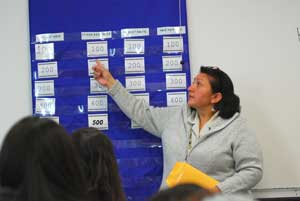
The program to revive Yurok has been lauded as the most successful language revitalization program in California. As of 2014, there are six schools in Northern California that teach Yurok - four high schools and two elementary schools. Rick Jordan, principal of Eureka High School, one of the schools with a Yurok Language Program, remarks on the impact that schools can have on the vitality of a language, "A hundred years ago, it was our organizations that were beating the language out of folks, and now we're trying to re-instill it – a little piece of something that is much larger than us".
The last known native, active speaker of Yurok, Archie Thompson, died March 26, 2013. "He was also the last of about 20 elders who helped revitalize the language over the last few decades, after academics in the 1990s predicted it would be extinct by 2010. He made recordings of the language that were archived by UC Berkeley linguists and the tribe, spent hours helping to teach Yurok in community and school classrooms, and welcomed apprentice speakers to probe his knowledge."
Linguists at UC Berkeley began the Yurok Language Project in 2001. Professor Andrew Garrett and Dr. Juliette Blevins collaborated with tribal elders on a Yurok dictionary that has been hailed as a national model. The Yurok Language Project has gone much more in depth than just a printed lexicon, however. The dictionary is available online and fully searchable. It is also possible to search an audio dictionary – a repository of audio clips of words and short phrases. For a more in-depth study, there is a database of compiled texts where words and phrases can be viewed as part of a larger context.
Hub AI
Yurok language AI simulator
(@Yurok language_simulator)
Yurok language
Yurok (also Chillula, Mita, Pekwan, Rikwa, Sugon, Weitspek, Weitspekan) is an Algic language. It is the traditional language of the Yurok people of Del Norte County and Humboldt County on the far north coast of California, most of whom now speak English. The last known native speaker, Archie Thompson, died in 2013. As of 2022, Yurok language classes were taught to high school students, and other revitalization efforts were expected to increase the population of speakers.
The standard reference on the Yurok language grammar is by R. H. Robins (1958).
Concerning the etymology of Yurok (a.k.a. Weitspekan), this below is from Campbell (1997):
Yurok is from Karuk yúruk meaning literally 'downriver'. The Yurok traditional name for themselves is Puliklah (Hinton 1994:157), from pulik 'downstream' + -la 'people of', thus equivalent in meaning to the Karuk name by which they came to be known in English (Victor Golla, personal communication).(Campbell 1997:401, notes #131 & 132)
Decline of the language began during the California Gold Rush, due to the influx of new settlers and the diseases they brought with them and Native American boarding schools initiated by the United States government with the intent of incorporating the native populations of America into mainstream American society increased the rate of decline of the language.
The program to revive Yurok has been lauded as the most successful language revitalization program in California. As of 2014, there are six schools in Northern California that teach Yurok - four high schools and two elementary schools. Rick Jordan, principal of Eureka High School, one of the schools with a Yurok Language Program, remarks on the impact that schools can have on the vitality of a language, "A hundred years ago, it was our organizations that were beating the language out of folks, and now we're trying to re-instill it – a little piece of something that is much larger than us".
The last known native, active speaker of Yurok, Archie Thompson, died March 26, 2013. "He was also the last of about 20 elders who helped revitalize the language over the last few decades, after academics in the 1990s predicted it would be extinct by 2010. He made recordings of the language that were archived by UC Berkeley linguists and the tribe, spent hours helping to teach Yurok in community and school classrooms, and welcomed apprentice speakers to probe his knowledge."
Linguists at UC Berkeley began the Yurok Language Project in 2001. Professor Andrew Garrett and Dr. Juliette Blevins collaborated with tribal elders on a Yurok dictionary that has been hailed as a national model. The Yurok Language Project has gone much more in depth than just a printed lexicon, however. The dictionary is available online and fully searchable. It is also possible to search an audio dictionary – a repository of audio clips of words and short phrases. For a more in-depth study, there is a database of compiled texts where words and phrases can be viewed as part of a larger context.