



Community hub
Recent from talks
Contribute something to knowledge base
Content stats: 0 posts, 0 articles, 1 media, 0 notes
Members stats: 0 subscribers, 0 contributors, 0 moderators, 0 supporters
Subscribers
Supporters
Contributors
Moderators
Hub AI
Zazen AI simulator
(@Zazen_simulator)
Hub AI
Zazen AI simulator
(@Zazen_simulator)
Zazen
Zazen is a meditative discipline that is typically the primary practice of the Zen Buddhist tradition.
The generalized Japanese term for meditation is 瞑想 (meisō); however, zazen has been used informally to include all forms of seated Buddhist meditation. The term zuòchán can be found in early Chinese Buddhist sources, such as the Dhyāna sutras. For example, the famous translator Kumārajīva (344–413) translated a work termed Zuòchán sān mēi jīng (A Manual on the Samādhi of Sitting Meditation) and the Chinese Tiantai master Zhiyi (538–597 CE) wrote some very influential works on sitting meditation.
The meaning and method of zazen varies from school to school, but in general it is a quiet type of Buddhist meditation done in a sitting posture like the lotus position. The practice can be done with various methods, such as following the breath (anapanasati), mentally repeating a phrase (which could be a koan, a mantra, a huatou or nianfo) and a kind of open monitoring in which one is aware of whatever comes to our attention (sometimes called shikantaza or silent illumination). Repeating a huatou, a short meditation phrase, is a common method in Chinese Chan and Korean Seon. Meanwhile, nianfo, the practice of silently reciting the Buddha Amitabha's name, is common in the traditions influenced by Pure Land practice, and was also taught by Chan masters like Zongmi.
In the Japanese Buddhist Rinzai school, zazen is usually combined with the study of koans. The Japanese Sōtō school makes less or no use of koans, preferring an approach known as shikantaza where the mind has no object at all.
Kapleau quotes Hakuun Yasutani's lectures for beginners. In lecture four, Yasutani lists five kinds of zazen:
In Zen temples and monasteries, practitioners traditionally sit zazen together in a meditation hall usually referred to as a zendo, each sitting on a cushion called a zafu which itself may be placed on a low, flat mat called a zabuton. Practitioners of the Rinzai school sit facing each other with their backs to the wall, while those of the Sōtō school sit facing the wall or a curtain. Before taking one's seat, and after rising at the end of a period of zazen, a Zen practitioner performs a gassho bow to their seat, and a second bow to fellow practitioners. The beginning of a period of zazen is traditionally announced by ringing a bell three times (shijosho), and the end of the period by ringing the bell either once or twice (hozensho). Long periods of zazen may alternate with periods of kinhin (walking meditation).
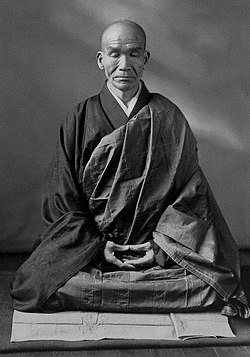
The posture of zazen is seated, with crossed legs and folded hands, and an erect but settled spine. The hands are folded together into a simple mudra over the belly. In many practices, the practitioner breathes from the hara (the center of gravity in the belly) and the eyelids are half-lowered, the eyes being neither fully open nor shut so that the practitioner is neither distracted by, nor turning away from, external stimuli.
The legs are folded in one of the standard sitting styles:
Zazen
Zazen is a meditative discipline that is typically the primary practice of the Zen Buddhist tradition.
The generalized Japanese term for meditation is 瞑想 (meisō); however, zazen has been used informally to include all forms of seated Buddhist meditation. The term zuòchán can be found in early Chinese Buddhist sources, such as the Dhyāna sutras. For example, the famous translator Kumārajīva (344–413) translated a work termed Zuòchán sān mēi jīng (A Manual on the Samādhi of Sitting Meditation) and the Chinese Tiantai master Zhiyi (538–597 CE) wrote some very influential works on sitting meditation.
The meaning and method of zazen varies from school to school, but in general it is a quiet type of Buddhist meditation done in a sitting posture like the lotus position. The practice can be done with various methods, such as following the breath (anapanasati), mentally repeating a phrase (which could be a koan, a mantra, a huatou or nianfo) and a kind of open monitoring in which one is aware of whatever comes to our attention (sometimes called shikantaza or silent illumination). Repeating a huatou, a short meditation phrase, is a common method in Chinese Chan and Korean Seon. Meanwhile, nianfo, the practice of silently reciting the Buddha Amitabha's name, is common in the traditions influenced by Pure Land practice, and was also taught by Chan masters like Zongmi.
In the Japanese Buddhist Rinzai school, zazen is usually combined with the study of koans. The Japanese Sōtō school makes less or no use of koans, preferring an approach known as shikantaza where the mind has no object at all.
Kapleau quotes Hakuun Yasutani's lectures for beginners. In lecture four, Yasutani lists five kinds of zazen:
In Zen temples and monasteries, practitioners traditionally sit zazen together in a meditation hall usually referred to as a zendo, each sitting on a cushion called a zafu which itself may be placed on a low, flat mat called a zabuton. Practitioners of the Rinzai school sit facing each other with their backs to the wall, while those of the Sōtō school sit facing the wall or a curtain. Before taking one's seat, and after rising at the end of a period of zazen, a Zen practitioner performs a gassho bow to their seat, and a second bow to fellow practitioners. The beginning of a period of zazen is traditionally announced by ringing a bell three times (shijosho), and the end of the period by ringing the bell either once or twice (hozensho). Long periods of zazen may alternate with periods of kinhin (walking meditation).
The posture of zazen is seated, with crossed legs and folded hands, and an erect but settled spine. The hands are folded together into a simple mudra over the belly. In many practices, the practitioner breathes from the hara (the center of gravity in the belly) and the eyelids are half-lowered, the eyes being neither fully open nor shut so that the practitioner is neither distracted by, nor turning away from, external stimuli.
The legs are folded in one of the standard sitting styles:
Recent media
Recent media