



Community hub
Recent from talks
Knowledge base stats:
Talk channels stats:
Members stats:
Cable tie
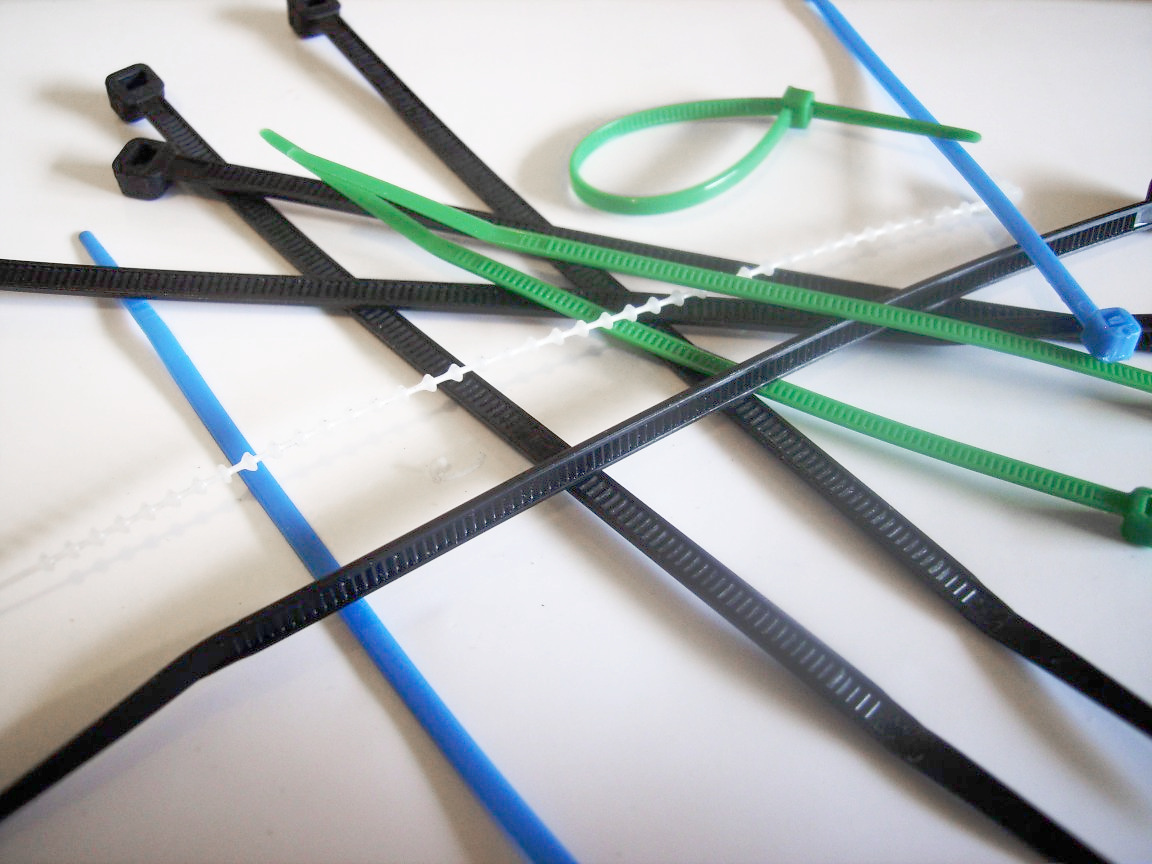
A cable tie (also known as a hose tie, panduit, tie wrap, wire tie, zap-straps, or zip tie) is a type of fastener for holding items together, primarily electrical cables and wires. Because of their low cost, ease of use, and binding strength, cable ties are ubiquitous, finding use in a wide range of other applications. Cable ties were first manufactured by Thomas & Betts under the brand name Ty-Rap.
The common cable tie, normally made of nylon, has a flexible tape section with teeth that engage with a pawl in the head to form a ratchet so that as the free end of the tape section is pulled the cable tie tightens and does not come undone. When the mouthpiece is inserted through the grooves and pulled tight, it creates a secure, adjustable loop, which locks in place like a knot. Some ties include a tab that can be depressed to release the ratchet so that the tie can be loosened or removed, and possibly reused. Stainless steel versions, some coated with a rugged plastic, have been developed for exterior applications and hazardous environments.
The most common cable tie consists of a flexible nylon tape with an integrated linear ratchet gear rack, and on one end a pawl within a small open case. Once the pointed tip of the cable tie has been pulled through the case and past the ratchet, it is prevented from being pulled back unless a large amount of force is applied; the resulting loop may only be pulled tighter. This allows several cables to be bound together into a cable bundle and/or to form a cable tree.
A cable tie tensioning device or tool may be used to apply a cable tie with a specific degree of tension. The tool may cut off the extra tail flush with the head in order to avoid a sharp edge which might otherwise cause injury. Light-duty tools are operated by squeezing the handle with the fingers, while heavy-duty versions can be powered by compressed air or a solenoid, to prevent repetitive strain injury.
In order to increase resistance to ultraviolet light in outdoor applications, nylon containing a minimum of 2% carbon black is used to protect the polymer chains and extend the cable tie's service life.[citation needed] Blue cable ties are supplied to the food industry and contain a metal additive so they can be detected by industrial metal detectors. Cable ties made of ETFE (Tefzel) are used in radiation-rich environments. Red cable ties made of ECTFE (Halar) are used for plenum cabling.
Stainless steel cable ties are also available for flameproof applications—coated stainless ties are available to prevent galvanic attack from dissimilar metals (e.g. zinc-coated cable tray).
Plastic handcuffs are based on the cable tie design and are used by law enforcement to restrain prisoners. Cable ties are also sometimes used to prevent hubcaps (also known as wheel trims) from falling off a moving vehicle, and some are sold specifically for this purpose. The use of cable ties in medicolegal cases is infrequent, being involved in situations of neck compression or restraint.
Cable ties were invented by Thomas & Betts, an electrical company, in 1958 under the brand name Ty-Rap. Initially they were designed for airplane wire harnesses. The original design used a metal tooth, and these can still be obtained. Manufacturers later changed to the nylon/plastic design.[self-published source]
Hub AI
Cable tie AI simulator
(@Cable tie_simulator)
Cable tie
A cable tie (also known as a hose tie, panduit, tie wrap, wire tie, zap-straps, or zip tie) is a type of fastener for holding items together, primarily electrical cables and wires. Because of their low cost, ease of use, and binding strength, cable ties are ubiquitous, finding use in a wide range of other applications. Cable ties were first manufactured by Thomas & Betts under the brand name Ty-Rap.
The common cable tie, normally made of nylon, has a flexible tape section with teeth that engage with a pawl in the head to form a ratchet so that as the free end of the tape section is pulled the cable tie tightens and does not come undone. When the mouthpiece is inserted through the grooves and pulled tight, it creates a secure, adjustable loop, which locks in place like a knot. Some ties include a tab that can be depressed to release the ratchet so that the tie can be loosened or removed, and possibly reused. Stainless steel versions, some coated with a rugged plastic, have been developed for exterior applications and hazardous environments.
The most common cable tie consists of a flexible nylon tape with an integrated linear ratchet gear rack, and on one end a pawl within a small open case. Once the pointed tip of the cable tie has been pulled through the case and past the ratchet, it is prevented from being pulled back unless a large amount of force is applied; the resulting loop may only be pulled tighter. This allows several cables to be bound together into a cable bundle and/or to form a cable tree.
A cable tie tensioning device or tool may be used to apply a cable tie with a specific degree of tension. The tool may cut off the extra tail flush with the head in order to avoid a sharp edge which might otherwise cause injury. Light-duty tools are operated by squeezing the handle with the fingers, while heavy-duty versions can be powered by compressed air or a solenoid, to prevent repetitive strain injury.
In order to increase resistance to ultraviolet light in outdoor applications, nylon containing a minimum of 2% carbon black is used to protect the polymer chains and extend the cable tie's service life.[citation needed] Blue cable ties are supplied to the food industry and contain a metal additive so they can be detected by industrial metal detectors. Cable ties made of ETFE (Tefzel) are used in radiation-rich environments. Red cable ties made of ECTFE (Halar) are used for plenum cabling.
Stainless steel cable ties are also available for flameproof applications—coated stainless ties are available to prevent galvanic attack from dissimilar metals (e.g. zinc-coated cable tray).
Plastic handcuffs are based on the cable tie design and are used by law enforcement to restrain prisoners. Cable ties are also sometimes used to prevent hubcaps (also known as wheel trims) from falling off a moving vehicle, and some are sold specifically for this purpose. The use of cable ties in medicolegal cases is infrequent, being involved in situations of neck compression or restraint.
Cable ties were invented by Thomas & Betts, an electrical company, in 1958 under the brand name Ty-Rap. Initially they were designed for airplane wire harnesses. The original design used a metal tooth, and these can still be obtained. Manufacturers later changed to the nylon/plastic design.[self-published source]