Hubbry Logo
Cable tieCable tieMain
Open search
Cable tie
Community hub
Cable tie
logo
8 pages, 0 posts
0 subscribers
Be the first to start a discussion here.
Cable tie
Cable tie
from Wikipedia
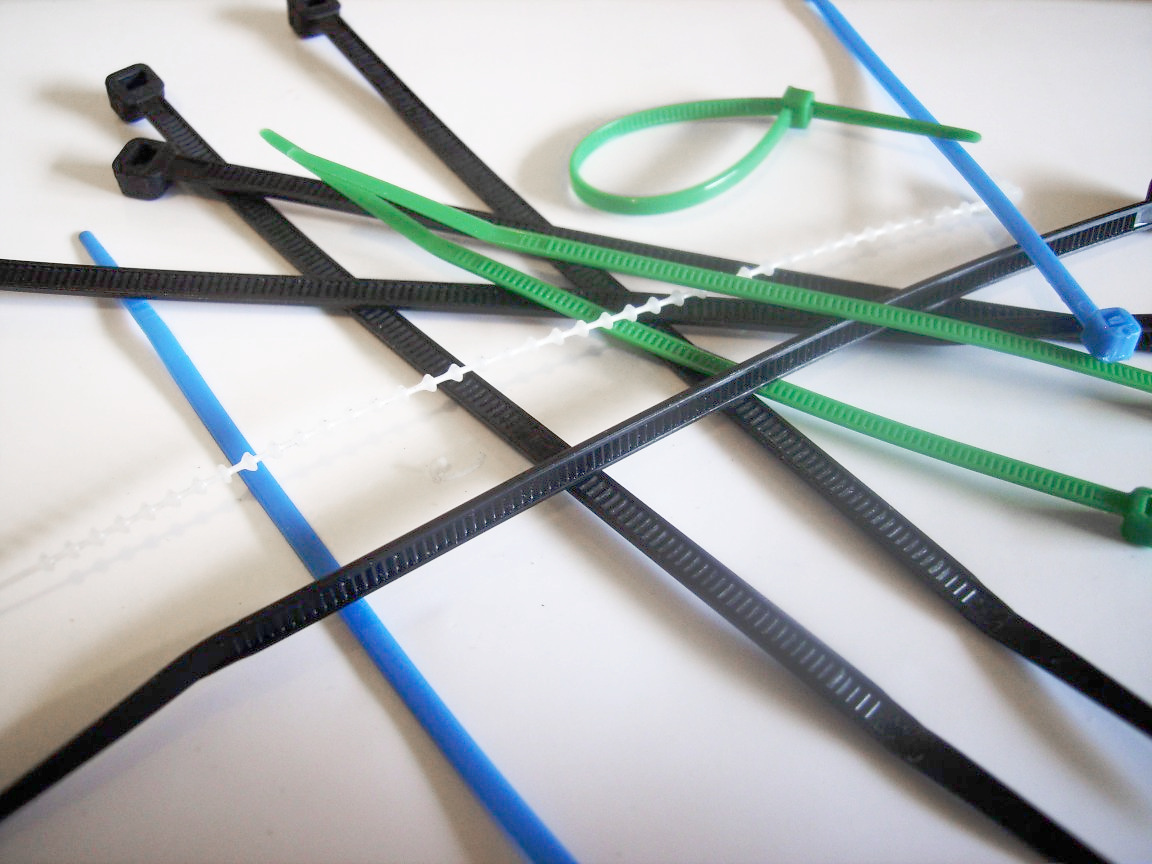
Assortment of cable ties

A cable tie (also known as a hose tie, panduit,[1] tie wrap, wire tie, zap-straps, or zip tie) is a type of fastener for holding items together, primarily electrical cables and wires. Because of their low cost, ease of use, and binding strength, cable ties are ubiquitous, finding use in a wide range of other applications. Cable ties were first manufactured by Thomas & Betts under the brand name Ty-Rap.

The common cable tie, normally made of nylon, has a flexible tape section with teeth that engage with a pawl in the head to form a ratchet so that as the free end of the tape section is pulled the cable tie tightens and does not come undone. When the mouthpiece is inserted through the grooves and pulled tight, it creates a secure, adjustable loop, which locks in place like a knot. Some ties include a tab that can be depressed to release the ratchet so that the tie can be loosened or removed, and possibly reused. Stainless steel versions, some coated with a rugged plastic, have been developed for exterior applications and hazardous environments.[2]

Design and use

[edit]
The ratchet mechanism on the head of a cable tie
Cable ties used to attach shade cloth to scaffolding at a construction site in Singapore

The most common cable tie consists of a flexible nylon tape with an integrated linear ratchet gear rack, and on one end a pawl within a small open case. Once the pointed tip of the cable tie has been pulled through the case and past the ratchet, it is prevented from being pulled back unless a large amount of force is applied; the resulting loop may only be pulled tighter. This allows several cables to be bound together into a cable bundle and/or to form a cable tree.

A cable tie tensioning device or tool may be used to apply a cable tie with a specific degree of tension. The tool may cut off the extra tail flush with the head in order to avoid a sharp edge which might otherwise cause injury. Light-duty tools are operated by squeezing the handle with the fingers, while heavy-duty versions can be powered by compressed air or a solenoid, to prevent repetitive strain injury.

In order to increase resistance to ultraviolet light in outdoor applications, nylon containing a minimum of 2% carbon black is used to protect the polymer chains and extend the cable tie's service life.[citation needed] Blue cable ties are supplied to the food industry and contain a metal additive so they can be detected by industrial metal detectors.[3] Cable ties made of ETFE (Tefzel) are used in radiation-rich environments. Red cable ties made of ECTFE (Halar) are used for plenum cabling.

Stainless steel cable ties are also available for flameproof applications—coated stainless ties are available to prevent galvanic attack from dissimilar metals (e.g. zinc-coated cable tray).[2]

Plastic handcuffs are based on the cable tie design and are used by law enforcement to restrain prisoners.[4] Cable ties are also sometimes used to prevent hubcaps (also known as wheel trims) from falling off a moving vehicle, and some are sold specifically for this purpose.[5] The use of cable ties in medicolegal cases is infrequent, being involved in situations of neck compression or restraint.[6]

History

[edit]

Cable ties were invented by Thomas & Betts, an electrical company, in 1958 under the brand name Ty-Rap. Initially they were designed for airplane wire harnesses. The original design used a metal tooth, and these can still be obtained. Manufacturers later changed to the nylon/plastic design.[7][self-published source]

Over the years the design has been extended and developed into numerous spin-off products. One example was a self-locking loop developed as an alternative to purse-string suture in colon anastomosis.[8]

The Ty-Rap cable tie's inventor, Maurus C. Logan, worked for Thomas & Betts and finished his career with the company as Vice President of Research and Development. During his tenure at Thomas & Betts, he contributed to the development and marketing of many successful Thomas & Betts products. Logan died on 12 November 2007, at the age of 86.[9]

The idea of the cable tie came to Logan while touring a Boeing aircraft manufacturing facility in 1956. Aircraft wiring was a cumbersome and detailed undertaking, involving thousands of feet of wire organized on sheets of 50-foot-long plywood and held in place with knotted, wax-coated, braided nylon cord. Each knot had to be pulled tight by wrapping the cord around one's finger which sometimes cut the operator's fingers until they developed thick calluses. Logan was convinced there had to be an easier, more forgiving, way to accomplish this critical task.

For the next couple of years, Logan experimented with various tools and materials. On June 24, 1958, a patent for the Ty-Rap cable tie was submitted.[10]

Reusable & recyclable cable ties

[edit]

Cable ties are generally designed as single-use devices, however they can be reopened with little or no damage by inserting a small flat object between the ratchet and the pawl, and pulling the pawl out. Some models have a mechanism to release the pawl and allow re-use. Alternatively, the tie can be twisted 180 degrees and inserted into the case upside down to create a weaker loop that can be easily opened by hand, but still strong enough for certain simple tasks, such as holding several cables together.

In later years, some manufacturers have developed cable ties of other materials than traditional plastics, with such cable ties instead being made by recyclable materials such as long wood fibres [11]

Speciality types

[edit]
A cable tie with an in-built security tag
Beaded
Beaded design allows them to be releasable and reusable
Releasable
Reusable cable ties with a releasable ratchet
Ladder style
For intermediate bundling and retail applications
Identification
Built-in flags for written or printed identification
Parallel entry
Tamper-proof, low profile heads
Tear-off
Quick release design requires no cutting tools
Pull-tight seals
Tamper-evident seals
Steggel
Heavy duty, multipurpose ties

Alternatives

[edit]

Other methods of bundling cable together securely and semi-permanently include cable lacing, strapping, binding knots such as the surgeon's knot or constrictor knot, Velcro brand hook-and-loop strips, conveyor belt hooks, twist ties, Rapstrap fasteners, or metal buckle.

See also

[edit]

References

[edit]
[edit]
Revisions and contributorsEdit on WikipediaRead on Wikipedia
from Grokipedia
A cable tie, also known as a zip tie or tie wrap, is a type of designed to bundle and secure cables, wires, or other items together, typically consisting of a flexible strap made from durable plastic such as with an integrated locking mechanism that allows one-way tightening to prevent loosening. The modern cable tie was invented in 1958 by engineer Maurus C. Logan at , originally as the Ty-Rap® to efficiently harness hundreds of wires in , replacing labor-intensive methods like knotting waxed cord. Since its patenting, cable ties have become ubiquitous in industries including , automotive, electrical installations, and , with over 180 billion produced annually and applications extending to extreme environments such as missions and deep-ocean operations. They are available in various types classified by performance under standards like UL 62275, including Type 1 (integral locking for general use), Type 2 (with fixing attachments for continuous stress), and specialized variants for metallic or high-temperature use, with tensile strengths ranging from 18 to over 600 pounds. Materials commonly include 6.6 for standard ties, offering resistance to chemicals, UV light, and temperatures up to 85°C, alongside options like for harsh conditions or detectable plastics for and medical applications.

Overview

Definition and Purpose

A cable tie is a type of designed to hold items together, particularly for bundling and securing cables, wires, or other slender objects. Also known as a zip tie, tie wrap, hose tie, or wire tie, it consists of a flexible with a mechanism that allows it to be tightened and locked in place, providing a quick and reliable way to organize materials. The primary purpose of a cable tie is to bundle and secure items to maintain organization, prevent tangling, and enhance safety in diverse environments, such as electrical installations where it keeps wires neatly grouped to reduce hazards. This fastening method allows for efficient identification and management of bundled elements, making it essential for both temporary and semi-permanent applications across industries and households. The term "zip tie" derives from the distinctive zipping sound produced when the strap is pulled through its locking head to tighten it, while "tie wrap" reflects the wrapping action used to encircle objects. "Hose tie" emphasizes its utility in securing hoses alongside cables. Unlike twist ties, which require manual twisting of a wire core for closure and are better suited for adjustable, reusable bindings on flexible items like bread bags, cable ties offer a one-way, self-locking mechanism for more permanent and tension-resistant securing.

Basic Mechanism

A cable tie operates through a ratchet mechanism that enables one-way locking to secure bundled items. The device consists of a flexible featuring a series of angled teeth or serrations along its length and a locking head containing a pawl, which is a flexible tab or . When the pointed tip of the strap is inserted into the head, the pawl engages with the teeth, permitting the strap to advance in one direction while preventing retraction. The tensioning process begins by wrapping the strap around the items to be bundled, such as wires or cables, and threading the tip through the head. Pulling the free end of the strap tightens the loop, with each successive tooth clicking past the pawl until the desired tension is achieved, at which point the excess strap can be trimmed if necessary. This self-locking action requires no additional tools and ensures the bundle remains secure under normal conditions. Once locked, the pawl firmly grips the engaged , resisting backward movement and preventing unintentional release, even when subjected to or moderate pulling forces. This release prevention mechanism contributes to the cable tie's reliability, with standard ties typically rated for tensile strengths between 18 and 50 pounds, depending on size and design.

Design and Materials

Construction Features

A standard cable tie consists of three primary structural elements: an elongated strap, a locking head, and a pawl mechanism within the head. The strap forms the main body, typically featuring a series of transverse ridges or teeth along one side to facilitate one-way engagement. The locking head is positioned at one end of the strap and houses the pawl, a flexible cantilevered tab or barb that snaps into the strap's teeth to secure the bundle. These components work together to enable secure bundling by allowing the strap to be threaded through the head and ratcheted tight, as detailed in the basic mechanism. Typical dimensions of cable ties vary to accommodate different bundling requirements, with lengths ranging from 4 to 48 inches to handle bundle diameters from small wires to large hoses. Widths generally fall between 0.1 and 0.3 inches, influencing the tensile strength and load capacity; narrower ties (around 0.1 inches) support lighter loads up to 18 pounds, while wider ones (up to 0.3 inches) can withstand over 120 pounds. These size variations ensure the tie's structural integrity matches the application's demands without compromising flexibility. Design variations enhance functionality while maintaining the core structure. Most straps are straight for straightforward wrapping, but some incorporate a curved or bent tip at the free end to simplify insertion under tight bundles and reduce installation time. Additionally, optional features include a mounting hole in the head for screw attachment to panels or a barb on the base for push-in fixation to holes. Certain designs integrate identification markers, such as a flat, writable flag extending from the head or a designated area on the strap for labeling contents.

Common Materials

The primary material used in most cable ties is nylon 6/6 (polyamide 66), valued for its balance of flexibility, high tensile strength, non-conductive properties that provide electrical insulation, and cost-effectiveness. These characteristics make it suitable for bundling wires and cables in diverse environments, particularly in electrical applications where it offers mechanical support and electrical safety. This material exhibits a of 255–265°C, allowing it to maintain structural under moderate , and demonstrates good chemical resistance to oils, fuels, and common solvents, which enhances its durability in industrial settings. To improve performance, nylon 6/6 cable ties often incorporate additives such as UV stabilizers, including carbon black, which prevents degradation from prolonged sun exposure in outdoor applications by absorbing ultraviolet radiation. Flame retardants are also added to achieve ratings like UL 94 V-2 or V-0, reducing flammability and smoke generation during potential fire exposure, particularly in enclosed or high-risk areas. Additionally, metal-detecting additives, such as iron oxide or magnetite, are incorporated into nylon or polypropylene variants to make them detectable by metal detectors or X-ray, suitable for food processing and medical applications to prevent contamination. Alternative base materials include tetrafluoroethylene (), a known for its superior chemical resistance to acids, bases, and solvents, as well as tolerance to gamma radiation and UV light, making it ideal for harsh chemical processing environments. Another option is chlorotrifluoroethylene (), which offers exceptional temperature tolerance up to 160°C continuously, along with inherent flame retardancy and low permeability to gases, suited for high-heat applications like or oil and gas. is also used for cable ties in highly corrosive or extreme mechanical stress environments, providing superior strength and resistance to chemicals and temperatures beyond plastic limits.

Types and Variants

Standard and Nylon Ties

Standard nylon cable ties, also known as zip ties, are the most prevalent type used for bundling wires, cables, and other items in everyday and electrical applications. Constructed primarily from durable material, these ties feature a self-locking mechanism that allows for quick, secure fastening but is designed for one-time use, rendering them disposable once tightened. They are available in natural (off-white) coloration for general purposes or in various colors such as red, blue, green, yellow, and UV-stabilized black to facilitate identification and organization of bundled items, particularly in complex wiring setups. The composition provides resistance to temperatures up to 185°F and flammability rating UL 94 V-2, making them suitable for indoor and light outdoor use. Tensile strength ratings classify these ties into categories like miniature (typically 18 lb), standard (40-50 lb), and heavy-duty (up to 120 lb or more), ensuring they can handle varying loads without failure under tension. For instance, a miniature tie might secure small bundles, while a heavy-duty version supports industrial . Common sizes range from 4 inches in length for miniature variants to 48 inches for heavy-duty ones, with widths from 0.1 inches to 0.35 inches, accommodating bundle diameters up to 11 inches. They are typically packaged in bulk for efficiency, such as 100 or 1,000 pieces per , ideal for electrical contractors and general maintenance tasks.

Reusable and Recyclable Types

Reusable cable ties incorporate mechanisms that allow for repeated use without the need for cutting or replacement, distinguishing them from traditional disposable variants. These designs typically feature a releasable pawl system, where an extended tab or lever in the tie's head enables the locking mechanism to be disengaged, facilitating easy unlocking and rebundling of cables. For instance, HellermannTyton offers releasable ties with an extended pawl that supports bundle diameters from 12.0 to 125.0 mm, allowing multiple cycles of securing and release while maintaining structural integrity. Alternatively, Velcro-like plastic alternatives use hook-and-loop fasteners integrated into flexible nylon straps, providing a non-permanent grip suitable for adjustable bundling in dynamic environments like networking or temporary installations. Marine grade hook and loop cable ties are reusable Velcro-style straps designed specifically for marine environments, featuring resistance to saltwater, UV radiation, and harsh weather conditions. Various weather-resistant and UV-resistant products, including those from brands like Velcro Brand ONE-WRAP and others marketed for outdoor and marine use, are available on Amazon. Recyclable cable ties emphasize environmental through materials that either break down naturally or can be reprocessed without significant loss of quality. Biodegradable variants often employ (PLA)-based polymers derived from renewable sources like or vegetable oils, which decompose in appropriate industrial composting conditions, contributing to reduction in applications such as outdoor or short-term events. Fully recyclable options, typically made from or 6,6, allow ties to be melted and reformed into new products, supporting principles in industrial settings. Recent innovations from 2023 to 2025 have introduced plant-based composites, such as wood fiber ties like FibreStrap, which replace plastics with Scandinavian-sourced long fibers, offering biodegradability within a reasonable timeframe while reducing reliance on fossil-based materials. While these reusable and recyclable types promote longevity and eco-friendliness, they often exhibit performance trade-offs compared to standard disposable ties, which can achieve higher tensile strengths for permanent applications. Reusable designs with releasable pawls typically max out at around 50 lb of tensile strength due to the modified head that prioritizes release functionality over maximum load-bearing, though this enables an extended lifecycle of dozens of uses without degradation. In contrast, biodegradable PLA variants may offer even lower strengths suited for light-duty tasks, but their ability to degrade prevents long-term accumulation of , balancing immediate utility with environmental benefits.

Specialty and Advanced Types

Beaded cable ties feature a series of molded beads along the strap, enabling adjustable tension and releasable locking for precise bundling in complex systems. This design allows users to incrementally tighten or loosen the tie without tools, making it suitable for environments requiring frequent adjustments. In automotive and applications, beaded ties secure wiring harnesses and components during assembly and maintenance, accommodating intricate designs and vibration resistance. Ladder-style cable ties incorporate a flexible, segmented strap resembling ladder rungs, which permits fine-tuned adjustable tension and enhanced flexibility for bundling in dynamic settings. Constructed from nylon 6/6, these ties offer a tensile strength of 40 pounds while using 60% less material than solid ties, reducing weight without compromising performance. They are widely adopted in automotive and industries for securing cables in oily or wet conditions, where their adjustable diameter range—from 1/16 inch to 3 inches—supports custom fits in harnesses and . Metal and cable ties provide superior durability in harsh environments, featuring resistance essential for marine and outdoor applications. Made from 316-grade alloyed with , these ties withstand salt spray, chemicals, and weather exposure, operating effectively from -80°C to +500°C. They achieve tensile strengths up to 250 pounds, enabling secure fastening of heavy bundles in coastal, offshore, and industrial settings where alternatives degrade. Advanced innovations in cable ties include metal-detectable variants designed for and pharmaceutical to minimize contamination risks. These ties incorporate dispersed metal particles throughout 6.6 construction, allowing detection by standard equipment, complemented by blue coloring for visual identification. Compliant with HACCP standards and FDA regulations for direct contact, they support bundle diameters up to 110 mm with a minimum tensile strength of 225 N, ensuring in environments as of 2025 implementations. Smart cable ties integrate embedded RFID transponders or sensors for enhanced tracking and monitoring capabilities. RFID-enabled models, utilizing UHF frequencies, facilitate real-time asset identification in industrial , automotive defect tracing, and tool , with developments in 2024 including durable tags for projects and offshore applications. Sensor-equipped variants monitor parameters like temperature and strain, providing data for in , aligning with Industry 4.0 advancements.

Applications

General and Industrial Uses

Cable ties are widely employed in electrical and networking applications to bundle and secure wires and cables in industrial, commercial, and residential installations, providing mechanical support, high tensile strength, electrical insulation due to the non-conductive properties of polyamide (nylon), organization, safety, and compliance with electrical standards, while preventing tangling and facilitating organized routing in various environments. In homes and offices, they secure power cords, extension leads, and audio-visual wiring behind furniture or along walls, reducing clutter and minimizing trip hazards during installation or maintenance. In data centers, cable ties organize dense bundles of Ethernet, optic, and power cables within racks and trays, improving , easing identification for , and supporting efficient cooling to prevent equipment overheating. In construction and automotive sectors, cable ties provide reliable fastening for structural and mechanical components. Construction workers use them to secure temporary fencing, hold rebar in place during concrete pours, and bundle pipes or hoses on scaffolding, ensuring stability and quick assembly on job sites. In automotive assembly, they are essential for creating wiring harnesses by tightly binding electrical wires, sensors, and connectors under hoods or along chassis, protecting against vibration-induced wear and simplifying vehicle manufacturing processes. Additionally, they fasten hoses, fuel lines, and interior panels, contributing to durable and streamlined vehicle designs. For general purposes, cable ties offer versatile solutions for everyday and securing tasks. They neatly bundle appliance cords, computer peripherals, and holiday lights in storage, preventing knots and enabling easy access when needed. In , users apply them to tie climbing plants to trellises, support stakes, or attach tools to handles, providing a simple, weather-resistant method for plant training and equipment management. They also aid in packaging by securing boxes, bags, or bundled items for moving or shipping, offering a cost-effective alternative to tape for temporary closures. Standard cable ties are commonly selected for these applications due to their affordability and ease of use.

Specialized Applications

In medical applications, sterile cable ties, often in the form of self-locking loops made from biocompatible , serve as alternatives to traditional purse-string sutures for temporarily sealing the colon lumen during procedures. A 2017 conducted on porcine models demonstrated that these devices achieve tight closure with good tissue grip, reducing operative time and simplifying the process compared to manual suturing, without causing perforations or significant complications. Such ties must undergo rigorous sterilization to prevent , enabling their use in laparoscopic colorectal surgeries where precision and minimal tissue trauma are critical. In and security contexts, cable ties function as disposable restraints, commonly known as flex cuffs, to temporarily secure individuals during arrests or transports, offering a , high-tensile-strength option with tensile ratings up to 250 pounds. Their one-way locking mechanism provides inherent tamper resistance, making them suitable for short-term detention, though studies indicate potential for hand and wrist injuries such as neuropathies when applied. Additionally, tamper-evident variants with serialized numbering or frangible seals are employed to secure bags, ensuring chain-of-custody by visibly indicating any unauthorized access during storage or transport. Aerospace and military applications demand cable ties engineered for extreme conditions, such as high-strength or variants that withstand , temperature fluctuations from -40°C to 185°C, and UV exposure without degrading. These ties secure wiring harnesses and components in vibration-prone environments like fuselages or vehicles, meeting standards such as SAE-AS23190A for reliability and commonality across systems. RFID-integrated smart cable ties enable real-time in these sectors, allowing , , and rapid identification of in resource-constrained operations. In marine applications, marine grade hook and loop cable ties—reusable Velcro-style straps—are used to secure cables, hoses, and wiring in harsh marine environments. These ties are designed with materials resistant to saltwater corrosion, UV radiation, and extreme weather conditions, making them suitable for boats, yachts, ships, and offshore installations where traditional self-locking cable ties may degrade prematurely.

History

Invention and Early Development

The cable tie, also known as a zip tie or Ty-Rap, was invented in 1958 by Maurus C. Logan, an engineer employed by the electrical company . Logan developed the device to address the inefficiencies of traditional wire bundling methods, particularly in the aerospace industry, where workers manually tied electrical cables using waxed strings in intricate wiring harnesses. His inspiration stemmed from observing this labor-intensive process during a 1956 tour of a facility, where the time-consuming lacing of wires highlighted the need for a faster, more reliable fastening solution. Logan's early development involved two years of experimentation with various materials and designs to create a self-locking that could securely bundle parallel insulated wires without requiring additional tools or knots. Initial prototypes consisted of flexible strips featuring a ratcheting mechanism with serrations on one side and a locking head, allowing the tie to be pulled tight and remain secure against slippage. These hand-fabricated prototypes were specifically tested for their ability to organize and support wire bundles in electrical panels and harnesses, demonstrating reduced assembly time and weight compared to metal clamps or lacing. The culmination of this work was formalized in U.S. Patent 3,022,557, titled "Cable Bundling and Supporting Strap," filed on June 24, 1958, and granted on February 27, 1962. The patent described a one-piece strap with a eyelet and ribs to prevent wire shifting, optimized for applications in telecommunication systems and where , durability, and ease of installation were critical. This invention marked a pivotal advancement in , laying the foundation for standardized bundling practices across industries.

Commercialization and Evolution

The Ty-Rap cable tie was introduced by in 1958 as the first self-clinching design, initially developed to streamline the bundling of wiring harnesses in . This innovation, filed for patent that year and granted in 1962, marked the commercial launch of cable ties under the Ty-Rap brand, replacing labor-intensive manual methods with a quick, secure fastening solution. Following its invention by Maurus C. Logan, the product gained traction amid the electronics boom, as expanding industries like and demanded efficient tools. By the mid-1960s, expanded internationally, securing patents in to support market entry and protect the design amid growing demand. The saw further evolution with improvements in materials and designs. In the 1980s, the original patent entered the , allowing multiple manufacturers to produce similar designs and accelerating global adoption. UV-resistant versions emerged in the early 1990s, formulated with stabilized to withstand outdoor exposure and degradation from sunlight, broadening applications in and utilities. Key milestones included the 2012 acquisition of by ABB, which integrated the Ty-Rap line into a global portfolio and accelerated innovation in low-voltage products. By the , global production of cable ties had reached billions of units cumulatively, driven by widespread adoption across , automotive, and sectors.

Manufacturing

Production Process

Cable ties, particularly those made from nylon 6/6, begin production with the preparation of raw material pellets, which are dried to remove moisture and prevent defects during molding. These pellets are then fed into an , where they are heated to 250–280°C to form molten . The molten material is injected under into precision-engineered, multi-cavity steel molds that simultaneously shape the flexible strap, locking head, and integral pawl in a single piece. This process ensures the pawl's inherent strength for secure engagement with the strap's serrations. Each molding cycle, including injection, cooling, and ejection, typically lasts 10–12 seconds, enabling high-volume output from molds with up to 144 cavities. Following molding, the solidified ties are automatically ejected using robotic arms and ejector pins, with any excess material (flash or ) trimmed for clean edges. For standard ties, no separate assembly is required, as the pawl is molded integrally; however, in with metal pawls, automated insertion ensures precise integration into the head. The ties then undergo cutting to specified lengths if produced in continuous form, though most are molded to final dimensions. Packaging occurs via automated systems that count, bundle, and seal ties into bags, coils, or bulk cartons, often at rates matching the molding cycle for efficiency. Throughout production, quality checks focus on tensile uniformity, with samples tested for loop strength to verify consistent performance across batches. In high-volume operations, continuous may supplement molding for specialized reel-fed ties, followed by head attachment, but injection molding dominates for discrete units due to its precision.

Quality Standards and Regulations

Cable ties must undergo rigorous to verify their mechanical strength, with the ASTM D638 standard serving as a primary method for determining tensile properties of the materials used in their construction. This test involves applying a controlled tensile force to specimens until failure, measuring key metrics such as and elongation at break to ensure the ties can withstand specified loads without premature rupture. Manufacturers integrate this testing into production processes to confirm compliance, often achieving tensile strengths ranging from 50 to 250 pounds for standard variants. Material certifications play a crucial role in guaranteeing the safety and reliability of cable ties. The standard evaluates flammability by classifying materials based on their burning behavior during vertical or horizontal tests, with common ratings for cable ties including V-0, V-1, V-2, and HB to minimize fire risks in electrical applications. Nylon 6/6, a prevalent material, typically meets UL 94 V-2 requirements, indicating self-extinguishing properties within 30 seconds after ignition. Additionally, ISO 9001 certification ensures consistent in , covering processes from selection to final assembly and requiring documented procedures for defect prevention and continuous improvement. Global regulations address specialized applications, particularly in sensitive industries. For food-contact variants, cable ties must comply with FDA regulations under 21 CFR 177.1500 and 177.1520, which approve materials for indirect or direct contact with due to their non-toxic composition and low extractables. In 2024, new and detectable variants were introduced to meet heightened standards in cleanrooms and production lines. These ties incorporate metal additives for and detector identification, reducing risks of foreign object debris in regulated environments.

Environmental and Safety Considerations

Sustainability and Impact

Cable ties, predominantly made from nylon or other petroleum-derived plastics, contribute to significant environmental emissions during their production phase. The manufacturing process for nylon cable ties involves extracting and refining fossil fuels, leading to greenhouse gas emissions estimated at approximately 9.3 kg CO₂ equivalent per kilogram of product. This lifecycle stage, encompassing raw material acquisition and processing, accounts for the majority of the product's carbon footprint due to energy-intensive polymerization of nylon 6,6 from petroleum sources. At the end of their lifecycle, single-use plastic cable ties exacerbate waste issues by accumulating in landfills and potentially degrading into microplastics. These non-biodegradable ties persist in the environment, breaking down slowly into tiny particles that contaminate and waterways, posing risks to aquatic ecosystems through by . Recycling cable ties presents substantial challenges, particularly for those used in mixed applications where contamination from residues or other materials occurs. Nylon ties are generally incompatible with standard municipal recycling streams due to their composition and small size, resulting in low recovery rates and often directing them to incineration or landfilling. Innovations in 2025, such as biodegradable cable ties made from plant-based fibers like those in FibreStrap products, address these issues by decomposing naturally and reducing carbon emissions by over 85% compared to traditional plastic ties, thereby minimizing landfill contributions. Metal cable ties, typically , offer recyclability advantages but carry upstream environmental burdens from . The extraction of metals like iron and involves habitat disruption, , and water contamination from and , contributing to broader ecosystem degradation. However, their indefinite recyclability without quality loss supports a , potentially offsetting impacts when scrap is reused, unlike plastic ties that generate persistent waste.

Safety Standards and Compliance

Cable ties are subject to stringent safety standards to mitigate risks associated with hazardous materials and improper use. The European Union's Restriction of Hazardous Substances (RoHS) Directive 2011/65/EU, which updated the original 2002/95/EC framework effective in 2006, limits the presence of substances like lead (<0.1%), mercury (<0.1%), cadmium (<0.01%), hexavalent chromium (<0.1%), polybrominated biphenyls (PBB), and polybrominated diphenyl ethers (PBDE) in electrical and electronic equipment, including cable ties used in such applications. Compliance ensures cable ties do not contribute to environmental or health hazards during manufacturing or end-use. Similarly, the REACH Regulation (EC) No 1907/2006 requires registration, evaluation, and restriction of chemicals, prohibiting or limiting substances of very high concern in cable tie production, such as certain phthalates and heavy metals, to protect human health and the environment. In workplace settings, the U.S. (OSHA) provides guidelines for safe cable tie application under standards like 29 CFR 1910.305, which mandates that supports such as cable ties must secure wiring without causing , using fittings like staples or straps installed to prevent abrasion or pinching. For procedures in 29 CFR 1910.147, zip ties may serve as attachment means if they are non-reusable, self-locking, and withstand at least 50 pounds of force, though locks are preferred for full compliance. In the , metal-detectable cable ties, often incorporating additives, comply with FDA regulations such as 21 CFR 177.1500 for food-contact materials, enabling detection of fragments to prevent in processing environments; these standards remain critical as of 2025 for maintaining product integrity. Best practices emphasize adherence to manufacturer-specified load limits to prevent failure, with standard cable ties typically rated for 18 to 50 pounds of tensile strength, while heavy-duty variants handle up to 250 pounds or more, selected based on application demands. Over-tightening must be avoided, as it can damage insulated wires, reduce bundle flexibility, or cause premature tie breakage; tensioning tools are recommended to apply uniform force without exceeding 80% of the rated strength. Regular inspections for wear and proper installation on smooth cable surfaces further ensure compliance and safety.

Alternatives

Traditional Methods

Cable lacing involves threading waxed cord or lacing tape through eyelets or hitches along wiring harnesses to secure bundles, a technique traditionally employed in and applications for organizing complex electrical systems. This method uses knots such as the , basket hitch, or weave tie to create stable supports, often spaced every few inches to minimize movement and support long spans in environments like or fixed installations. While adjustable during installation to achieve proper tension, cable lacing is labor-intensive, requiring skilled application and periodic maintenance to prevent wear from environmental factors. Twist ties, consisting of metal wire wrapped in or , have been used historically for bundling small cable groups, particularly in low-tech or temporary setups where reusability is valued. In contexts, these ties are twisted manually around wires to provide quick securing, as seen in field installations for telephones or tactical wiring. Although reusable and easily adjustable, metal components make them prone to in humid or outdoor conditions, limiting long-term reliability. Tape wrapping employs adhesive tapes, such as electrical or , wound around cables to achieve temporary bundling, a common practice in prototyping and scenarios. This method secures small sections or protects wire ends by overlapping layers for insulation and hold, often used in tactical or repair environments where rapid application is essential. It offers simplicity and availability but can degrade over time, leaving residue or loosening under stress. Cable ties provide a more permanent and efficient alternative to these labor-intensive traditional approaches.

Modern Substitutes

Modern substitutes for cable ties have emerged to address demands for reusability, ease of installation, and reduced environmental impact, particularly in sectors prioritizing and efficiency. straps, utilizing hook-and-loop fastening technology, provide a reusable and adjustable option for bundling cables in (IT) environments, automotive applications, and marine environments. Marine-grade variants of these hook-and-loop cable ties are resistant to saltwater, UV radiation, and harsh weather conditions, making them suitable for demanding outdoor and marine uses. Various products, including those from brands like Velcro Brand ONE-WRAP, are available on Amazon. These straps allow for quick release and reconfiguration without tools, making them ideal for dynamic setups like server racks or vehicle wiring harnesses where frequent access is required. Magnetic and clip systems represent tool-free, releasable alternatives that have gained traction in data centers as part of 2024 trends toward streamlined infrastructure. These systems employ embedded magnets or spring-loaded clips to secure and organize cables, facilitating rapid deployment and removal while minimizing airflow disruptions in high-density computing environments. The global magnetic cable management market reached USD 1.34 billion in 2024, driven by adoption in data centers for efficient routing and maintenance. Biodegradable wraps, including plant-based ties and adhesive films, offer eco-friendly solutions for cable securing in environmentally sensitive areas such as outdoor installations or conservation sites. Products like FibreStrap, made from Scandinavian wood fibers, provide strength comparable to ties while fully biodegrading and remaining recyclable, thereby reducing long-term accumulation. Similarly, ties composed of derived from vegetable oils decompose into water and through composting, supporting CO2 reduction efforts in applications where traditional ties would persist as waste. These substitutes enhance by breaking down naturally without harming ecosystems, contrasting with the persistent from conventional options.

References

Add your contribution
Related Hubs
User Avatar
No comments yet.