
Recent from talks
Zone of proximal development
Knowledge base stats:
Talk channels stats:
Members stats:
Zone of proximal development
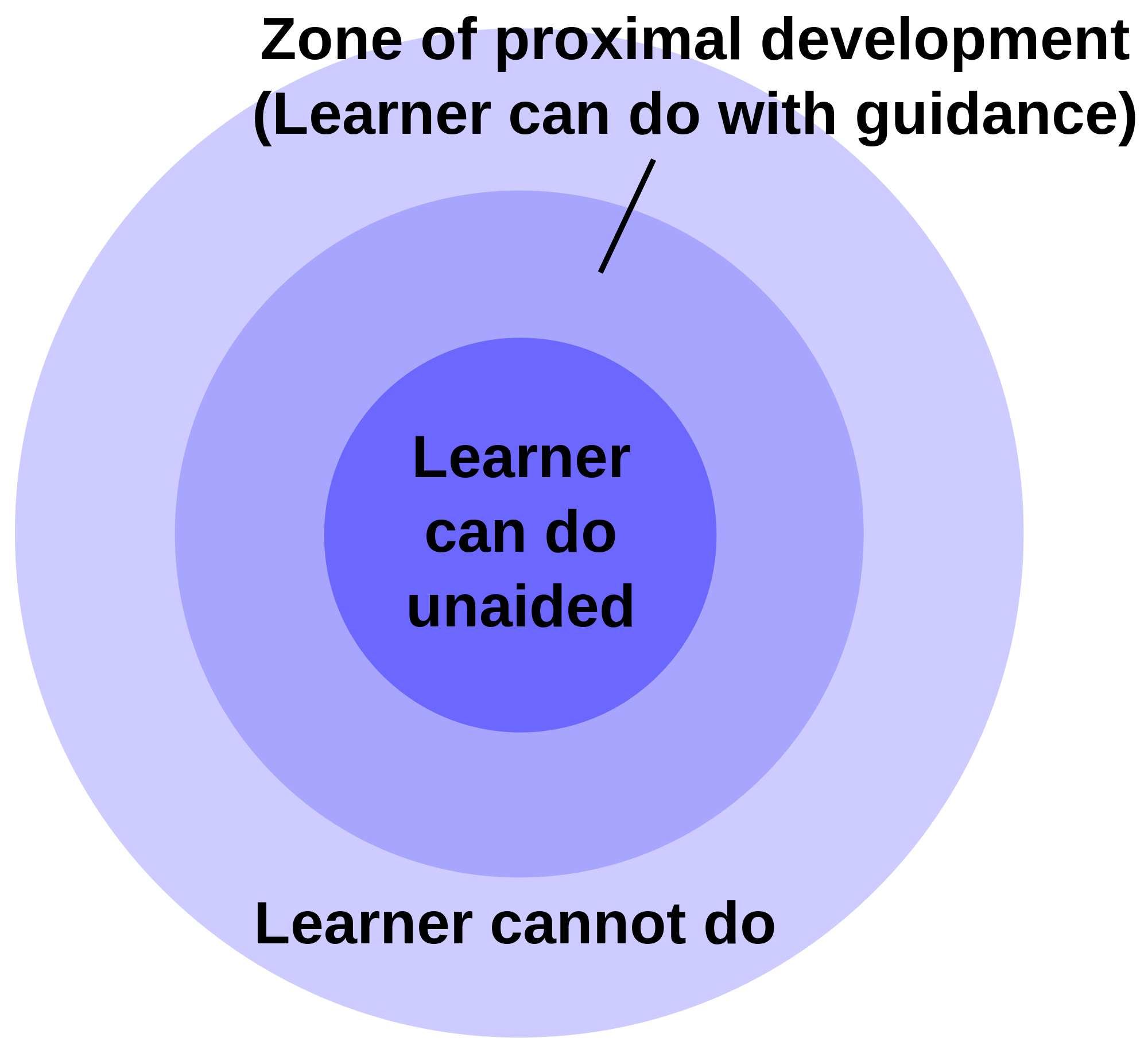
The zone of proximal development (ZPD) is a concept in educational psychology that represents the space between what a learner is capable of doing unsupported and what the learner cannot do even with support. It is the range where the learner is able to perform, but only with support from a teacher or a peer with more knowledge or expertise. This person is known as the "more knowledgable other." The concept was introduced, but not fully developed, by psychologist Lev Vygotsky (1896–1934) during the last three years of his life. Vygotsky argued that a child gets involved in a dialogue with the "more knowledgeable other" and gradually, through social interaction and sense-making, develops the ability to solve problems independently and do certain tasks without help. Following Vygotsky, some educators believe that the role of education is to give children experiences that are within their zones of proximal development, thereby encouraging and advancing their individual learning skills and strategies.
The concept of the zone of proximal development was originally developed by Vygotsky to argue against the use of academic, knowledge-based tests as a means to gauge students' intelligence. He also created ZPD to further develop Jean Piaget's theory of children being lone and autonomous learners. Vygotsky spent a lot of time studying the impact of school instruction on children and noted that children grasp language concepts quite naturally, but that math and writing did not come as naturally. Essentially, he concluded that because these concepts were taught in school settings with unnecessary assessments, they were more difficult for learners. Piaget believed that there was a clear distinction between development and teaching. He said that development is a spontaneous process that is initiated and completed by the children, stemming from their own efforts. Piaget was a proponent of independent thinking and critical of the standard teacher-led instruction that was common practice in schools.
Alternatively, Vygotsky saw natural, spontaneous development as important, but not all-important. He believed that children would not advance very far if they were left to discover everything on their own. It is crucial for a child's development that they are able to interact with more knowledgeable others: they are not able to expand on what they know if this is not possible. The term more knowledgeable others (MKO) is used to describe someone who has a better understanding or higher ability level than the learner, in reference to the specific task, idea, or concept. He noted cultural experiences where children are greatly helped by knowledge and tools handed down from previous generations. Vygotsky noted that good teachers should not present material that is too difficult and "pull the students along."
Vygotsky argued that, rather than examining what a student knows to determine intelligence, it is better to examine their ability to solve problems independently and ability to solve problems with an adult's help. He proposed a question: "if two children perform the same on a test, are their levels of development the same?" He concluded that they were not. However, Vygotsky's untimely death interrupted his work on the zone of proximal development, and it remained mostly incomplete.
Since Vygotsky's original conception, the definition for the zone of proximal development has been expanded and modified. The zone of proximal development is an area of learning that occurs when a person is assisted by a teacher or peer with a higher skill set. The person learning the skill set cannot complete it without the assistance of the teacher or peer. The teacher then helps the student attain the skill the student is trying to master, until the teacher is no longer needed for that task.
Any function within the zone of proximal development matures within a particular internal context that includes not only the function's actual level but also how susceptible the child is to types of help, the sequence in which these types of help are offered, the flexibility or rigidity of previously formed stereotypes, how willing the child is to collaborate, along with other factors. This context can impact the diagnosis of a function's potential level of development.
Vygotsky stated that one cannot just look at what students are capable of doing on their own; one must look at what they are capable of doing in a social setting. In many cases students are able to complete a task within a group before they are able to complete it on their own. He notes that the teacher's job is to move the child's mind forward step-by-step (teachers cannot teach complex chemical equations to six-year-olds, for example). At the same time, teachers cannot teach all children equally; they must determine which students are ready for which lessons. An example is the often-used accelerated reading program in schools. Students are assessed and given a reading level and a range. Books rated below their level are easy to read, while books above their level challenge the student. Sometimes students are not even allowed to check out books from the school library that are outside their range. Vygotsky argued that a major shortcoming of standardized tests is that they only measure what students are capable of on their own, not in a group setting where their minds are being pushed by other students.
In the context of second language learning, the ZPD can be useful to many adult users. Prompted by this fact as well as the finding that adult peers do not necessarily need to be more capable to provide assistance in the ZPD, Vygotsky's definition has been adapted to better suit the adult L2 developmental context.
Hub AI
Zone of proximal development AI simulator
(@Zone of proximal development_simulator)
Zone of proximal development
The zone of proximal development (ZPD) is a concept in educational psychology that represents the space between what a learner is capable of doing unsupported and what the learner cannot do even with support. It is the range where the learner is able to perform, but only with support from a teacher or a peer with more knowledge or expertise. This person is known as the "more knowledgable other." The concept was introduced, but not fully developed, by psychologist Lev Vygotsky (1896–1934) during the last three years of his life. Vygotsky argued that a child gets involved in a dialogue with the "more knowledgeable other" and gradually, through social interaction and sense-making, develops the ability to solve problems independently and do certain tasks without help. Following Vygotsky, some educators believe that the role of education is to give children experiences that are within their zones of proximal development, thereby encouraging and advancing their individual learning skills and strategies.
The concept of the zone of proximal development was originally developed by Vygotsky to argue against the use of academic, knowledge-based tests as a means to gauge students' intelligence. He also created ZPD to further develop Jean Piaget's theory of children being lone and autonomous learners. Vygotsky spent a lot of time studying the impact of school instruction on children and noted that children grasp language concepts quite naturally, but that math and writing did not come as naturally. Essentially, he concluded that because these concepts were taught in school settings with unnecessary assessments, they were more difficult for learners. Piaget believed that there was a clear distinction between development and teaching. He said that development is a spontaneous process that is initiated and completed by the children, stemming from their own efforts. Piaget was a proponent of independent thinking and critical of the standard teacher-led instruction that was common practice in schools.
Alternatively, Vygotsky saw natural, spontaneous development as important, but not all-important. He believed that children would not advance very far if they were left to discover everything on their own. It is crucial for a child's development that they are able to interact with more knowledgeable others: they are not able to expand on what they know if this is not possible. The term more knowledgeable others (MKO) is used to describe someone who has a better understanding or higher ability level than the learner, in reference to the specific task, idea, or concept. He noted cultural experiences where children are greatly helped by knowledge and tools handed down from previous generations. Vygotsky noted that good teachers should not present material that is too difficult and "pull the students along."
Vygotsky argued that, rather than examining what a student knows to determine intelligence, it is better to examine their ability to solve problems independently and ability to solve problems with an adult's help. He proposed a question: "if two children perform the same on a test, are their levels of development the same?" He concluded that they were not. However, Vygotsky's untimely death interrupted his work on the zone of proximal development, and it remained mostly incomplete.
Since Vygotsky's original conception, the definition for the zone of proximal development has been expanded and modified. The zone of proximal development is an area of learning that occurs when a person is assisted by a teacher or peer with a higher skill set. The person learning the skill set cannot complete it without the assistance of the teacher or peer. The teacher then helps the student attain the skill the student is trying to master, until the teacher is no longer needed for that task.
Any function within the zone of proximal development matures within a particular internal context that includes not only the function's actual level but also how susceptible the child is to types of help, the sequence in which these types of help are offered, the flexibility or rigidity of previously formed stereotypes, how willing the child is to collaborate, along with other factors. This context can impact the diagnosis of a function's potential level of development.
Vygotsky stated that one cannot just look at what students are capable of doing on their own; one must look at what they are capable of doing in a social setting. In many cases students are able to complete a task within a group before they are able to complete it on their own. He notes that the teacher's job is to move the child's mind forward step-by-step (teachers cannot teach complex chemical equations to six-year-olds, for example). At the same time, teachers cannot teach all children equally; they must determine which students are ready for which lessons. An example is the often-used accelerated reading program in schools. Students are assessed and given a reading level and a range. Books rated below their level are easy to read, while books above their level challenge the student. Sometimes students are not even allowed to check out books from the school library that are outside their range. Vygotsky argued that a major shortcoming of standardized tests is that they only measure what students are capable of on their own, not in a group setting where their minds are being pushed by other students.
In the context of second language learning, the ZPD can be useful to many adult users. Prompted by this fact as well as the finding that adult peers do not necessarily need to be more capable to provide assistance in the ZPD, Vygotsky's definition has been adapted to better suit the adult L2 developmental context.
Recent media