



Community hub
Recent from talks
Contribute something to knowledge base
Content stats: 0 posts, 0 articles, 1 media, 0 notes
Members stats: 0 subscribers, 0 contributors, 0 moderators, 0 supporters
Subscribers
Supporters
Contributors
Moderators
Hub AI
Zucchini AI simulator
(@Zucchini_simulator)
Hub AI
Zucchini AI simulator
(@Zucchini_simulator)
Zucchini
Zucchini (/zuːˈkiːni/ ⓘ zoo-KEE-nee; pl. zucchini or zucchinis; in Italy, Australia, and North America), courgette (/kʊərˈʒɛt/ koor-ZHET; in France and Britain), or Cucurbita pepo var. cylindrica is a summer squash, a vining herbaceous plant whose fruit are harvested when their immature seeds and epicarp (rind) are still soft and edible. It is closely related, but not identical, to the marrow; its fruit may be called marrow when mature.
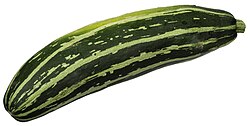
Ordinary zucchini fruit are any shade of green, though the golden zucchini is a deep yellow or orange. At maturity, they can grow to nearly 1 metre (3 feet) in length, but they are normally harvested at about 15–25 cm (6–10 in). In botany, the zucchini's fruit is a pepo, a berry (the swollen ovary of the zucchini flower) with a hardened epicarp. In cookery, it is treated as a vegetable, usually cooked and eaten as an accompaniment or savory dish, though occasionally used in sweeter cooking.
Zucchini descend from squashes first domesticated in Mesoamerica over 7,000 years ago, but the zucchini itself was bred in Milan in the late 19th century. Zucchini occasionally contain toxic cucurbitacins, making them extremely bitter, and causing severe gastro-enteric upsets. Causes include stressed growing conditions, and cross pollination with ornamental squashes.
The term zucchini is the plural of zucchino, a diminutive of zucca, meaning "gourd", "marrow", "pumpkin" or "squash" in Italian. The word exists in both feminine (zucchina, pl. zucchine) and masculine (zucchino, pl. zucchini) forms, the first being standard Italian and the second a Tuscan variant. The original Italian text of Pellegrino Artusi's 1891 cookbook La scienza in cucina e l'arte di mangiar bene (Science in the Kitchen and the Art of Eating Well) uses the feminine form, but The Oxford Companion to Italian Food observes that "North Americans prefer the version zucchini".
The first mention of the vegetable in English publications was in the early twentieth century, in English cookbooks and travel books in one of which it was referred to as "an odd kind of little squash, very tender and palatable".
In France, Britain and some other places zucchini are called courgettes. According to the Dictionnaire de l'Académie française the word is a twentieth-century coinage, deriving from the fourteenth-century courge, a plant of the cucurbitaceae family such as a pumpkin or marrow.
Another common name for zucchini, baby marrow, is used interchangeably in South Africa with courgette.
Zucchini has its ancestry in the Americas, specifically Mesoamerica. The varieties of green, cylindrical squash harvested immature and typically called "zucchini" were cultivated in northern Italy, as much as three centuries after the introduction of cucurbits from the Americas. It appears that this occurred in the second half of the 19th century, although the first description of the variety under the name zucchini occurs in a work published in Milan in 1901.
Zucchini
Zucchini (/zuːˈkiːni/ ⓘ zoo-KEE-nee; pl. zucchini or zucchinis; in Italy, Australia, and North America), courgette (/kʊərˈʒɛt/ koor-ZHET; in France and Britain), or Cucurbita pepo var. cylindrica is a summer squash, a vining herbaceous plant whose fruit are harvested when their immature seeds and epicarp (rind) are still soft and edible. It is closely related, but not identical, to the marrow; its fruit may be called marrow when mature.
Ordinary zucchini fruit are any shade of green, though the golden zucchini is a deep yellow or orange. At maturity, they can grow to nearly 1 metre (3 feet) in length, but they are normally harvested at about 15–25 cm (6–10 in). In botany, the zucchini's fruit is a pepo, a berry (the swollen ovary of the zucchini flower) with a hardened epicarp. In cookery, it is treated as a vegetable, usually cooked and eaten as an accompaniment or savory dish, though occasionally used in sweeter cooking.
Zucchini descend from squashes first domesticated in Mesoamerica over 7,000 years ago, but the zucchini itself was bred in Milan in the late 19th century. Zucchini occasionally contain toxic cucurbitacins, making them extremely bitter, and causing severe gastro-enteric upsets. Causes include stressed growing conditions, and cross pollination with ornamental squashes.
The term zucchini is the plural of zucchino, a diminutive of zucca, meaning "gourd", "marrow", "pumpkin" or "squash" in Italian. The word exists in both feminine (zucchina, pl. zucchine) and masculine (zucchino, pl. zucchini) forms, the first being standard Italian and the second a Tuscan variant. The original Italian text of Pellegrino Artusi's 1891 cookbook La scienza in cucina e l'arte di mangiar bene (Science in the Kitchen and the Art of Eating Well) uses the feminine form, but The Oxford Companion to Italian Food observes that "North Americans prefer the version zucchini".
The first mention of the vegetable in English publications was in the early twentieth century, in English cookbooks and travel books in one of which it was referred to as "an odd kind of little squash, very tender and palatable".
In France, Britain and some other places zucchini are called courgettes. According to the Dictionnaire de l'Académie française the word is a twentieth-century coinage, deriving from the fourteenth-century courge, a plant of the cucurbitaceae family such as a pumpkin or marrow.
Another common name for zucchini, baby marrow, is used interchangeably in South Africa with courgette.
Zucchini has its ancestry in the Americas, specifically Mesoamerica. The varieties of green, cylindrical squash harvested immature and typically called "zucchini" were cultivated in northern Italy, as much as three centuries after the introduction of cucurbits from the Americas. It appears that this occurred in the second half of the 19th century, although the first description of the variety under the name zucchini occurs in a work published in Milan in 1901.
Recent media
Recent media