cykeo
cykeo
Main page
2656544
Message

cykeo

(@cykeorfid)
Personal Hub0 subscribers
Hub photo

cykeo doesn't have any subscribers yet.

cykeo hasn't subscribed to any hubs yet.

What are your thoughts?
author image
cykeorfid10 hr. ago
general
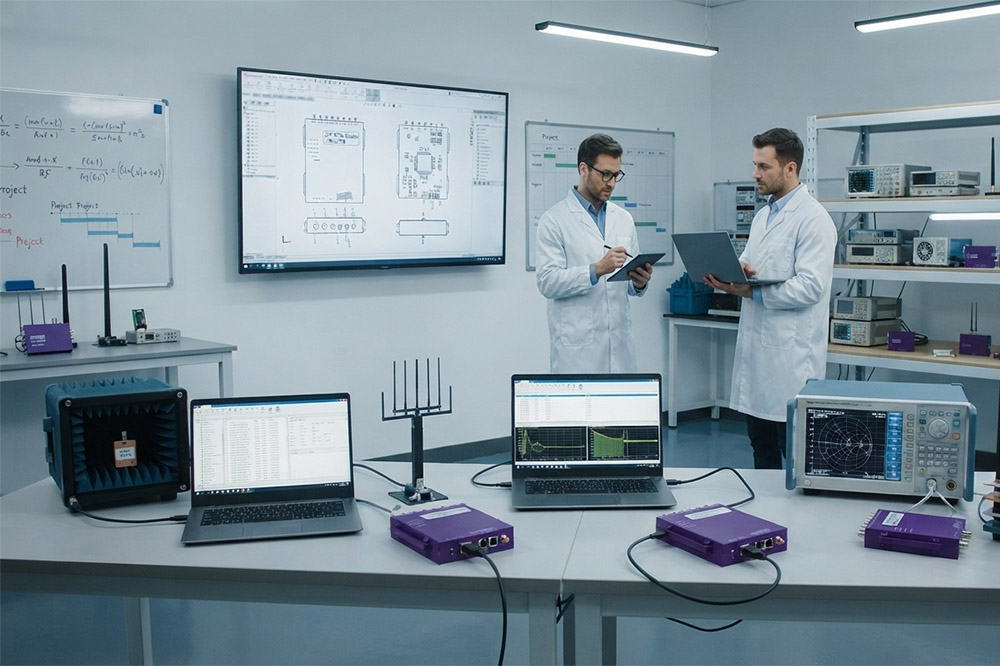
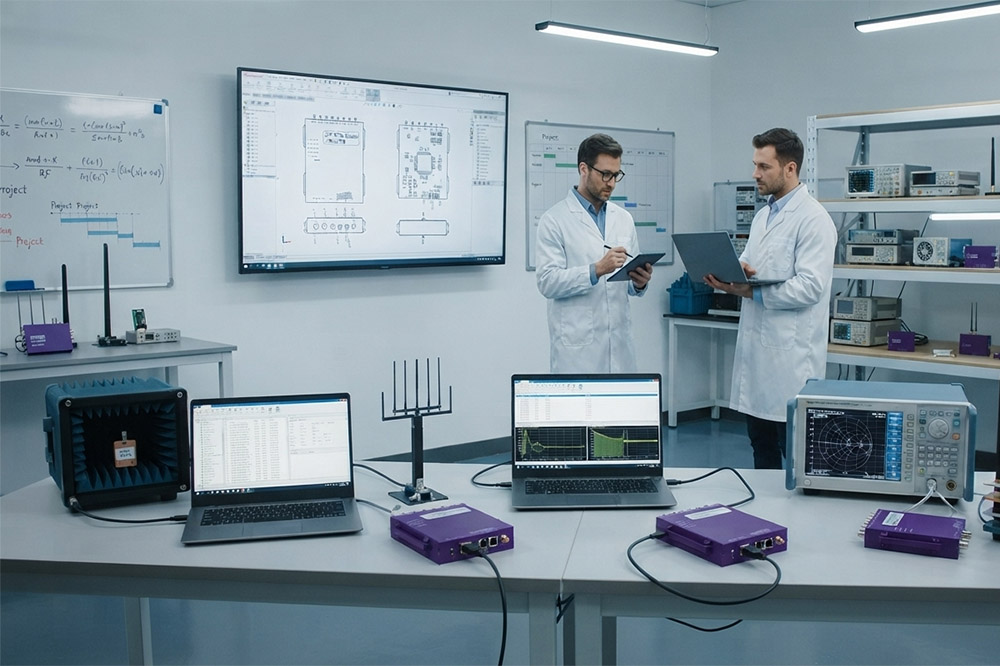
Long Range RFID Reader SDK: A Practical Development Guide for Java, C#, Android and Linux

When people search for a Long Range RFID Reader SDK, they usually aren’t looking for another hardware brochure. More often, they’re already working on a warehouse, logistics, manufacturing or asset tracking project and need to connect an RFID reader with their own software.

That sounds straightforward, but the development work often becomes more complicated than expected.

One customer we worked with had already finished the warehouse management system. The only missing part was reading RFID tags automatically at the dock door. Their biggest concern wasn’t the reading distance—it was finding an SDK that could communicate reliably with their existing Java application.

Situations like this are actually very common.

A practical RFID SDK should support the operating systems developers already use, including Windows, Linux and Android, while also providing libraries for Java and C#. That saves plenty of time during integration because developers don’t have to build the communication layer from scratch.

Communication methods matter just as much.

Some logistics systems prefer TCP Socket because readers are connected through Ethernet. Others still use Serial (RS232/RS485), especially when upgrading older factories where existing controllers remain in service. In newer cloud-based projects, a REST API often makes integration with ERP, WMS or MES systems much easier.

Instead of worrying about low-level commands, developers can simply send HTTP requests and receive tag data in a familiar format.

Another detail that often gets overlooked is sample code.

A complete SDK shouldn’t stop at documentation. Developers usually expect working demos showing how to connect, configure antennas, start inventory scanning and process EPC data. Having ready-to-run examples can shorten development from several days to only a few hours.

Java developers normally focus on backend integration with warehouse management systems. C# is still widely used for Windows desktop applications in factories. Android SDKs are common for handheld terminals used in inventory counting or receiving operations.

Because every project looks a little different, it’s useful when the SDK follows the same communication logic across all platforms. That way, moving from Windows testing to Linux deployment doesn’t require learning a completely different interface.

GitHub examples are another feature many engineers search for. Before selecting hardware, developers often want to review the project structure, communication methods and API design. Even a simple inventory demo helps them estimate the integration workload before purchasing equipment.

In logistics environments, RFID readers rarely work alone. They usually interact with barcode scanners, conveyor systems, PLC controllers, traffic lights or warehouse software. The SDK should therefore expose clear APIs for reading tag IDs, controlling GPIO, configuring antennas and monitoring reader status in real time.

From our experience, developers generally don’t ask for dozens of advanced functions on the first day. What they really want is stable communication, readable documentation and code examples that can be adapted without spending days decoding proprietary commands.

CYKEO long range RFID readers are designed with this in mind. The SDK supports Java, C#, Android, Linux and Windows, together with TCP, Serial and REST API communication. Demo programs and development documents are available to help software teams connect RFID readers with WMS, ERP, logistics and industrial automation systems more efficiently.

If you’re developing a logistics platform, warehouse management solution or industrial tracking system, choosing an SDK that’s easy to understand can save far more time than simply choosing the reader with the longest detection range.

post image 1
0
author image
cykeorfid1 days ago
general
External RFID Reader: Why Is It the Preferred Choice for Industrial RFID Systems?

external RFID reader provides flexible antenna deployment, longer reading distances, and higher identification accuracy than integrated readers. It is widely used in asset tracking, warehouse management, manufacturing, logistics, and intelligent inventory systems where stable RFID performance is essential.

When customers ask why one RFID project consistently achieves over 99% read accuracy while another struggles with missed tags, the discussion almost always shifts from the reader itself to antenna placement. After participating in RFID deployments across factories, warehouses, laboratories, and equipment management centers, I’ve found that the ability to position antennas independently is often the deciding factor. That flexibility is exactly why industrial integrators continue choosing external RFID readers for complex environments.

What Is an External RFID Reader?

An external RFID reader is an RFID device designed to connect with one or multiple external antennas instead of relying solely on an integrated antenna.

This architecture offers significantly greater installation flexibility.

Rather than placing the reader exactly where tags need to be identified, engineers install antennas at optimal reading positions while mounting the reader safely inside electrical cabinets, control boxes, or server rooms.

Typical communication interfaces include:

  • USB

  • RS-232

  • RS-485

  • Ethernet (TCP/IP)

  • Wi-Fi

  • Bluetooth

  • GPIO for industrial automation

Because rfid antenna placement becomes independent of the reader location, the system adapts much more easily to changing production layouts.

Why Do Industrial Projects Prefer External RFID Readers?

During warehouse commissioning, one issue appears repeatedly.

Metal shelving, forklifts, conveyors, and moving personnel create constantly changing RF environments.

Instead of relocating the entire reader, engineers simply adjust antenna locations.

That seemingly small advantage saves hours of installation work.

Key benefits include:

FeaturePractical ValueExternal antenna supportFlexible installationMultiple antenna portsCovers larger working areasLong reading distanceEfficient bulk identificationIndustrial interfacesEasy PLC and MES integrationHigh transmit powerStable RFID performanceContinuous operationSuitable for 24/7 automation

Unlike portable handheld devices designed for mobile inspection, external RFID readers are optimized for permanent infrastructure.

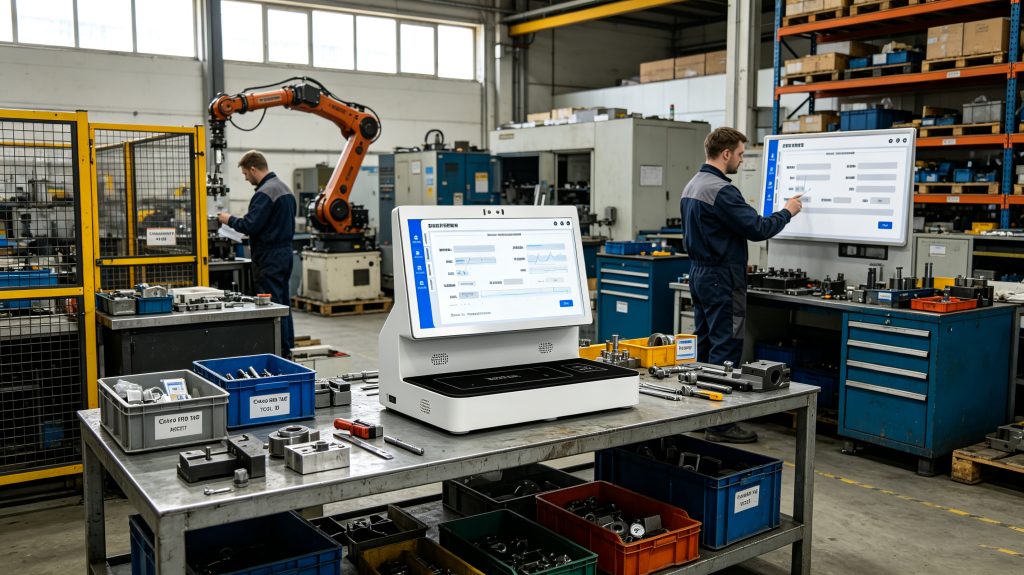
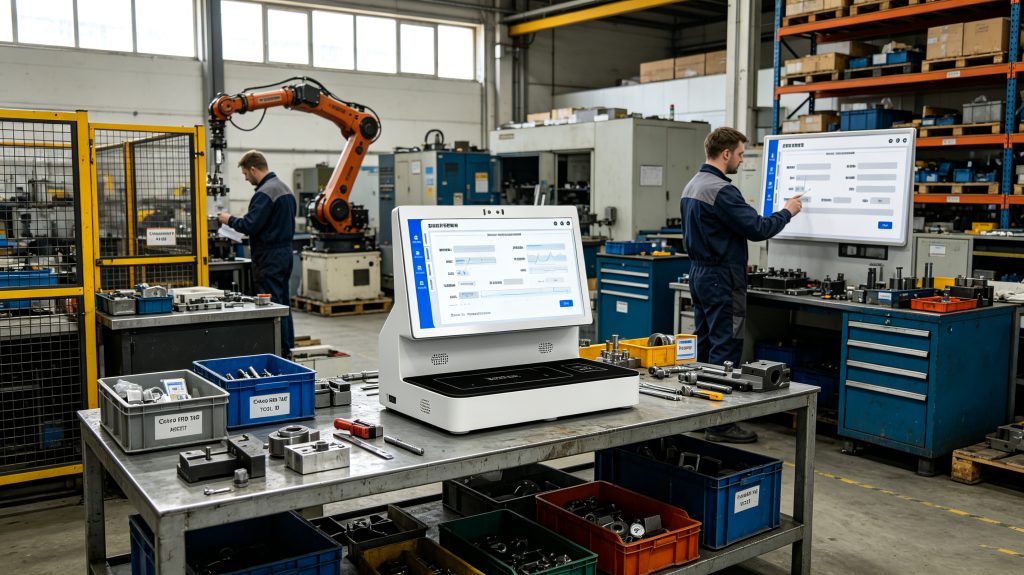
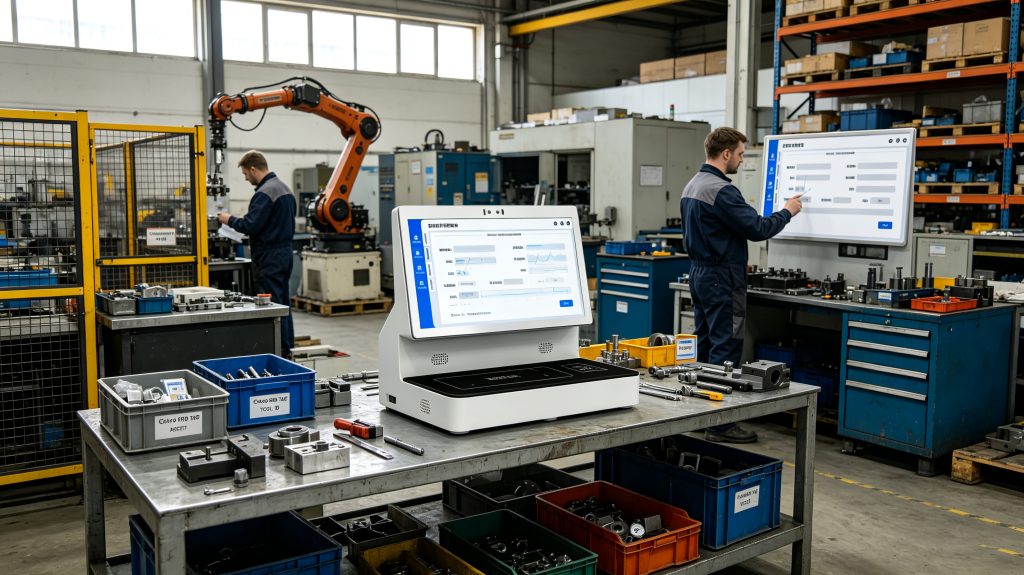
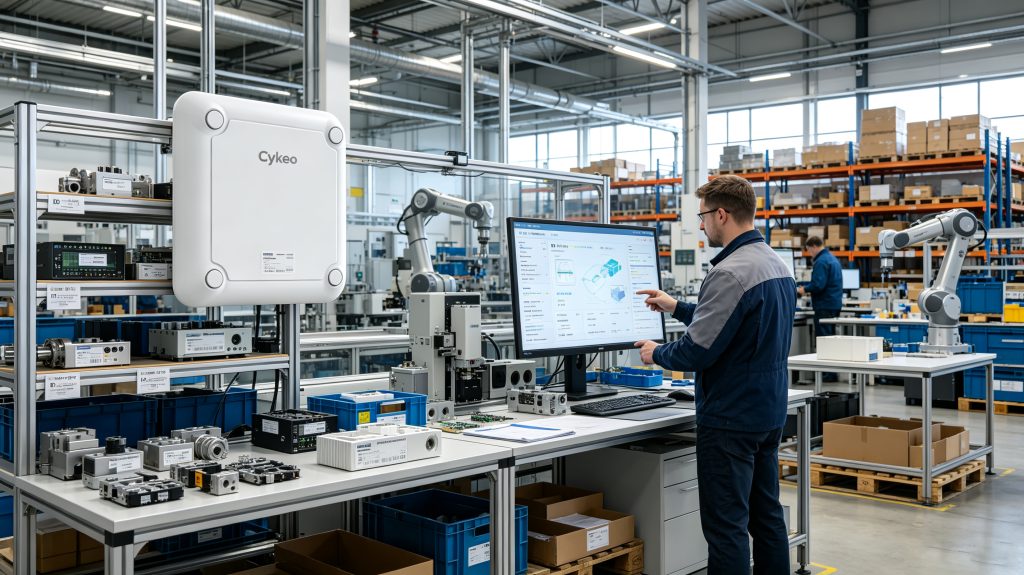
Cykeo external RFID reader performing long-range asset identification on a production line.

Applications Where an External RFID Reader Excels

From our deployment experience, these readers perform particularly well where large numbers of RFID tags must be identified automatically.

Typical applications include:

  • Warehouse management

  • Manufacturing automation

  • Asset tracking

  • Tool management

  • Vehicle identification

  • Library automation

  • Medical equipment management

  • Laundry tracking

  • Intelligent cabinets

  • Industrial production lines

One electronics manufacturer initially installed handheld readers for inventory verification. Six months later, fixed external RFID readers with overhead antennas automated the same workflow, eliminating manual scanning while improving inventory visibility across multiple production zones.

Performance Matters More Than Maximum Read Distance

Many buyers focus exclusively on advertised reading range.

In practice, experienced RFID engineers evaluate additional performance indicators.

Multi-Tag Reading Capability

Industrial environments often require simultaneous identification of dozens or hundreds of RFID tags.

Advanced collision management algorithms greatly improve throughput.

Stable RF Output

Consistent transmit power is more valuable than occasional maximum distance.

Industrial readers typically support transmit power up to 33 dBm, providing stable communication across challenging environments.

RSSI Support

Received Signal Strength Indicator (RSSI) helps software estimate tag proximity and verify reading quality.

Software Development Support

Cykeo provides SDKs for:

  • C#

  • Java

This enables rapid integration with ERP, WMS, MES, and custom enterprise applications.

Industry Data Supporting RFID Infrastructure

Independent industry organizations continue reporting rapid RFID adoption across industrial sectors.

According to RAIN Alliance, billions of passive UHF RFID tags are shipped annually, supporting applications in manufacturing, healthcare, logistics, aviation, retail, and industrial automation.

Meanwhile, GS1 states that RFID implementations can achieve inventory accuracy exceeding 99% when deployed using standardized identification practices and appropriate infrastructure.

These findings closely match what we observe during enterprise RFID deployments.

Engineering Perspective from Cykeo

One installation remains particularly memorable.

A customer wanted to monitor metal tool carts moving through a narrow production corridor.

The first installation placed antennas directly opposite one another.

Read rates fluctuated.

Instead of replacing hardware, we repositioned the external antennas slightly above the doorway and adjusted their polarization.

Nothing else changed.

Read performance immediately stabilized.

Experiences like this reinforce a practical lesson: successful RFID systems depend not only on reader specifications but also on RF design, antenna placement, and environmental testing. That is why Cykeo engineers routinely perform on-site validation before recommending final antenna layouts.

Warehouse RFID infrastructure using a Cykeo external RFID reader with external antennas.

Frequently Asked Questions

What is the difference between an external RFID reader and an integrated reader?

An external RFID reader supports separate antennas, allowing greater installation flexibility, wider coverage, and improved industrial performance.

Can one external RFID reader support multiple antennas?

Yes. Many industrial readers support multiple antenna ports, enabling one device to monitor several reading zones.

Which industries commonly use external RFID readers?

Manufacturing, logistics, healthcare, warehouses, transportation, libraries, laboratories, and industrial asset management all rely heavily on external RFID readers.

Can Cykeo external RFID readers integrate with enterprise software?

Yes. Cykeo provides C# and Java development kits, making integration with WMS, ERP, MES, and custom management platforms straightforward.

Conclusion

An external RFID reader offers the flexibility, scalability, and performance required for modern RFID infrastructure. By supporting external antennas, intelligent multi-tag reading, stable RF output, and industrial communication interfaces, Cykeo solutions help organizations automate identification workflows while improving operational visibility. Whether deployed in manufacturing, logistics, asset management, or warehouse automation, a properly engineered external RFID reader delivers dependable long-term performance.

post image 1
0
author image
cykeorfid3 days ago
general
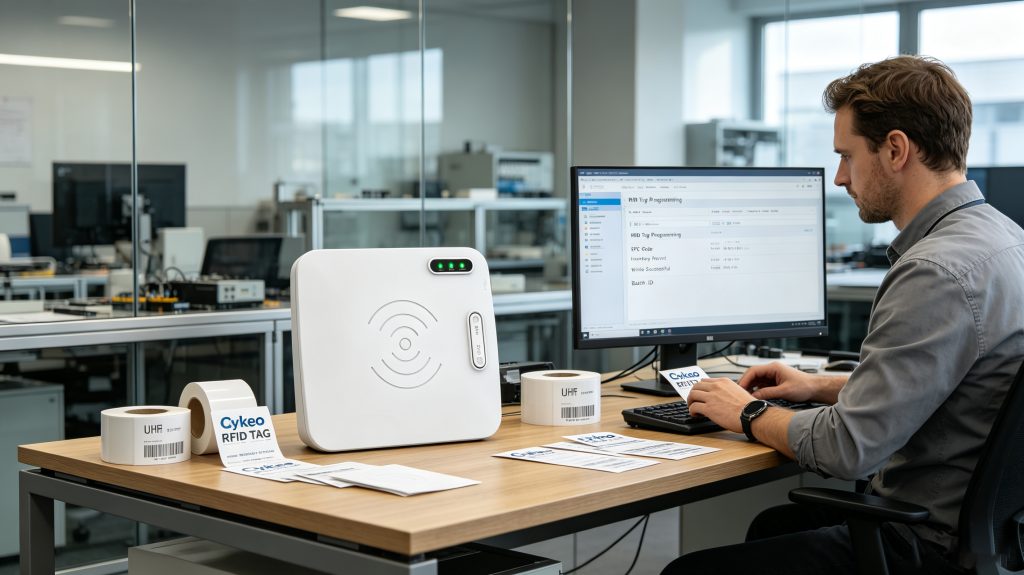
uhf label RFID Smart Identification and Industrial Tracking Solution

uhf label is a passive UHF RFID tag used for long-range identification and tracking of assets, cartons, and industrial goods. It enables fast, contactless data capture, improves inventory accuracy, and supports real-time logistics visibility across warehouses, manufacturing lines, and supply chain operations.

In field deployments across logistics hubs and production floors, the most noticeable change is not just speed—it’s how quietly data becomes continuous instead of manually recorded.

What makes uhf label different from standard barcode labels

A uhf label uses radio frequency identification instead of optical scanning. That difference seems small on paper, but in real operations it changes workflow design entirely.

Unlike barcodes, UHF labels do not require line-of-sight. Items can be read:

  • Inside sealed cartons

  • On moving conveyor lines

  • Through grouped pallets

According to widely cited RFID adoption frameworks from GS1 (gs1.org) and EPCglobal standards, UHF EPC Gen2 labels are designed specifically for bulk, non-line-of-sight environments where scanning speed and automation matter more than manual confirmation.

How uhf label systems behave in real warehouse environments

1. High-density reading in motion

In warehouse corridors or loading docks, multiple tagged items often pass a reader simultaneously. UHF labels are built to handle this through anti-collision protocols defined in ISO/IEC 18000-6C.

Instead of sequential scanning, the system captures many labels at once—this is where efficiency gains become visible.

2. Inventory visibility without manual cycles

Traditional inventory systems rely on periodic scanning cycles. UHF label systems shift this into continuous observation:

  • Entry logs recorded automatically

  • Exit movements captured instantly

  • Zone-based tracking updated in real time

In practice, this reduces dependency on scheduled manual audits and shifts inventory management closer to live data.

3. Field insight: where the gap really closes

In one European logistics environment similar to Cykeo deployments, operators noted that labeling errors dropped not because people worked faster, but because the system removed the need for repeated manual confirmation.

The difference shows up most clearly during peak shipping hours—when human error typically rises, RFID systems maintain consistency.

Technical foundation of uhf label systems

Standards and interoperability

Most uhf label deployments rely on:

  • EPC Class 1 Gen2

  • ISO/IEC 18000-6C protocol

  • GS1 EPC encoding structures

These standards ensure cross-compatibility between readers, software platforms, and supply chain systems worldwide.

Performance characteristics in real usage

While performance depends on environment and antenna setup:

  • Multi-tag reading capability

  • Passive operation (no battery required)

  • Meter-level to multi-meter read range

GS1 and EPCglobal documentation highlight that these systems are optimized for high-throughput logistics environments rather than single-item identification.

Real-time logistics visibility through smart labeling

Where uhf label technology is applied

1. Logistics and warehousing

  • Pallet tracking

  • Carton-level identification

  • Dock-in/dock-out recording

2. Manufacturing production lines

  • Work-in-progress tracking

  • Component traceability

  • Batch control

3. Retail and distribution systems

  • Inventory synchronization

  • Anti-loss visibility

  • Automated stock counting

Why enterprises adopt uhf label systems

The motivation is usually operational, not technical:

  • Less manual scanning workload

  • Reduced missing-item incidents

  • Faster inventory reconciliation

Industry reports from organizations such as GS1 and RFID Journal ecosystem studies consistently show that RFID-based labeling improves process visibility in high-volume supply chains, especially where barcode scanning becomes a bottleneck.

Deployment considerations from real-world systems

A few details often determine success more than hardware selection:

  • Label placement consistency affects read stability

  • Metal surfaces can distort RF performance

  • Reader tuning impacts dense-zone accuracy

In practice, system calibration matters as much as label quality itself.

Automated inbound and outbound detection

FAQ about uhf label systems

Q: Can uhf label replace barcode labels completely?
Yes in many logistics and industrial environments, but hybrid systems are still common during transition phases.

Q: Do uhf labels require power?
No. They are passive RFID tags powered by reader signals.

Q: Are uhf labels reusable?
Most are designed for single-use or limited reuse depending on adhesive and application type.

Closing perspective

uhf label systems quietly shift operations from “scan-based control” to “system-based visibility.” In real environments, the change is less about replacing labels and more about removing blind spots in movement and inventory flow.

The result is not just faster tracking—but fewer moments where you have to guess where something went.

post image 1
0
author image
cykeorfid4 days ago
general
Tracking Device for Power Tools: Smart RFID Industrial Control System | Cykeo

tracking device for power tools is an RFID-based industrial monitoring system that provides real-time visibility, location tracking, and usage accountability for powered tools across job sites. It reduces tool loss, improves operational efficiency, and strengthens safety control in construction and industrial maintenance environments.

In real-world field operations, the core challenge is not detecting tools—but maintaining continuous awareness across shifting teams, locations, and workflows.

What Tracking Device for Power Tools Means in Industrial Environments

A tracking device for power tools refers to RFID-enabled or digital monitoring systems that record movement, usage, and return cycles of tools such as drills, grinders, cutters, and calibration equipment.

Tracked assets typically include:

  • Cordless drills and impact drivers

  • Electric cutting and grinding tools

  • Maintenance and calibration instruments

  • Shared industrial toolkits

  • Portable construction equipment

Based on occupational safety frameworks referenced by OSHA (osha.gov), asset accountability directly supports workplace safety and reduces operational risk caused by missing or misplaced equipment.

Field Reality: Why Power Tool Tracking Is Operationally Critical

From real deployment experience in maintenance workshops and construction sites, power tools present unique tracking challenges:

  • High-frequency tool handover between operators

  • Temporary tool usage across multiple job zones

  • Inconsistent manual logging under workload pressure

  • Tools left in hidden or elevated work areas

According to industry insights from Plant Engineering (plantengineering.com), maintenance teams can lose up to 5–10% of productive working time due to tool searching and reconciliation processes.

This is not a storage issue—it is a visibility gap across operations.

RFID-Based Tracking Device Architecture (Cykeo System)

A modern tracking device for power tools system typically consists of:

  • RFID-tagged power tools (industrial-grade rugged tags)

  • Smart tool cabinets or mobile storage carts

  • UHF RFID readers (fixed or embedded)

  • Cloud-based asset management platform

  • User authentication and event logging system

This structure creates a continuous data loop: issue → usage → return → verification → audit trail

Automated power tool visibility and accountability system

How Tracking Device for Power Tools Works in Daily Workflow

A typical operational process:

  1. Technician selects power tool from RFID-enabled storage

  2. System automatically detects tool removal

  3. User identity and timestamp are recorded instantly

  4. Tool usage is tracked during operation cycle

  5. Return event updates inventory automatically

Unlike barcode systems, no manual scanning is required for each transaction, reducing workflow friction significantly.

Performance Factors in Real Deployment Environments

From field integration experience, system reliability depends on three core factors:

1. Tag durability under vibration and impact

Power tools operate under constant mechanical stress, requiring industrial-grade RFID tags.

2. RF interference in metal-dense environments

Workshops and construction sites contain metal surfaces that affect signal consistency.

3. Operational discipline across teams

System accuracy depends on consistent return behavior and proper tool handling procedures.

Industrial Applications of Power Tool Tracking Systems

This tracking device is widely used in:

  • Construction site tool management systems

  • Industrial maintenance workshops

  • Energy sector repair operations

  • Manufacturing equipment service rooms

  • Rail infrastructure maintenance teams

Each scenario requires real-time visibility and traceable tool responsibility across teams and shifts.

Real-time monitoring of power tool usage in field operations

Data Insight: Why Tool Tracking Improves Operational Efficiency

According to OSHA safety guidance (osha.gov) and industrial maintenance studies:

  • Tool mismanagement contributes to measurable downtime in maintenance operations

  • Manual tool search can account for up to 10% of technician working hours

  • Digital tracking systems significantly improve asset visibility and audit accuracy

The real value is not speed—it is elimination of uncertainty in operational workflows.

Engineering Insight from Field Deployment

In real environments, operational behavior changes in a visible way:

Before RFID:

  • Tools are shared informally

  • Loss is detected late during audits

  • Responsibility is unclear

After RFID:

  • Every tool movement is recorded automatically

  • Ownership is traceable in real time

  • Missing tools trigger immediate alerts

This transforms tool management from reactive to proactive control.

FAQ: tracking device for power tools

Q1: Can RFID track all types of power tools?
Yes, with industrial-grade RFID tags designed for vibration and metal environments.

Q2: Does it require manual scanning?
No, RFID automatically detects tool movement within the tracking zone.

Q3: What is the main benefit?
It provides real-time visibility and reduces tool loss across dynamic job sites.

At the operational level, the tracking device for power tools is not just a monitoring tool—it is the invisible control layer that turns scattered tool usage into a fully traceable, safety-aligned industrial system.

post image 1
0
author image
cykeorfid5 days ago
general
RFID Writer and Reader: Desktop UHF Encoding Platform for Industrial Tag Management | Cykeo

RFID writer and reader is a desktop UHF encoding platform designed for fast tag registration, writing, and inventory management in operational environments. It enables stable multi-tag processing, high-success-rate writing, and structured asset workflows such as borrowing, returning, and tag registration without line-of-sight constraints.

In practical deployments across library and tool-room systems, its performance is defined not by single-tag speed, but by consistency under repeated batch encoding cycles.

Desktop RFID Writer and Reader System Overview

This RFID writer and reader desktop platform is built for tag administrators handling daily operational workflows. It supports:

  • Item borrowing and return processing

  • Tag registration and credential encoding

  • Shelf and rack label creation

  • Asset inquiry and inventory statistics

  • Log tracking and audit queries

  • Tag conversion and rewriting operations

Based on EPC Gen2 / ISO/IEC 18000-6C architecture (GS1 EPCglobal standard), the system is widely used in structured asset environments where traceability matters.

Field Experience Insight: Why Desktop RFID Matters

In real operational rooms—especially libraries and maintenance centers—the workflow is not “single scan speed” but batch stability.

Operators typically process:

  • 50–300 tags per batch session

  • Continuous encoding cycles across shifts

  • Mixed tag states (new + reused + overwritten)

This is where a desktop RFID writer and reader system becomes essential: it reduces manual barcode dependency and enforces structured digital identity creation at the edge.

Cykeo Desktop RFID Writer and Reader Platform

The Cykeo desktop platform is engineered for tag administrators rather than general warehouse scanning. It focuses on controlled RF fields, stable encoding, and repeatable read/write accuracy.

A typical deployment looks like a controlled workstation:

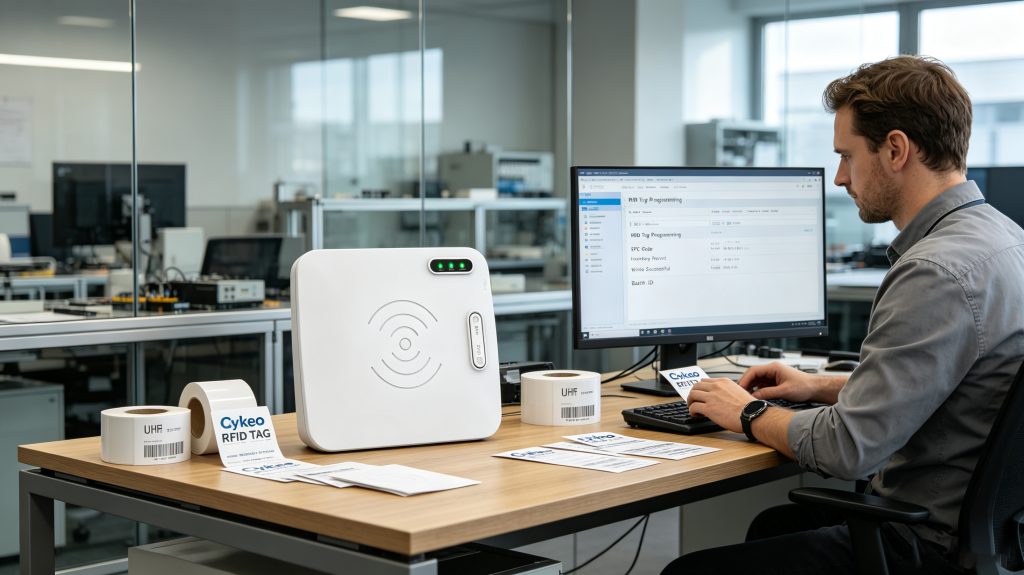
Controlled near-field encoding for asset registration workflows

Technical Architecture of RFID Writer and Reader System

This desktop platform is not a generic reader—it integrates RF control + encoding logic + filtering layer.

Core capabilities include:

  • USB interface for plug-and-play deployment

  • Up to 33 dBm output power stability for writing operations

  • Near-field antenna design with controlled range

  • Read range: ~30 cm

  • Write range: ~10 cm

According to ISO/IEC 18000-6C standards (ISO.org), UHF Gen2 systems are designed for high-speed anti-collision and structured EPC memory writing, which is essential for batch encoding environments.

Signal Processing and Anti-Collision Performance

In real-world encoding rooms, multiple tags often overlap in the field.

The system uses:

  • Advanced anti-collision algorithm

  • RSSI-based signal strength filtering

  • Multi-tag recognition logic

  • Tag data filtering before write execution

From field observation, RSSI filtering is particularly important in dense tag stacks—especially when operators place multiple labels at once on the desktop antenna zone.

Application Scenarios in Operational Environments

This RFID writer and reader desktop system is widely used in:

  • Library registration and book lifecycle tracking

  • Industrial tool issuance and return systems

  • Linen and textile management in hospitality

  • Asset onboarding in enterprise IT rooms

Each scenario shares one requirement: controlled identity creation at the source.

Real-time tag writing and registration using Cykeo desktop platform

Software Integration and Developer Access

A key advantage of this platform is its developer accessibility.

It provides:

  • C# SDK integration package

  • Java API development support

  • Device control libraries for encoding logic

  • Demo software for rapid deployment

In enterprise deployments, this reduces integration time significantly—especially when connecting to ERP or inventory systems.

Operational Behavior in Real Use

Unlike high-range industrial readers, this desktop system behaves like a precision RF writing station:

  • Stable writing success rate under repeated cycles

  • Reduced miswrite probability through controlled field zone

  • Predictable tag activation zone

  • Minimal RF leakage outside working area

This is critical in environments where tag accuracy is more important than scanning distance.

Data Reference and Industry Standards

RFID UHF systems used in encoding platforms follow global standards:

  • GS1 EPCglobal Gen2 protocol (gs1.org)

  • ISO/IEC 18000-6C air interface standard (iso.org)

GS1 notes that EPC-based identification enables interoperable supply chain identity management across industries, while ISO defines communication reliability and anti-collision behavior in UHF environments.

FAQ: RFID Writer and Reader

Can RFID writer and reader encode multiple tags at once?

Yes, the desktop system supports multi-tag recognition and batch encoding with anti-collision processing.

What is the writing range of the device?

Is it suitable for library or tool management?

Yes, it is widely used in structured environments like libraries, tool rooms, and asset registration stations.

At the edge of asset digitization workflows, the rfid writer and reader is not just a device—it is the controlled identity creation point for modern RFID ecosystems.

post image 1
0
author image
cykeorfid6 days ago
general
RFID UHF Reader: Industrial-Grade Long Range Identification System | Cykeo

RFID UHF reader delivers long-range, high-speed multi-tag identification for logistics, manufacturing, and asset tracking systems. In real warehouse deployments, it reads hundreds of EPC Gen2 tags in motion without line-of-sight, supporting continuous automation workflows. Based on ISO/IEC 18000-6C (GS1 EPCglobal UHF Gen2 standard), it is widely adopted in global supply chains and industrial IoT environments (GS1.org, ISO.org).

From field integration experience in warehouse gate systems, the stability of a UHF reader depends less on theoretical range and more on antenna tuning, tag density, and RF environment noise.

What is RFID UHF Reader in Industrial Systems

A RFID UHF reader operates in the 860–960 MHz band and communicates with passive UHF tags using backscatter modulation. It is the backbone of modern logistics automation, enabling non-contact identification at scale.

Unlike HF or NFC systems, UHF readers support:

  • Long read distance (meters-level depending on antenna gain)

  • Multi-tag anti-collision processing

  • Conveyor and portal-style bulk scanning

  • Real-time inventory visibility

According to GS1 EPCglobal standards, UHF Gen2 systems are designed specifically for supply chain interoperability, enabling global traceability across retail, logistics, and manufacturing ecosystems.

Industrial Deployment Reality: Where Performance Is Decided

In real warehouse commissioning projects, performance gaps rarely come from the reader itself. They come from:

  • Metal reflection interference in pallet zones

  • Tag orientation inconsistency on cartons

  • RF noise from motors and Wi-Fi congestion

  • Antenna placement angle (often underestimated)

A fixed RFID UHF reader system behaves like a “RF environment sensor.” When tuned correctly, it delivers near real-time inventory visibility at dock doors and conveyor crossings.

Cykeo RFID UHF Reader in Field Integration

Cykeo systems are commonly deployed in industrial automation layers where reliability matters more than raw specs. Engineers typically integrate readers into:

  • Smart warehouse dock doors

  • Tool tracking cabinets

  • Production line WIP tracking systems

Below is a typical deployment scenario.

High-density tag capture at dock door using Cykeo UHF reader system

Technical Standards Behind RFID UHF Reader

The foundation of most modern UHF systems is:

  • ISO/IEC 18000-6C

  • GS1 EPCglobal Gen2 protocol

These standards define anti-collision behavior, tag memory structure (EPC, TID, user memory), and air interface communication rules.

GS1 emphasizes interoperability across global supply chains, allowing a single RFID tag format to work across manufacturers, retailers, and logistics providers (GS1.org).

From integration experience, systems compliant with these standards significantly reduce middleware complexity during multi-vendor deployments.

Real-World Performance Factors (Field Notes)

Instead of focusing only on lab numbers, industrial engineers evaluate:

  • Read stability under motion (0–3 m/s conveyor speed)

  • Multi-tag density tolerance (50–300+ tags per scan zone)

  • Miss-rate under metallic environments

  • Reader cooling stability in 24/7 operation

In practice, UHF RFID readers used in logistics rarely operate in isolation. They are part of a full edge architecture:

Reader → Antenna Array → Middleware → WMS / ERP System

RFID UHF Reader in Smart Logistics Workflow

A typical workflow in deployment:

  1. Pallet enters gate zone

  2. UHF reader triggers continuous scan

  3. EPC tags are captured in bulk

  4. Middleware filters duplicate reads

  5. Inventory system updates in real time

This replaces manual barcode scanning and reduces human dependency in high-throughput warehouses.

Real-time tracking of manufacturing workflow using RFID

Engineering Insight: Why UHF Reader Stability Matters

From deployment experience, the most critical factor is not range—it is repeatability under noise.

A stable RFID UHF reader must maintain:

  • Consistent read rate under variable tag density

  • Low false positive duplication

  • Predictable antenna field shaping

RFID Journal has repeatedly highlighted that system-level performance depends heavily on integration design rather than isolated hardware capability (rfidjournal.com).

Industrial Use Cases

Common applications include:

  • Warehouse inbound/outbound automation

  • Retail inventory tracking

  • Tool and asset management

  • Smart manufacturing WIP tracking

  • Vehicle and container identification

Each scenario adjusts antenna layout rather than changing core reader architecture.

FAQ: RFID UHF Reader

Can RFID UHF reader work without line of sight?

Yes, UHF RFID uses radio waves, allowing tag reading without direct optical visibility.

What affects reading performance most?

Tag placement, antenna tuning, and surrounding metal interference are the top factors.

Is it suitable for real-time logistics tracking?

Yes, when integrated with middleware and WMS systems, it supports real-time inventory visibility.

post image 1
0
author image
cykeorfid6 days ago
general
RFID UHF Reader: Industrial-Grade Long Range Identification System | Cykeo

RFID UHF reader delivers long-range, high-speed multi-tag identification for logistics, manufacturing, and asset tracking systems. In real warehouse deployments, it reads hundreds of EPC Gen2 tags in motion without line-of-sight, supporting continuous automation workflows. Based on ISO/IEC 18000-6C (GS1 EPCglobal UHF Gen2 standard), it is widely adopted in global supply chains and industrial IoT environments (GS1.org, ISO.org).

From field integration experience in warehouse gate systems, the stability of a UHF reader depends less on theoretical range and more on antenna tuning, tag density, and RF environment noise.

What is RFID UHF Reader in Industrial Systems

A RFID UHF reader operates in the 860–960 MHz band and communicates with passive UHF tags using backscatter modulation. It is the backbone of modern logistics automation, enabling non-contact identification at scale.

Unlike HF or NFC systems, UHF readers support:

  • Long read distance (meters-level depending on antenna gain)

  • Multi-tag anti-collision processing

  • Conveyor and portal-style bulk scanning

  • Real-time inventory visibility

According to GS1 EPCglobal standards, UHF Gen2 systems are designed specifically for supply chain interoperability, enabling global traceability across retail, logistics, and manufacturing ecosystems.

Industrial Deployment Reality: Where Performance Is Decided

In real warehouse commissioning projects, performance gaps rarely come from the reader itself. They come from:

  • Metal reflection interference in pallet zones

  • Tag orientation inconsistency on cartons

  • RF noise from motors and Wi-Fi congestion

  • Antenna placement angle (often underestimated)

A fixed RFID UHF reader system behaves like a “RF environment sensor.” When tuned correctly, it delivers near real-time inventory visibility at dock doors and conveyor crossings.

Cykeo RFID UHF Reader in Field Integration

Cykeo systems are commonly deployed in industrial automation layers where reliability matters more than raw specs. Engineers typically integrate readers into:

  • Smart warehouse dock doors

  • Tool tracking cabinets

  • Production line WIP tracking systems

Below is a typical deployment scenario.

High-density tag capture at dock door using Cykeo UHF reader system

Technical Standards Behind RFID UHF Reader

The foundation of most modern UHF systems is:

  • ISO/IEC 18000-6C

  • GS1 EPCglobal Gen2 protocol

These standards define anti-collision behavior, tag memory structure (EPC, TID, user memory), and air interface communication rules.

GS1 emphasizes interoperability across global supply chains, allowing a single RFID tag format to work across manufacturers, retailers, and logistics providers (GS1.org).

From integration experience, systems compliant with these standards significantly reduce middleware complexity during multi-vendor deployments.

Real-World Performance Factors (Field Notes)

Instead of focusing only on lab numbers, industrial engineers evaluate:

  • Read stability under motion (0–3 m/s conveyor speed)

  • Multi-tag density tolerance (50–300+ tags per scan zone)

  • Miss-rate under metallic environments

  • Reader cooling stability in 24/7 operation

In practice, UHF RFID readers used in logistics rarely operate in isolation. They are part of a full edge architecture:

Reader → Antenna Array → Middleware → WMS / ERP System

RFID UHF Reader in Smart Logistics Workflow

A typical workflow in deployment:

  1. Pallet enters gate zone

  2. UHF reader triggers continuous scan

  3. EPC tags are captured in bulk

  4. Middleware filters duplicate reads

  5. Inventory system updates in real time

This replaces manual barcode scanning and reduces human dependency in high-throughput warehouses.

Real-time tracking of manufacturing workflow using RFID

Engineering Insight: Why UHF Reader Stability Matters

From deployment experience, the most critical factor is not range—it is repeatability under noise.

A stable RFID UHF reader must maintain:

  • Consistent read rate under variable tag density

  • Low false positive duplication

  • Predictable antenna field shaping

RFID Journal has repeatedly highlighted that system-level performance depends heavily on integration design rather than isolated hardware capability (rfidjournal.com).

Industrial Use Cases

Common applications include:

  • Warehouse inbound/outbound automation

  • Retail inventory tracking

  • Tool and asset management

  • Smart manufacturing WIP tracking

  • Vehicle and container identification

Each scenario adjusts antenna layout rather than changing core reader architecture.

FAQ: RFID UHF Reader

Can RFID UHF reader work without line of sight?

Yes, UHF RFID uses radio waves, allowing tag reading without direct optical visibility.

What affects reading performance most?

Tag placement, antenna tuning, and surrounding metal interference are the top factors.

Is it suitable for real-time logistics tracking?

Yes, when integrated with middleware and WMS systems, it supports real-time inventory visibility.

post image 1
0
author image
cykeorfid6 days ago
general
RFID UHF Reader: Industrial-Grade Long Range Identification System | Cykeo

RFID UHF reader delivers long-range, high-speed multi-tag identification for logistics, manufacturing, and asset tracking systems. In real warehouse deployments, it reads hundreds of EPC Gen2 tags in motion without line-of-sight, supporting continuous automation workflows. Based on ISO/IEC 18000-6C (GS1 EPCglobal UHF Gen2 standard), it is widely adopted in global supply chains and industrial IoT environments (GS1.org, ISO.org).

From field integration experience in warehouse gate systems, the stability of a UHF reader depends less on theoretical range and more on antenna tuning, tag density, and RF environment noise.

What is RFID UHF Reader in Industrial Systems

A RFID UHF reader operates in the 860–960 MHz band and communicates with passive UHF tags using backscatter modulation. It is the backbone of modern logistics automation, enabling non-contact identification at scale.

Unlike HF or NFC systems, UHF readers support:

  • Long read distance (meters-level depending on antenna gain)

  • Multi-tag anti-collision processing

  • Conveyor and portal-style bulk scanning

  • Real-time inventory visibility

According to GS1 EPCglobal standards, UHF Gen2 systems are designed specifically for supply chain interoperability, enabling global traceability across retail, logistics, and manufacturing ecosystems.

Industrial Deployment Reality: Where Performance Is Decided

In real warehouse commissioning projects, performance gaps rarely come from the reader itself. They come from:

  • Metal reflection interference in pallet zones

  • Tag orientation inconsistency on cartons

  • RF noise from motors and Wi-Fi congestion

  • Antenna placement angle (often underestimated)

A fixed RFID UHF reader system behaves like a “RF environment sensor.” When tuned correctly, it delivers near real-time inventory visibility at dock doors and conveyor crossings.

Cykeo RFID UHF Reader in Field Integration

Cykeo systems are commonly deployed in industrial automation layers where reliability matters more than raw specs. Engineers typically integrate readers into:

  • Smart warehouse dock doors

  • Tool tracking cabinets

  • Production line WIP tracking systems

Below is a typical deployment scenario.

High-density tag capture at dock door using Cykeo UHF reader system

Technical Standards Behind RFID UHF Reader

The foundation of most modern UHF systems is:

  • ISO/IEC 18000-6C

  • GS1 EPCglobal Gen2 protocol

These standards define anti-collision behavior, tag memory structure (EPC, TID, user memory), and air interface communication rules.

GS1 emphasizes interoperability across global supply chains, allowing a single RFID tag format to work across manufacturers, retailers, and logistics providers (GS1.org).

From integration experience, systems compliant with these standards significantly reduce middleware complexity during multi-vendor deployments.

Real-World Performance Factors (Field Notes)

Instead of focusing only on lab numbers, industrial engineers evaluate:

  • Read stability under motion (0–3 m/s conveyor speed)

  • Multi-tag density tolerance (50–300+ tags per scan zone)

  • Miss-rate under metallic environments

  • Reader cooling stability in 24/7 operation

In practice, UHF RFID readers used in logistics rarely operate in isolation. They are part of a full edge architecture:

Reader → Antenna Array → Middleware → WMS / ERP System

RFID UHF Reader in Smart Logistics Workflow

A typical workflow in deployment:

  1. Pallet enters gate zone

  2. UHF reader triggers continuous scan

  3. EPC tags are captured in bulk

  4. Middleware filters duplicate reads

  5. Inventory system updates in real time

This replaces manual barcode scanning and reduces human dependency in high-throughput warehouses.

Real-time tracking of manufacturing workflow using RFID

Engineering Insight: Why UHF Reader Stability Matters

From deployment experience, the most critical factor is not range—it is repeatability under noise.

A stable RFID UHF reader must maintain:

  • Consistent read rate under variable tag density

  • Low false positive duplication

  • Predictable antenna field shaping

RFID Journal has repeatedly highlighted that system-level performance depends heavily on integration design rather than isolated hardware capability (rfidjournal.com).

Industrial Use Cases

Common applications include:

  • Warehouse inbound/outbound automation

  • Retail inventory tracking

  • Tool and asset management

  • Smart manufacturing WIP tracking

  • Vehicle and container identification

Each scenario adjusts antenna layout rather than changing core reader architecture.

FAQ: RFID UHF Reader

Can RFID UHF reader work without line of sight?

Yes, UHF RFID uses radio waves, allowing tag reading without direct optical visibility.

What affects reading performance most?

Tag placement, antenna tuning, and surrounding metal interference are the top factors.

Is it suitable for real-time logistics tracking?

Yes, when integrated with middleware and WMS systems, it supports real-time inventory visibility.

post image 1
0
author image
cykeorfid6 days ago
general
RFID UHF Reader: Industrial-Grade Long Range Identification System | Cykeo

RFID UHF reader delivers long-range, high-speed multi-tag identification for logistics, manufacturing, and asset tracking systems. In real warehouse deployments, it reads hundreds of EPC Gen2 tags in motion without line-of-sight, supporting continuous automation workflows. Based on ISO/IEC 18000-6C (GS1 EPCglobal UHF Gen2 standard), it is widely adopted in global supply chains and industrial IoT environments (GS1.org, ISO.org).

From field integration experience in warehouse gate systems, the stability of a UHF reader depends less on theoretical range and more on antenna tuning, tag density, and RF environment noise.

What is RFID UHF Reader in Industrial Systems

A RFID UHF reader operates in the 860–960 MHz band and communicates with passive UHF tags using backscatter modulation. It is the backbone of modern logistics automation, enabling non-contact identification at scale.

Unlike HF or NFC systems, UHF readers support:

  • Long read distance (meters-level depending on antenna gain)

  • Multi-tag anti-collision processing

  • Conveyor and portal-style bulk scanning

  • Real-time inventory visibility

According to GS1 EPCglobal standards, UHF Gen2 systems are designed specifically for supply chain interoperability, enabling global traceability across retail, logistics, and manufacturing ecosystems.

Industrial Deployment Reality: Where Performance Is Decided

In real warehouse commissioning projects, performance gaps rarely come from the reader itself. They come from:

  • Metal reflection interference in pallet zones

  • Tag orientation inconsistency on cartons

  • RF noise from motors and Wi-Fi congestion

  • Antenna placement angle (often underestimated)

A fixed RFID UHF reader system behaves like a “RF environment sensor.” When tuned correctly, it delivers near real-time inventory visibility at dock doors and conveyor crossings.

Cykeo RFID UHF Reader in Field Integration

Cykeo systems are commonly deployed in industrial automation layers where reliability matters more than raw specs. Engineers typically integrate readers into:

  • Smart warehouse dock doors

  • Tool tracking cabinets

  • Production line WIP tracking systems

Below is a typical deployment scenario.

High-density tag capture at dock door using Cykeo UHF reader system

Technical Standards Behind RFID UHF Reader

The foundation of most modern UHF systems is:

  • ISO/IEC 18000-6C

  • GS1 EPCglobal Gen2 protocol

These standards define anti-collision behavior, tag memory structure (EPC, TID, user memory), and air interface communication rules.

GS1 emphasizes interoperability across global supply chains, allowing a single RFID tag format to work across manufacturers, retailers, and logistics providers (GS1.org).

From integration experience, systems compliant with these standards significantly reduce middleware complexity during multi-vendor deployments.

Real-World Performance Factors (Field Notes)

Instead of focusing only on lab numbers, industrial engineers evaluate:

  • Read stability under motion (0–3 m/s conveyor speed)

  • Multi-tag density tolerance (50–300+ tags per scan zone)

  • Miss-rate under metallic environments

  • Reader cooling stability in 24/7 operation

In practice, UHF RFID readers used in logistics rarely operate in isolation. They are part of a full edge architecture:

Reader → Antenna Array → Middleware → WMS / ERP System

RFID UHF Reader in Smart Logistics Workflow

A typical workflow in deployment:

  1. Pallet enters gate zone

  2. UHF reader triggers continuous scan

  3. EPC tags are captured in bulk

  4. Middleware filters duplicate reads

  5. Inventory system updates in real time

This replaces manual barcode scanning and reduces human dependency in high-throughput warehouses.

Real-time tracking of manufacturing workflow using RFID

Engineering Insight: Why UHF Reader Stability Matters

From deployment experience, the most critical factor is not range—it is repeatability under noise.

A stable RFID UHF reader must maintain:

  • Consistent read rate under variable tag density

  • Low false positive duplication

  • Predictable antenna field shaping

RFID Journal has repeatedly highlighted that system-level performance depends heavily on integration design rather than isolated hardware capability (rfidjournal.com).

Industrial Use Cases

Common applications include:

  • Warehouse inbound/outbound automation

  • Retail inventory tracking

  • Tool and asset management

  • Smart manufacturing WIP tracking

  • Vehicle and container identification

Each scenario adjusts antenna layout rather than changing core reader architecture.

FAQ: RFID UHF Reader

Can RFID UHF reader work without line of sight?

Yes, UHF RFID uses radio waves, allowing tag reading without direct optical visibility.

What affects reading performance most?

Tag placement, antenna tuning, and surrounding metal interference are the top factors.

Is it suitable for real-time logistics tracking?

Yes, when integrated with middleware and WMS systems, it supports real-time inventory visibility.

post image 1
0
author image
cykeorfid7 days ago
general
RFID Real Time Tracking: How Smart RFID Tool Cabinets Deliver Complete Tool Visibility

RFID real time tracking enables organizations to automatically identify, monitor, and manage tools without manual scanning, improving inventory accuracy, borrowing accountability, operational safety, and maintenance efficiency through continuous RFID identification.

Modern factories no longer lose productivity because someone cannot locate a torque wrench or verify whether an insulated tool has been returned. After participating in industrial RFID deployments for manufacturing plants, energy utilities, and maintenance workshops, I’ve found that the greatest value of RFID is not simply locating assets—it is removing uncertainty from everyday operations. A properly configured RFID smart tool cabinet quietly records every movement, creating an accurate digital history while employees continue working naturally.

Why RFID Real Time Tracking Is Replacing Manual Tool Management​

The answer is straightforward.

Traditional tool rooms depend on paper logs, barcode labels, or manual registration. Every additional step increases the chance of forgotten returns, incorrect records, and missing equipment.

RFID real time tracking removes those interruptions.

Once RFID-tagged tools enter or leave the cabinet, the system identifies every item automatically. No barcode scanning. No manual input. No uncertainty.

Our deployment experience shows that maintenance departments appreciate one feature more than any specification sheet—the ability to complete a complete inventory inspection in seconds rather than walking shelf by shelf.

Cykeo RFID Smart Tool Cabinets comply with ISO/IEC 18000-63 (EPC Class 1 Gen2 / ISO 18000-6C), one of the world’s most widely adopted passive UHF RFID standards supported by GS1 and RAIN RFID technologies.

According to the RAIN Alliance, more than 50 billion RAIN RFID tags were shipped globally in 2023, reflecting rapid adoption across manufacturing, logistics, healthcare, and industrial asset management.

Key Functions of the Cykeo RFID Smart Tool Cabinet​

Automatic Borrowing and Return Management​

Every tagged tool is identified automatically when removed or returned.

Employees no longer need to scan each item individually, reducing administrative work while improving record accuracy.

10-Second Inventory Verification​

Routine inspections become dramatically faster.

Daily or monthly inventory checks can be completed in approximately 10 seconds, allowing supervisors to focus on equipment readiness rather than paperwork.

Continuous Data Collection​

Every transaction becomes structured operational data.

Managers can analyze:

  • Tool utilization frequency

  • Borrowing duration

  • Department usage

  • Maintenance cycles

  • Peak demand periods

Complete Accountability​

Integrated identity authentication links every borrowing event with a verified user.

Multiple authentication methods can be configured, allowing organizations to know exactly:

  • Who borrowed the tool

  • When it was removed

  • When it was returned

  • Which cabinet was accessed


Automatic RFID identification records every tool movement.


How RFID Real Time Tracking Improves Industrial Operations​

Operational ChallengeRFID Smart Tool Cabinet SolutionManual inventoryAutomatic RFID inventoryMissing toolsInstant location recordsBorrowing disputesComplete transaction historyInspection workloadOne-click inventory in secondsUnauthorized accessIdentity-based permissionsCompliance auditsAutomatic digital reports

One lesson repeated across projects is that operational efficiency rarely comes from faster software alone. It comes from eliminating unnecessary human actions. When technicians stop scanning tools individually, work flows naturally.

Designed for Continuous Industrial Operation​

Cykeo RFID Smart Tool Cabinets are designed for:

  • Indoor industrial facilities

  • Protected semi-outdoor environments

  • Manufacturing workshops

  • Utility maintenance centers

  • Railway depots

  • Aviation maintenance facilities

  • Energy infrastructure

  • Government equipment rooms

The cabinet operates unattended around the clock while maintaining stable RFID performance and intuitive human-machine interaction.

Unlike conventional storage cabinets, every opening event immediately updates inventory records without requiring operator intervention.


Managers receive instant visibility of tool availability and borrowing history.


Professional Insight from Real Deployments​

After supporting RFID implementations across industrial maintenance environments, one observation appears consistently.

Companies initially purchase RFID because they want to know where their tools are.

Months later, they value something different.

Historical borrowing records begin revealing maintenance habits, department demand, and equipment utilization that were previously invisible. RFID evolves from an inventory technology into a decision-support platform.

That operational transparency is often the project’s most valuable long-term outcome.

According to GS1, standardized EPC identification enables consistent RFID interoperability across global supply chains, supporting accurate identification throughout the product lifecycle. Meanwhile, NIST continues to recognize automatic identification technologies as important contributors to industrial digital transformation and operational visibility.

Frequently Asked Questions​

Can RFID real time tracking operate without manual scanning?​

Yes. RFID automatically identifies tagged tools whenever they enter or leave the cabinet without requiring barcode scanning.

Does the cabinet support unattended operation?​

Yes. The Cykeo RFID Smart Tool Cabinet is designed for continuous 24-hour unattended operation in industrial environments.

How quickly can inventory be completed?​

Typical inventory verification can be completed in approximately 10 seconds depending on cabinet configuration.

Can borrowing records be linked to specific employees?​

Yes. Identity authentication allows every borrowing and return event to be associated with an authorized individual for complete accountability.

Which industries benefit most from RFID real time tracking?​

Manufacturing, energy, utilities, aviation maintenance, railway operations, mining, government facilities, and industrial equipment management all benefit from automated RFID tool tracking.


RFID real time tracking is no longer simply an inventory technology. Combined with the Cykeo RFID Smart Tool Cabinet, it becomes an always-on operational platform that automates tool management, strengthens accountability, accelerates inspections, and delivers the reliable visibility industrial organizations need every day.

post image 1
0
User Avatar
No comments yet.